
You planned to keep working past 65. The employer health plan still looks useful, the HSA is receiving payroll contributions, and retirement may be a year—or several years—away. Then the Medicare mail begins, and one practical question becomes unexpectedly urgent: when, exactly, do the HSA contributions need to stop?
The answer is not simply “at 65.” It depends on when Medicare coverage begins, which employer provides the current health plan, how that plan coordinates with Medicare, and whether a later application could create retroactive Medicare coverage.
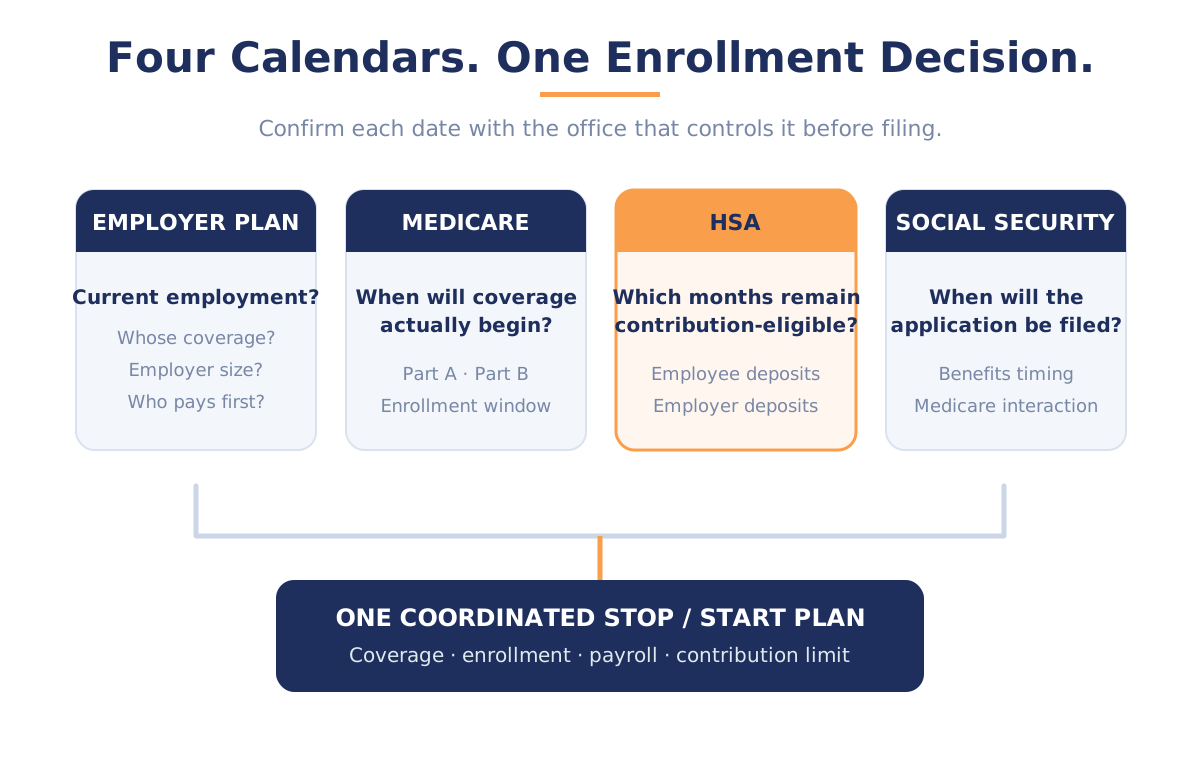
That is why the cleanest first step is to place four calendars on one page.
Age 65 starts the review; it does not finish it
Medicare says most people first become eligible around age 65, but someone covered through current employment—his or her own or a spouse’s—may be able to delay Part B without a late-enrollment penalty. That possibility depends on the actual coverage and employment facts.
Before deciding to delay or enroll, confirm:
- whether the coverage comes from current employment rather than COBRA, retiree coverage, or an individual policy;
- whose employment supports the coverage;
- whether the employer has at least 20 employees;
- whether the plan expects Medicare to pay first after age 65;
- whether the prescription coverage is considered creditable; and
- what happens to covered family members when the employee enrolls or retires.
Medicare’s enrollment questionnaire asks specifically about active employment and employer size because those facts can change how the employer plan and Medicare coordinate. Do not infer the answer from the insurance card or from a coworker’s experience. Ask the benefits administrator to describe how the plan works for this employee and spouse.
Medicare enrollment and HSA contribution eligibility are different decisions
An HSA requires more than enrollment in a high-deductible health plan. IRS Publication 969 says an eligible individual also cannot be enrolled in Medicare.
Beginning with the first month of Medicare enrollment, the HSA contribution limit is zero. That includes contributions made by the employee, through payroll, or by the employer. The existing HSA remains the account owner’s; the restriction is on new contributions during Medicare-covered months.
This creates a distinction worth writing down:
- Health-plan eligibility: whether the employer plan can continue;
- Medicare enrollment: when Part A or Part B coverage begins; and
- HSA contribution eligibility: which months remain eligible for contributions.
The three may change on different dates. Continuing to work does not maintain HSA contribution eligibility after Medicare coverage begins.
The retroactive-coverage issue is why the stop date needs a buffer
IRS Publication 969 says the contribution limit is zero for periods of retroactive Medicare coverage. Medicare’s working-past-65 guidance therefore tells HSA owners and their employers to stop contributing six months before retirement or before applying for Social Security or Railroad Retirement Board benefits.
That does not mean everyone uses the same date. Medicare coverage cannot be retroactive to a period before a person was eligible, and the application, retirement, and Social Security facts matter. The practical lesson is to calculate the stop date before filing—not after payroll has continued making contributions.
Build the timeline backward from the contemplated Medicare or Social Security application:
- Identify the desired coverage start date.
- Ask Social Security or Medicare whether Part A may begin retroactively in the specific circumstances.
- Mark the earliest month that could be covered by Medicare.
- Stop employee payroll deductions and employer HSA contributions before that month.
- Have the tax professional calculate the permitted contribution for the final eligible year.
This is a coordination exercise, not a prediction. The agencies determine enrollment; the employer controls payroll; and the tax return reports the allowed HSA contribution.
COBRA and retiree coverage are not substitutes for active-employment coverage
The Part B Special Enrollment Period generally provides an eight-month window after current employment or the related job-based coverage ends, whichever happens first. Medicare warns that choosing COBRA does not postpone the start of that window.
That distinction matters when retirement and employer coverage end on different dates. A person may be offered COBRA for continuity and assume it carries the same Medicare delay rights as active-employment coverage. Medicare’s guidance says otherwise.
Before the last day of work, record:
- the final date of active-employment coverage;
- the intended Medicare application date;
- the expected Part A and Part B effective dates;
- whether temporary COBRA or retiree coverage is involved;
- the final employee HSA payroll contribution; and
- the final employer HSA contribution.
Keep the employer’s coverage confirmation and annual notice of creditable prescription coverage with the retirement records.
Payroll, benefits, Social Security, and the CPA each own a different part
These transitions become frustrating when one office is expected to answer every question. A cleaner approach assigns each fact to its source.
- Benefits administrator: confirms the nature of the employer coverage, employer size, coordination with Medicare, family coverage, and creditable drug coverage.
- Payroll: stops employee and employer HSA contributions on the chosen date and confirms the year-to-date total.
- Medicare or Social Security: confirms enrollment procedures and effective dates.
- CPA or qualified tax professional: calculates the permitted HSA contribution and addresses any excess contribution.
- Financial advisor: coordinates the coverage transition with retirement cash flow, income, and other planning decisions.
The financial-planning question is not which agency form to complete. It is whether the retirement date, coverage start, cash reserves, tax plan, and income decisions still fit together after the health-benefit calendar is made explicit.
Related planning can include Medicare income-related surcharges. Our articles on how IRMAA is calculated and what an IRMAA letter may cost explain why a prior tax return can affect later Medicare premiums.
The HSA still has a role after contributions stop
Medicare enrollment changes contribution eligibility; it does not require the HSA to be closed or spent immediately. IRS Publication 969 says qualifying HSA distributions may remain tax-free, and the funds remain in the account until used.
Keep records for qualified medical expenses and maintain a current HSA beneficiary designation. Then decide how the account fits beside near-term medical costs, retirement reserves, and other available assets. That is a household planning question, not a reason to force a distribution.
Turning 65 is one date. A clean transition comes from coordinating every date around it.
What to consider next
Start with written confirmation from the employer’s benefits administrator. Identify whether the coverage is based on current employment, how employer size affects coordination, and when coverage will end. Then ask Medicare or Social Security to confirm the likely enrollment dates before filing.
Once the possible Medicare effective date is known, coordinate the HSA stop date with payroll and have the tax professional calculate the final permitted contribution. Keep the coverage records, contribution totals, and enrollment confirmations together.
The objective is not to find one universal age-65 rule. It is to reduce the chance that four separate calendars create a coverage gap, an enrollment penalty, or an excess HSA contribution.
Sources
- Medicare enrollment timing when a worker or spouse has active job-based coverage, including the eight-month Part B Special Enrollment Period and HSA coordination warning — Medicare.gov, Working past 65
- Medicare enrollment questions include active-employment status and whether the employer has 20 or more employees — Medicare.gov, When can I sign up for Medicare?
- HSA contribution eligibility ends with Medicare enrollment and applies to periods of retroactive Medicare coverage — Internal Revenue Service, Publication 969 (2025), Health Savings Accounts and Other Tax-Favored Health Plans