
A surcharge that works like a cliff, not a ramp
Most people assume Medicare is a flat cost. It isn’t, once your income climbs. Higher-income beneficiaries pay an extra charge called IRMAA — the Income-Related Monthly Adjustment Amount — on top of their Part B and Part D premiums. In 2026, the standard Part B premium is $202.90 a month. At the top of the income scale, it’s $689.90 a month, per person.
Here’s what makes IRMAA different from the income tax you’re used to. Tax brackets are marginal — only the dollars above each threshold get taxed at the higher rate. IRMAA is a cliff. Cross a threshold by a single dollar and the full surcharge for that tier applies to your premiums for the entire year. There’s no easing into it.
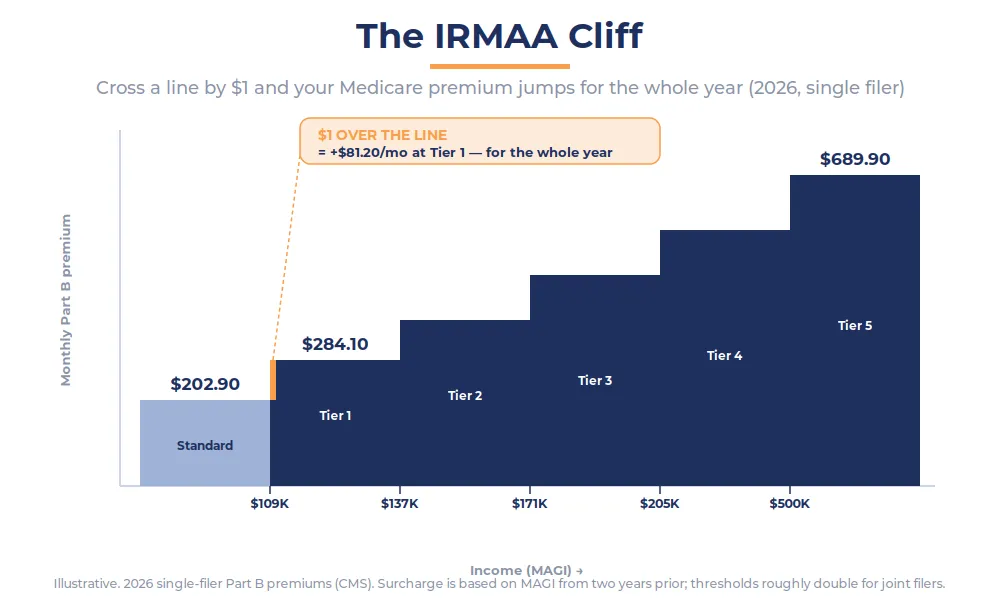
The first threshold in 2026 is $109,000 of income for a single filer and $218,000 for a married couple. From there it climbs in steps. And it applies per person — for a couple, both spouses pay the surcharge once their joint income crosses a line.
Your 2026 premium was set by your 2024 tax return
This is the part that surprises people most. IRMAA runs on a two-year lookback. Your 2026 Medicare premiums are based on your income from 2024 — the most recent return the Social Security Administration has on file.
That delay is exactly why IRMAA catches retirees off guard. A one-time event in a single year — a large Roth conversion, the sale of a rental property, an unusually big required distribution, a concentrated stock sale — can quietly push your income over a threshold and show up as a higher Medicare bill two years later, long after you’ve forgotten the transaction that caused it.
What actually counts as income
IRMAA is based on your modified adjusted gross income — your adjusted gross income plus a few add-backs. The one that trips people up is tax-exempt interest. Municipal bond interest is free of federal income tax, but it still counts toward your MAGI for IRMAA. So a portfolio made for tax efficiency can still push you over a Medicare threshold. The taxable portion of a Roth conversion or a capital gain counts too.
The levers that actually work
Because the thresholds are published and predictable, IRMAA is manageable in a way most retirement costs aren’t. A few of the moves that matter:
Size conversions to the line. If you’re doing Roth conversions, convert up to just below the next threshold rather than blowing through it. Spreading conversions across several years keeps each year’s income under control instead of spiking it.
Use QCDs. For the charitably inclined who are taking required distributions, a qualified charitable distribution satisfies the RMD without adding to your MAGI — money goes straight from the IRA to the charity and never lands on your return.
Choose which account to draw from. In a year you’re near a threshold, pulling from a Roth or from the basis in a taxable account can fund your spending without lifting your MAGI.
Time the big one-time sales. A property or business sale is often the single event that triggers IRMAA. Knowing where the lines sit before you sell — not after — is the whole game, because once the calendar year closes, your MAGI is locked.
The first-year trap, and the appeal nobody uses
The cruelest version of IRMAA hits in your very first year on Medicare. Because the surcharge is priced off income from two years earlier, your first Medicare premium is often based on your last full year of working — when your income was at its peak.
There’s a fix, and it’s underused. If your income has dropped because of a qualifying life-changing event — retirement, marriage, divorce, the death of a spouse, or a work stoppage — you can file Form SSA-44 to ask Social Security to use your current income instead of the two-year-old figure. For legitimate events, these appeals are routinely approved. Many people simply don’t know the form exists.
IRMAA is one of the few costs in retirement you can see coming two years out. That’s not a trap — it’s a planning window.
None of this requires predicting the market or timing anything exotic. It requires knowing where the thresholds are and watching your income against them before each year closes. The cliff only surprises the people who aren’t looking for it — and with coordinated tax and distribution planning, most of them never need to be surprised at all.
Sources
- 2026 IRMAA income thresholds — $109,000 single filer, $218,000 married filing jointly — Centers for Medicare & Medicaid Services, 2026 Medicare Parts A & B Premiums and Deductibles fact sheet
- 2026 standard Medicare Part B premium of $202.90 and annual deductible of $283 — Centers for Medicare & Medicaid Services, 2026 Medicare Parts A & B Premiums and Deductibles fact sheet
- Two-year lookback on modified adjusted gross income for IRMAA determinations — 42 U.S.C. §1395r(i); Social Security Administration, Medicare Premiums: Rules for Higher-Income Beneficiaries (SSA Publication No. 05-10536)
- Requesting an IRMAA reduction after a life-changing event — Social Security Administration Form SSA-44