

The notice comes from Social Security rather than the IRS, it concerns health coverage rather than taxes, and it is about a decision made two years ago. That combination is unusually good at producing alarm — which is worth separating from the size of the number.
Someone opens the letter in the fall. Their Medicare premium is going up, by an amount they did not plan for, because of income they earned in a year that is already closed. In my experience this lands harder than a tax bill several times larger, and the reaction is rarely proportional to the dollars.
The reaction is not irrational. But it is worth understanding where it comes from, because the feeling the letter produces is not a good guide to how much of a plan should bend around it.
Four reasons it lands the way it does
It is a cliff. One dollar over a threshold moves the entire year. Nothing about the design smooths the edge.
It looks backward. The income that sets a 2026 premium was earned in 2024 and reported on a return filed in 2025. By the time the consequence appears, the decision is cold and unchangeable.
It arrives as a health-coverage notice. A larger number on a tax return is filed under “taxes.” This one is filed under “medical,” which is a different emotional category entirely.
It is quoted per month, per person. That framing makes a one-year amount feel ongoing and personal in a way an annual figure does not.
What it actually costs
For 2026 the standard Part B premium is $202.90 a month, with a $283 annual deductible.
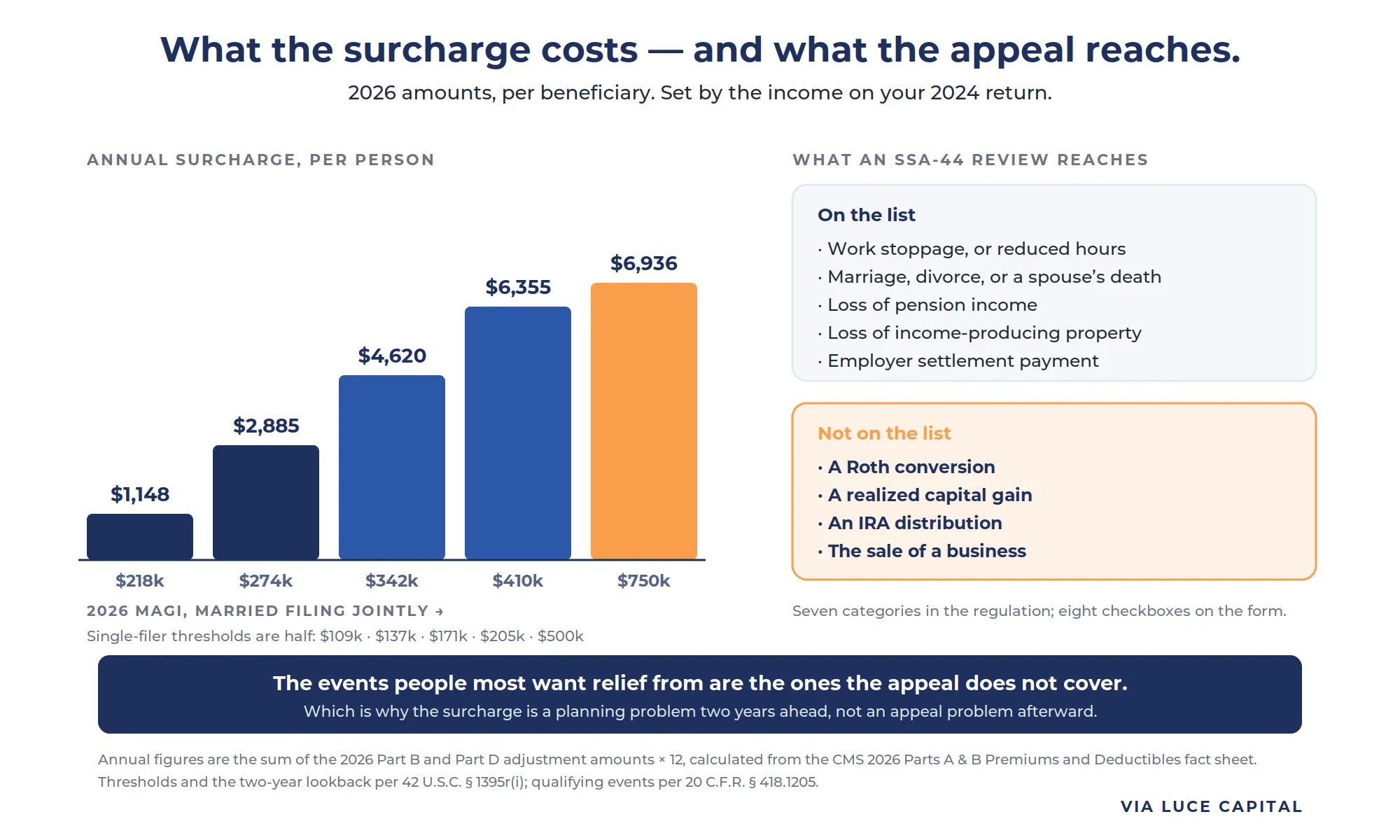
At the first tier — modified adjusted gross income above $218,000 filing jointly, or $109,000 filing single — the Part B adjustment is $81.20 a month and the Part D adjustment is $14.50. Together, $95.70 a month, or roughly $1,148 for the year, per beneficiary.
At the top tier the two adjustments total $578.00 a month, or about $6,936 for the year.
The adjustment is assessed for the individual, not the household. A married couple both enrolled and both above the first threshold each pay their own, so the household number at that step is roughly $2,297 for the year.
That is real money. It is also, at the first step, less than many households spend on a single line item they never think about.
Two years back, and one year at a time
Modified adjusted gross income here means adjusted gross income increased by tax-exempt interest. Municipal bond interest counts even though it never appears in taxable income, which surprises people who bought the bonds partly to keep income down.
The determination is annual. A single year above a threshold raises premiums for one premium year, and the next year is redetermined on that year’s income. It does not compound, and it does not follow you. That matters for how much weight a one-time event deserves.
The appeal reaches less than people expect
The Social Security Administration will use a more recent tax year, but only after a life-changing event — and the regulation lists seven categories, which appear as eight checkboxes on Form SSA-44: work stoppage, reduced hours, marriage, divorce or annulment, the death of a spouse, loss of income-producing property, loss of pension income, and an employer settlement payment.
Read that list for what is missing. A Roth conversion is not on it. Neither is a realized capital gain, a retirement account distribution, or the sale of a business.
Those four are among the most common reasons a retired household crosses a threshold. None of them can be appealed.
Which is exactly why the avoidance deserves watching
Because it is a cliff, and because it cannot be undone afterward, the instinct is to organize income around it. Sometimes that instinct is right. If a conversion can be sized to land under a threshold at no other cost, size it — that is free.
The instinct can also run past its usefulness. A household that declines a conversion outright, defers a gain indefinitely, or leaves a concentrated position untouched in order to stay under a line is trading a known, one-year, per-person amount against something that may be larger and may be permanent.
The question worth asking is not how to avoid the surcharge. It is what this year’s surcharge costs, set against what the thing being given up to avoid it costs. Sometimes the comparison favors staying under the line. Sometimes it does not. Either way it is a comparison, and it has to be run rather than assumed.
(Any figures used in that comparison are specific to the household. Illustrative, not a real client.)
What the planning actually looks like
- Know where the lines are for the year you are in, because that is the year setting a premium two years out. Planning for the current premium is planning for something already decided.
- Watch the income that does not feel like income — municipal interest, a one-time distribution, a gain realized for a reason unrelated to taxes.
- Model the surcharge alongside the decision, not instead of it.
- Remember the reset. One year over is one year, not a new baseline.
- Keep the CPA in it. The return is where modified adjusted gross income is determined, and it is the only place the number can be seen before it becomes a premium.
The pattern
The surcharge is small and loud. A good deal of what people attribute to IRMAA is not the surcharge at all — it is the cost of the decisions made to avoid it.
The surcharge is a one-year number. The decision deferred to avoid it usually isn’t.
Knowing where the thresholds sit is worth something. Letting them set the agenda is worth considerably less. The plan is the residue. The planning is the work.
Sources
- 2026 standard Medicare Part B premium of $202.90, annual deductible of $283, and the full income-related monthly adjustment amount schedule for Part B and Part D at every tier — Centers for Medicare & Medicaid Services, 2026 Medicare Parts A & B Premiums and Deductibles fact sheet
- 2026 Part B premium and income-related adjustment amounts as published in the Federal Register — Medicare Program; Medicare Part B Monthly Actuarial Rates, Premium Rates, and Annual Deductible Beginning January 1, 2026, 90 Fed. Reg. 52063 (Nov. 19, 2025)
- The adjustment is determined for the individual and is based on the individual's modified adjusted gross income, defined as adjusted gross income increased by tax-exempt interest — 42 U.S.C. § 1395r(i)(1), (i)(4)(A)
- Modified adjusted gross income is taken from the tax year two years prior to the effective year, with a three-year fallback where the two-year data is unavailable — 42 U.S.C. § 1395r(i)(4)(B)(i); 20 C.F.R. § 418.1135
- The seven categories of major life-changing event that permit use of a more recent tax year, and the conditions under which the request may be made — 20 C.F.R. §§ 418.1201, 418.1205
- Form SSA-44 and its eight listed life-changing events — Social Security Administration, Form SSA-44, Medicare Income-Related Monthly Adjustment Amount – Life-Changing Event (12-2025), OMB No. 0960-0784