


For years, the “silver tsunami” of retiring business owners was a talking point. Now it’s a market condition. McKinsey’s analysis this spring projects roughly six million U.S. small and mid-sized businesses will change hands by 2035 as boomer owners exit — one of the largest transfers of private business ownership in history. And surveys keep finding the same uncomfortable pattern: only about half of owners approaching retirement have a formal succession or exit plan.
Put those two facts together and the conclusion writes itself. When that much supply meets finite buyer demand, buyers get selective. Selective buyers pay premiums for prepared businesses and discount everything else — when they don’t simply walk.
What a buyer’s market actually does
Sellers tend to imagine the risk as “getting a lower multiple.” The reality is messier. In a crowded market, unprepared businesses don’t just price lower — they fail to transact. Deals die in diligence when the financials can’t be verified quickly, when revenue turns out to be concentrated in a few relationships the owner personally holds, or when the buyer realizes the business is the owner. Industry data has long shown that a large majority of small businesses listed for sale never sell at all; a flooded market makes that math worse, not better.
The sellers who do well in this environment aren’t lucky or well-timed. They’re the ones who look, to a skeptical buyer, like a low-risk purchase: clean books, a management team that runs the business without the owner, diversified revenue, documented processes, and a story about future growth the buyer can believe without squinting.
Readiness has three dimensions, not one
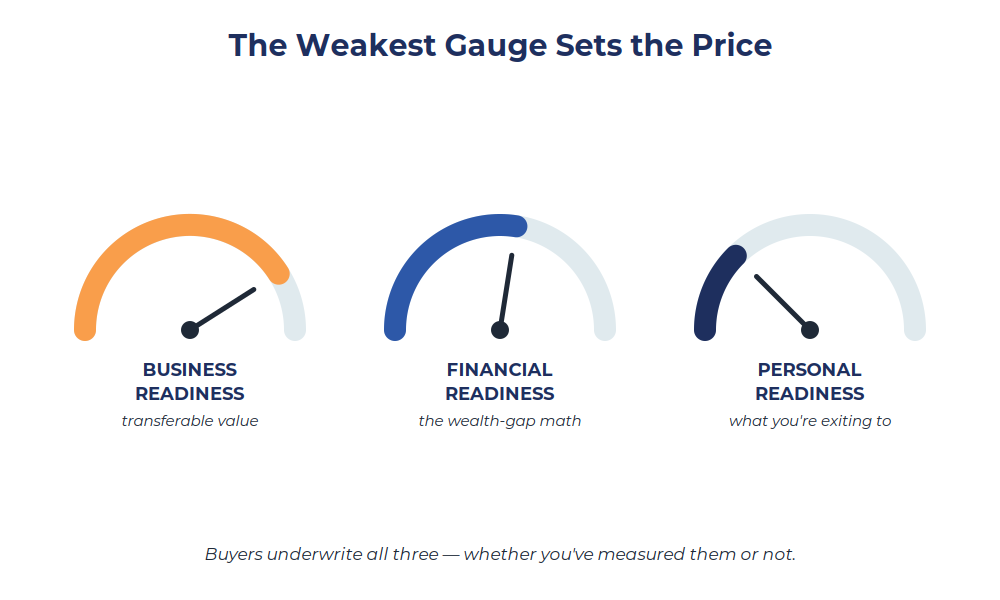
Exit planning gets reduced to “get a valuation, find a buyer.” In practice, readiness runs on three tracks, and the weakest one sets your outcome.
Business readiness is the obvious track: transferable value. Can the business produce its cash flow without you? Buyers pay for what continues after the wire hits; they discount whatever walks out the door with the seller. Owner dependence, customer concentration, thin management, informal financials — each is a specific, fixable discount. Fixing them is what moves a business from “priced to move” to “priced at a premium,” and none of them fix quickly.
Financial readiness is the track owners skip: what does the sale actually need to net, after taxes and debt, to fund the life you’re planning? That number — your wealth gap — determines whether an offer is acceptable before emotions get a vote. Owners who’ve never run this math either anchor on a fantasy number and reject workable deals, or accept a headline price that quietly doesn’t fund the next thirty years. For most owners, the business is the largest asset on the balance sheet; the gap analysis is not optional.
Personal readiness is the track everyone laughs off until closing week. What are you exiting to? Deals fall apart at the finish line more often than buyers admit, and seller cold feet — no plan for identity, time, or purpose after the sale — is a leading cause. A buyer can underwrite your inventory. They can’t underwrite your ambivalence.
Why the runway is three to five years
Every meaningful value driver takes multiple annual cycles to change. Building a management layer takes hiring cycles. Diversifying a concentrated customer base takes sales cycles. Producing the three years of clean, verifiable financial statements a buyer’s lender will want takes — by definition — three years. Tax structuring for a sale (entity cleanup, compensation normalization, and where applicable, positioning for qualified small business stock treatment) rewards lead time and punishes improvisation.
This is why “I’ll get ready when I’m ready to sell” is the most expensive sentence in exit planning. The window opens when a buyer shows up, when health changes, when a partner wants out, when the market shifts — rarely on your schedule. Readiness isn’t about predicting the window. It’s about being sellable whenever it opens.
There’s a bonus most owners don’t expect: everything that makes a business sellable — transferable operations, strong management, clean reporting, diversified revenue — also makes it more profitable and less stressful to own. Exit readiness is just good ownership with a deadline attached.
Where this fits in a plan
At Via Luce Capital, exit readiness isn’t a project that starts when an owner decides to sell — it’s a standing agenda item. Our annual planning cycle includes a dedicated wealth-strategy review each summer: business value and profit-gap analysis, the maintain-grow-exit decision, and coordination with the CPA and attorney who’ll eventually paper the deal. The owners who command premiums in a buyer’s market made themselves ready years before anyone made an offer.
In a buyer’s market, readiness is the negotiation.
If your exit horizon is inside ten years, the preparation window is already open. The only question is whether you’re using it.
Key takeaways
• Roughly six million U.S. businesses are projected to change hands by 2035 as boomer owners exit, while only about half of retiring owners have a formal succession plan.
• In a buyer’s market, unprepared businesses don’t just price lower — many never transact at all; deals die in diligence over owner dependence, customer concentration, and unverifiable financials.
• Readiness runs on three tracks — business (transferable value), financial (the wealth-gap math), and personal (what you’re exiting to) — and the weakest track sets the outcome.
• Every major value driver takes multiple annual cycles to fix, which is why the credible runway is three to five years, not a scramble when a buyer appears.
• Everything that makes a business sellable also makes it more profitable and less stressful to own in the meantime.
Common questions about exit readiness
When should I start exit planning?
Three to five years before your earliest realistic exit — and if your horizon is inside ten years, now. Value drivers like management depth, customer diversification, and clean financials take multiple annual cycles to change.
What do buyers discount most heavily?
Owner dependence leads the list: revenue tied to the owner’s personal relationships, decisions that only the owner can make, and processes that live in the owner’s head. Customer concentration and informal financials follow close behind.
Do I need a formal valuation?
You need a credible estimate of transferable value and, just as important, the wealth-gap analysis that tells you what a sale must net to fund your plan. A formal valuation often makes sense as part of that work — but the gap math is what makes an offer evaluable.
What if I don’t plan to sell — my kids will take over?
Family transitions need the same readiness work, plus more: the business still has to run without you, the wealth gap still has to close (often without full market proceeds), and the estate plan has to treat children in and out of the business fairly. An internal transition is an exit — it just has a different buyer.
Is it too late if the wave is already here?
No — the transition volume runs for years. But every year of preparation you skip shows up in the price, the terms, or whether the deal closes at all.
This article is for informational and educational purposes only and is not tax, legal, business valuation, or financial planning advice. Business sale outcomes depend on individual circumstances, market conditions, and factors outside any owner’s control; no level of preparation guarantees a sale or any particular price. Consult your financial advisor, CPA, and attorney regarding your specific situation. Via Luce Capital and LPL Financial do not provide legal or tax advice.
Brent Rupnow is a Registered Representative with, and Securities and advisory services are offered through LPL Financial (LPL), a registered investment advisor and broker-dealer (member FINRA/SIPC). Insurance products are offered through LPL or its licensed affiliates. Via Luce Capital is not registered as a broker-dealer or investment advisor. Registered representatives of LPL offer products and services using Via Luce Capital, and may also be employees of Via Luce Capital. These products and services are being offered through LPL or its affiliates, which are separate entities from, and not affiliates of Via Luce Capital.