


Trump Accounts went live on July 4, and the first week brought over six million signups plus a wave of corporate and philanthropic pledges. For eligible children — U.S. citizens born between January 1, 2025 and December 31, 2028 — the government deposits $1,000 into an account at no cost to you. If you have a child or grandchild in that window, claiming it is close to a free lunch: file the election, take the money, let it compound.
That’s the easy call, and it’s where most of the coverage stops. The harder question — the one that actually matters for families with real savings capacity — is what to do after the seed money. The account accepts up to $5,000 a year in additional contributions. Whether it deserves those dollars depends on tax mechanics the headlines have mostly skipped.
What the account actually is
Strip away the branding and a Trump Account is a traditional IRA opened for a child, with special rules until January 1 of the year the child turns 18. During that “growth period”: contributions are capped at $5,000 per year across all sources (indexed after 2027), no earned income is required, investments are restricted to low-cost U.S. equity index funds with expense ratios of 0.10% or less, and withdrawals are essentially prohibited. At 18, it becomes an ordinary traditional IRA under the beneficiary’s control.
Three details deserve more attention than they’ve gotten.
First, contributions are after-tax and non-deductible — but growth is taxed as ordinary income when withdrawn. That combination is unusual, and not in a good way. A regular taxable account taxes long-term growth at capital gains rates; this account converts that growth into ordinary income taxed at the beneficiary’s future rate.
Second — and this is the detail almost nobody is reporting — only out-of-pocket contributions from individuals create basis. The government’s $1,000, employer contributions, and charitable or state contributions do not. Every one of those dollars, plus all earnings on everything, comes out as taxable ordinary income. The free money is still free; it’s just fully taxable on the way out.
Third, the account belongs to the child, completely, at 18. Whatever it’s grown to, an eighteen-year-old controls it — and can drain it, taxes and penalty notwithstanding.
The marginal dollar question
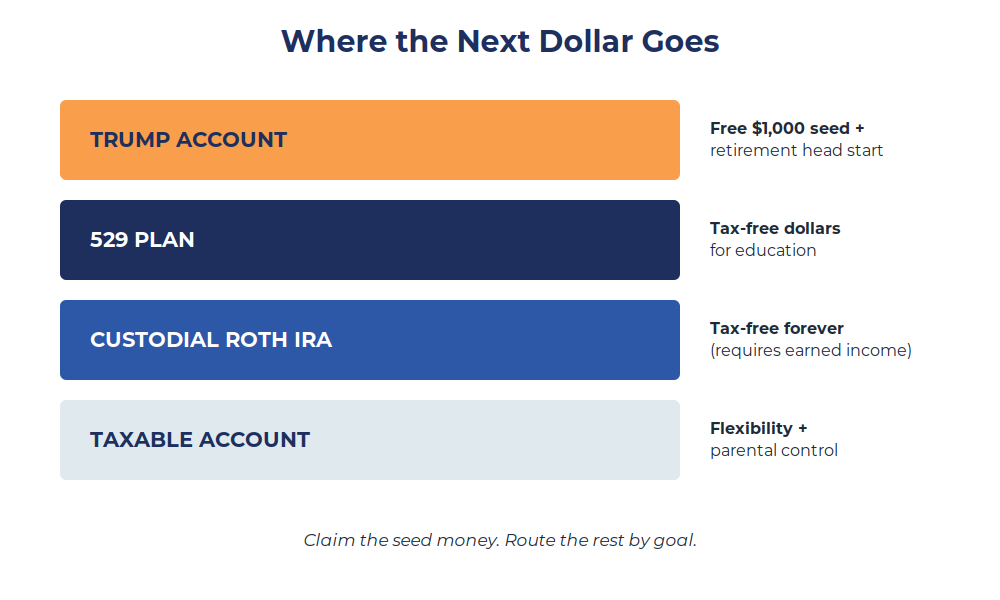
So run the comparison the way we’d run it in a plan: not “is this account good?” but “which account should get the family’s next dollar for this child?”
If the goal is education, a 529 plan is still the stronger vehicle — tax-free withdrawals for qualified expenses, higher effective contribution capacity, and no ordinary-income conversion on growth.
If the child has earned income — a teenager with a real W-2 or legitimate wages from the family business — a custodial Roth IRA is hard to beat: after-tax money in, but tax-free forever on the way out. Same dollars, dramatically better exit.
If the goal is flexibility, a plain taxable account keeps parental control past 18 and taxes growth at capital gains rates rather than ordinary income.
Held against those alternatives, the Trump Account’s case for large ongoing contributions is thin for most affluent families. The dollars go in after-tax like a Roth, but come out taxed like a traditional IRA — the worst half of each.
The two exceptions worth knowing
The first is the Roth conversion window. At 18, the account can be converted to a Roth IRA. A college freshman with little or no income sits in the lowest brackets of their life — converting then means paying modest tax on the accumulated balance in exchange for decades of tax-free compounding. A seed-plus-modest-contributions account converted at 18 is a genuinely attractive outcome. The catch: kiddie tax rules can tax some of that conversion income at the parents’ rate while the child is a dependent, so the timing needs actual analysis, not a rule of thumb.
The second is for business owners. Employers can contribute up to $2,500 per year to employees’ — or their dependents’ — Trump Accounts, excluded from the employee’s taxable income (it counts against the $5,000 cap). That makes it a small but novel benefits lever: a family-friendly perk for recruiting, and worth evaluating alongside the rest of a company’s benefits stack. Like the seed money, though, employer dollars create no basis — the exclusion today is paid for with ordinary income treatment later.
The honest summary
Claim the $1,000 for every eligible child — there’s no scenario where free compounding money is wrong. Consider modest contributions if you value the forced lock-up until 18, or if a Roth conversion at 18 is part of the plan. But for the serious annual dollars an affluent family sets aside per child, the established tools — 529 for education, custodial Roth where there’s earned income, taxable for flexibility — still win most of the time on exit taxation and control.
And hold all of it loosely: the IRS has issued initial guidance with full regulations still coming, and state tax treatment isn’t fully settled. This is a year-one program. The plan should treat it that way.
The free $1,000 is the easy call. The next $5,000 is a tax decision.
At Via Luce Capital, questions like this get answered inside the plan — per child, per goal, alongside the 529s, the gifting strategy, and for business owners, the benefits design. New accounts are worth understanding. They’re rarely worth reorganizing a plan around.
Key takeaways
• Trump Accounts launched July 4, 2026: a traditional IRA for children with a $1,000 federal seed for kids born 2025–2028, a $5,000 annual contribution cap, index-fund-only investing, and no withdrawals until the year the child turns 18.
• Claiming the seed money is an easy yes for every eligible child — it’s free and doesn’t count against the contribution limit.
• The tax structure is the catch: contributions are after-tax, but growth — and all seed, employer, and charitable dollars — comes out as ordinary income.
• For ongoing contributions, 529s (education), custodial Roth IRAs (earned income), and taxable accounts (flexibility) usually offer better exits for affluent families.
• Two planning bright spots: a potential Roth conversion in the child’s low-income years after 18, and a $2,500/year employer contribution channel business owners can add to a benefits package.
Common questions about Trump Accounts
Should I claim the $1,000 for my child?
If your child was born between 2025 and 2028 and is a U.S. citizen with a Social Security number — yes. It costs nothing, doesn’t count against the contribution limit, and compounds for 18 years. The election is filed via IRS Form 4547 or at the Treasury’s enrollment site.
Is a Trump Account better than a 529?
For education savings, generally no. A 529 offers tax-free withdrawals for qualified education expenses; Trump Account growth is taxed as ordinary income. The accounts serve different goals — many families will reasonably hold both, with the 529 doing the heavy lifting.
My child wasn’t born between 2025 and 2028 — is the account still available?
Yes, any child under 18 with a Social Security number can have one; they just don’t receive the federal seed. Without the free $1,000, the case for the account gets thinner and depends on the same marginal-dollar analysis.
What happens when my child turns 18?
The account becomes a regular traditional IRA under their full control — including the ability to withdraw everything, taxes and penalties included. That control transfer is a real consideration for larger balances, and it’s also when a Roth conversion may make sense.
Can grandparents contribute?
Yes — individuals other than parents can contribute, all within the shared $5,000 annual cap per child. Grandparent contributions create basis (they come back tax-free); the earnings on them don’t.
This article is for informational and educational purposes only and is not tax, legal, or financial planning advice. Trump Accounts are a new program; IRS and Treasury guidance is still being issued, and rules described here — including contribution limits, tax treatment, and state-level conformity — may change. Consult your tax professional and financial advisor before acting. Via Luce Capital and LPL Financial do not provide legal or tax advice.
Brent Rupnow is a Registered Representative with, and Securities and advisory services are offered through LPL Financial (LPL), a registered investment advisor and broker-dealer (member FINRA/SIPC). Insurance products are offered through LPL or its licensed affiliates. Via Luce Capital is not registered as a broker-dealer or investment advisor. Registered representatives of LPL offer products and services using Via Luce Capital, and may also be employees of Via Luce Capital. These products and services are being offered through LPL or its affiliates, which are separate entities from, and not affiliates of Via Luce Capital.
Prior to investing in a 529 Plan investors should consider whether the investor's or designated beneficiary's home state offers any state tax or other state benefits such as financial aid, scholarship funds, and protection from creditors that are only available for investments in such state's qualified tuition program. Withdrawals used for qualified expenses are federally tax free. Tax treatment at the state level may vary. Please consult with your tax advisor before investing.
Trump Accounts offer tax deferred growth on earnings. Family contributions are made with after tax dollars, and eligible employer contributions may be excluded from the employee’s taxable income. A one time $1,000 federal contribution may be available for eligible children born between 2025 and 2028. Distributions are generally prohibited during the child's growth period and, once permitted, are taxable as ordinary income and may be subject to a 10% IRS early distribution penalty if taken before age 59½. Contribution limits and other restrictions apply, and some rules remain subject to future Treasury and IRS guidance. Consult a qualified tax advisor or financial professional before making decisions.
Traditional IRA account owners have considerations to make before performing a Roth IRA conversion. These primarily include income tax consequences on the converted amount in the year of conversion, withdrawal limitations from a Roth IRA, and income limitations for future contributions to a Roth IRA. In addition, if you are required to take a required minimum distribution (RMD) in the year you convert, you must do so before converting to a Roth IRA.