


A common estate-planning instinct — give the appreciated stock or the family home to the kids now, while I’m alive — quietly hands them a bigger tax bill than doing nothing would have. For most families, the reason is a rule called the step-up in basis.
There’s a generous instinct that quietly costs families money: giving appreciated assets to your children while you’re alive.
It feels like smart estate planning. Move the appreciated stock, or the rental, or the family home to the kids now — get it out of your name, watch them enjoy it, maybe sidestep some future complication. But for most families, handing a low-basis asset to an heir during your lifetime does the opposite of what it looks like. It takes a tax nobody was going to owe and turns it into one your heir will.
The mechanism has a name, even if the trap doesn’t: the step-up in basis.
Two ways an asset can change hands
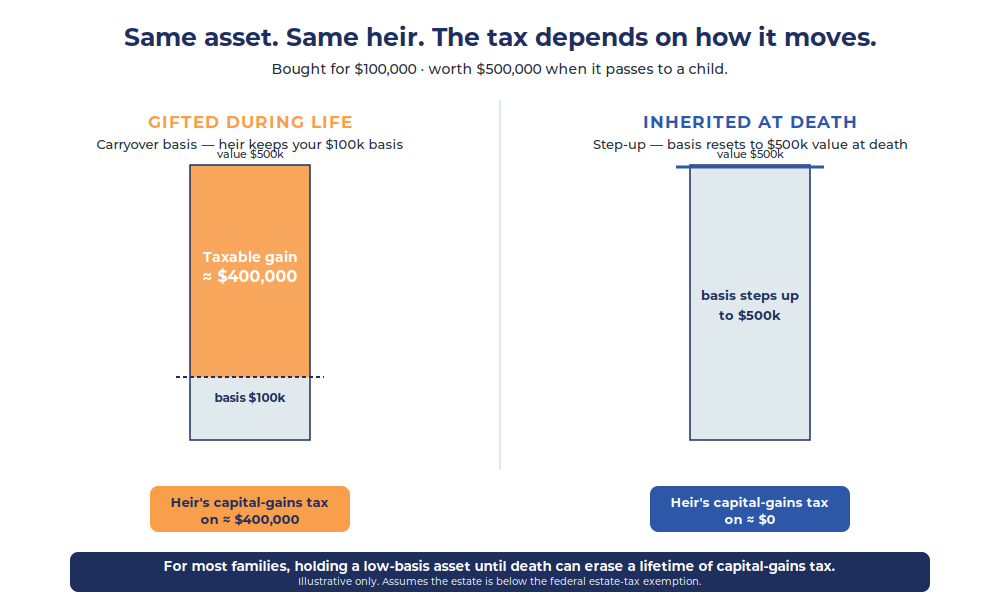
When you give an appreciated asset away during your life, the recipient takes your cost basis along with it. This is carryover basis. If you bought stock for $100,000 and it’s worth $500,000 when you gift it, your child’s basis is still $100,000. The day they sell, they owe capital-gains tax on the $400,000 of growth — growth that happened on your watch, not theirs.
When you instead hold that same asset until death, something very different happens. The basis “steps up” to the asset’s fair-market value on the date of death. Your child inherits it with a basis of $500,000. If they sell it the next week for $500,000, the taxable gain is roughly zero. The entire lifetime of appreciation escapes capital-gains tax.
Same asset. Same child. The only difference is whether it moved by gift or by inheritance — and that difference can be worth six figures.
Why the “get it out of my estate” logic usually doesn’t apply
The reflex to shrink your estate made a lot of sense when the estate-tax exemption was low and a middle-class house could trigger it. That’s not most families’ situation today. The federal estate-tax exemption now sits in the range of $15 million per person — meaning a married couple can pass a very large estate before a dollar of federal estate tax is owed.
So for the large majority of families, there’s no estate tax to plan around. Gifting an appreciated asset to avoid an estate tax you were never going to pay doesn’t save anything — it just strips away the step-up and leaves your heir with the capital-gains bill. You’ve solved a problem you didn’t have and created one you didn’t need.
When gifting still makes sense
This isn’t an argument against lifetime giving. It’s an argument for gifting the right assets — and for knowing which situation you’re in.
• Cash and high-basis assets are fine to give. There’s little or no built-in gain to lose, so no step-up is being wasted. If you want to help now, give from these first.
• Above the exemption, the math can flip. For families whose estates exceed the exemption, removing an asset’s future appreciation from the taxable estate can outweigh the lost step-up. That’s a real strategy — but it’s a calculation, not a reflex, and it belongs to a specific tier of wealth.
• The heir’s own tax picture matters. A recipient in a low income year may face little capital-gains tax; a high earner in a high-tax state faces much more. Who receives it, and when, changes the answer.
The pattern underneath
The step-up trap is a good example of why estate planning is a coordination problem, not a paperwork problem. The move that looks efficient in isolation — get the asset out of my name — can be the expensive one once the capital-gains side is on the table. The asset that feels like a burden to hold is often the exact one worth holding, precisely because death resets its basis.
The instinct to give while you can is a good one. It just deserves to be pointed at the assets where it helps, and kept away from the ones where patience quietly does more.
For most families, the most tax-efficient thing you can do with a highly appreciated asset is often the thing that feels like doing nothing: hold it.
Before you move an appreciated asset to the next generation, the question worth asking isn’t “how do I give this away?” It’s “which assets should move now, which should wait, and what does each choice cost the people receiving them?”
Key takeaways
• Assets gifted during life carry your original cost basis (carryover basis); the heir owes capital-gains tax on all the built-in appreciation when they sell.
• Assets inherited at death receive a step-up in basis to fair-market value, often erasing the capital-gains tax on a lifetime of growth.
• With the federal estate-tax exemption now around $15 million per person, most families owe no estate tax — so gifting a low-basis asset to “shrink the estate” trades away the step-up for no benefit.
• Cash and high-basis assets are the better things to gift; low-basis appreciated assets are usually better held until death — though the math can flip for estates above the exemption.
Common questions about the step-up in basis
What is a step-up in basis?
When someone inherits an asset, its cost basis is reset to the fair-market value on the date of the owner’s death. That typically eliminates capital-gains tax on all the appreciation that occurred during the owner’s lifetime.
If I gift stock to my child, do they get the step-up?
No. A lifetime gift carries your original basis to your child (carryover basis). The step-up only happens when an asset passes at death.
Does this mean I should never gift assets to my kids?
Not at all. Cash and high-basis assets are generally fine to give. The caution is specifically about giving away low-basis, highly appreciated assets, where you’d be forfeiting a valuable step-up.
We have a large estate — does the same advice apply?
Not necessarily. For estates above the federal exemption, removing an asset’s future growth from the taxable estate can outweigh the lost step-up. That’s a genuine strategy, but it requires running the actual numbers with your advisor and estate attorney.
Isn’t this something my will or trust handles?
No. Basis and estate-tax exposure sit outside the document that directs where assets go. A trust can pass an asset perfectly and still leave your heir a large capital-gains bill if the asset was mishandled during your lifetime.
This article is for informational and educational purposes only and is not tax, legal, or estate-planning advice. Basis rules, the estate-tax exemption, and gift-tax provisions are complex, subject to inflation adjustments, and apply differently to each family’s situation; the law may also change. Decisions involving gifting and appreciated assets can have significant and sometimes irreversible tax consequences. Consult a qualified estate or tax attorney, your CPA, and your financial advisor before acting.
Brent Rupnow is a Registered Representative with, and Securities and advisory services are offered through LPL Financial (LPL), a registered investment advisor and broker-dealer (member FINRA/SIPC). Insurance products are offered through LPL or its licensed affiliates. Via Luce Capital is not registered as a broker-dealer or investment advisor. Registered representatives of LPL offer products and services using Via Luce Capital, and may also be employees of Via Luce Capital. These products and services are being offered through LPL or its affiliates, which are separate entities from, and not affiliates of Via Luce Capital.