


Nonprofits, foundations, and businesses hold reserve portfolios — and most are managed by default rather than by design. “Keep it conservative” feels responsible, but without a defined purpose, horizon, and spending policy, it quietly creates its own risks.
Most institutional reserve portfolios aren’t managed badly. They’re managed by default — which is a different problem, and often a more expensive one.
A nonprofit builds an operating reserve. A foundation holds an endowment. A company parks retained earnings it doesn’t need this quarter. In each case, someone reasonable made a reasonable call — “let’s keep it safe” — and the money has been sitting in that decision ever since. No one revisits it, because nothing appears to be wrong. The account isn’t losing money. The auditors don’t flag it. The board has other things to discuss.
But “keep it safe” isn’t a strategy. It’s the absence of one. And the gap between a reserve that’s been parked and a reserve that’s been designed tends to show up at the worst time — when the organization actually needs the money to have done its job.
“Conservative” is a decision, not a default
Here’s the uncomfortable part: there’s no such thing as a no-risk reserve. There’s only a choice about which risk you’re taking.
Hold everything in cash and short-term instruments, and you’ve chosen inflation risk — the near-certainty that, over years, the reserve’s purchasing power quietly erodes while it “safely” does nothing. A reserve meant to fund three years of operations a decade from now can lose a meaningful share of its real value sitting in “safe” accounts.
Reach for yield without a defined horizon, and you’ve chosen the opposite risk — reserves exposed to market swings they may have to sell into at exactly the wrong moment, because the money was needed and the timing wasn’t yours to choose.
Neither is inherently wrong. What’s wrong is choosing by accident. “Conservative” that hasn’t been defined against a purpose isn’t caution — it’s an unexamined bet that happens to feel prudent.
Reserves need a job description
The fix isn’t a hot investment idea. It’s a document, and a conversation. Institutional money is most appropriately managed against a defined mandate — most formally, an investment policy statement (IPS) — that answers questions the reserve can’t answer on its own.
• What is this money for? Operating cushion, a known future capital project, a perpetual endowment, opportunistic dry powder — each implies a completely different approach. Money you might need in six months and money you won’t touch for twenty are not the same asset, even if they’re sitting in the same account.
• What’s the time horizon? The single most important input. Horizon determines how much volatility the reserve can actually tolerate — and a portfolio with no defined horizon defaults to the shortest one, which usually means too conservative for the money that could grow.
• What’s the spending policy? How much gets drawn, how often, and under what rules. A foundation spending 5% a year and a reserve that may never be touched need entirely different structures. Without a spending policy, you can’t set an allocation — you’re guessing.
• What are the constraints? Liquidity needs, governance requirements, risk tolerance, and any restrictions the organization or its donors impose.
Answer those, and the allocation almost designs itself. Skip them, and you get “conservative” — a label standing in for a plan.
Why this is a governance question, not an investment one
The instinct, when reserves come up, is to ask “what should we invest in?” That’s the wrong first question. The right one is “what is this money supposed to do, and over what period?” — and that’s a board and leadership question, not a portfolio question.
This is where fiduciary responsibility actually lives. A board’s duty isn’t to pick investments; it’s to define the mandate, document the reasoning, and ensure the reserves are managed against a purpose the organization has actually articulated. When a reserve is structured around a clear IPS, every decision downstream becomes explainable and defensible — which is precisely what a fiduciary is supposed to be able to do. When it’s “conservative by default,” there’s nothing to point to when someone eventually asks why.
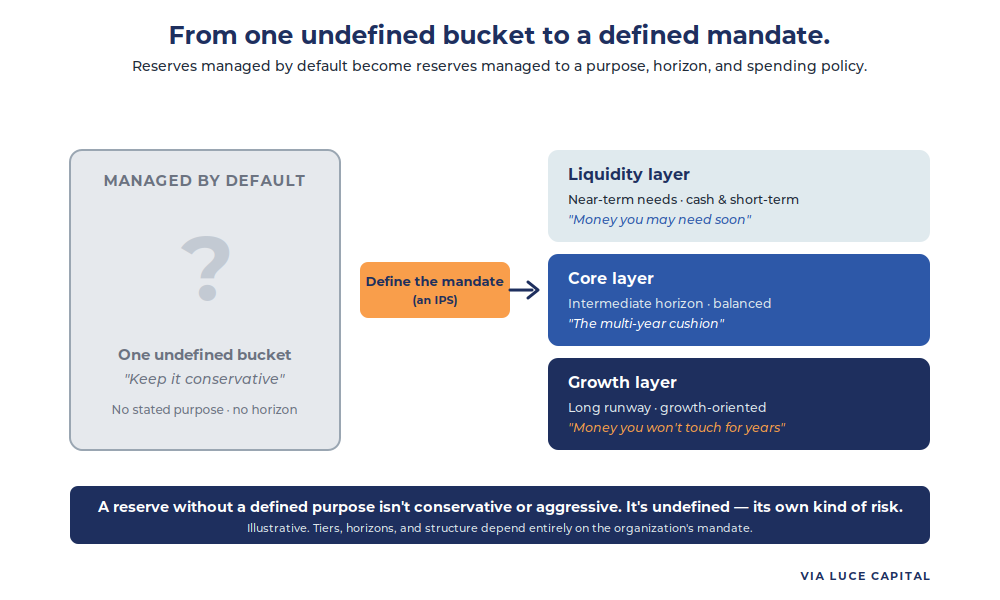
Often the cleanest answer isn’t one bucket at all. Reserves can be tiered — a liquidity layer for near-term needs, a core layer for the intermediate horizon, a growth layer for money with a genuinely long runway — each managed to its own job. But that structure only follows from doing the definitional work first.
What it means for your organization
If your reserves have been sitting in the same “conservative” posture for years without anyone revisiting why, that’s worth a fresh look — not because the posture is necessarily wrong, but because no one has recently checked whether it still fits the mandate. The reserve may be taking too little risk for money that could grow, or too much for money that might be needed soon. You can’t know which until the purpose is defined.
A reserve without a defined purpose isn’t conservative or aggressive. It’s undefined — and undefined is its own kind of risk.
The work isn’t finding a better investment. It’s answering, deliberately and on the record, what the money is for — and then building a portfolio that actually serves that answer.
Key takeaways
• Most institutional reserves are managed by default, not by design — “keep it conservative” is the absence of a strategy, not a strategy.
• There’s no risk-free reserve: all-cash chooses inflation risk; reaching for yield without a horizon chooses market risk. The error is choosing by accident.
• Reserves need a defined mandate — ideally an investment policy statement — answering what the money is for, its time horizon, spending policy, and constraints.
• Defining the reserve is a governance and fiduciary responsibility, not an investment-selection task; a clear mandate makes every downstream decision explainable and defensible.
Common questions about institutional reserves
What is an operating reserve or institutional reserve portfolio?
It’s money an organization holds beyond immediate needs — an operating cushion, an endowment, a capital-project fund, or retained earnings. The common thread is that it isn’t needed today, which raises the question of how it should be managed until it is.
Isn’t keeping reserves in cash the safe choice?
It’s safe against market swings but not against inflation. Over years, cash can quietly lose purchasing power, so for reserves with a long horizon, all-cash may be taking a real risk that isn’t obvious on a statement.
What is an investment policy statement (IPS)?
A document that defines how a pool of money should be managed — its purpose, time horizon, spending policy, risk tolerance, and constraints. It turns “keep it conservative” into a specific, defensible mandate the portfolio can be built and measured against.
Who’s responsible for setting the reserve strategy?
Ultimately the board and organizational leadership. Their role is to define the mandate and document the reasoning — a governance duty — while investment professionals help translate that mandate into an appropriate portfolio.
Should all our reserves be managed the same way?
Often not. Money needed soon and money with a long runway have different jobs, and reserves are frequently structured in tiers — a liquidity layer, a core layer, and a growth layer — each managed to its own horizon and purpose.
This article is for informational and educational purposes only and is not investment, legal, or fiduciary advice. The appropriate management of any reserve or institutional portfolio depends on the organization’s specific purpose, time horizon, spending needs, governance requirements, and constraints. All investing involves risk, including possible loss of principal, and no strategy assures success or protects against loss. Consult qualified investment, legal, and governance professionals before making decisions for your organization.
Brent Rupnow is a Registered Representative with, and Securities and advisory services are offered through LPL Financial (LPL), a registered investment advisor and broker-dealer (member FINRA/SIPC). Insurance products are offered through LPL or its licensed affiliates. Via Luce Capital is not registered as a broker-dealer or investment advisor. Registered representatives of LPL offer products and services using Via Luce Capital, and may also be employees of Via Luce Capital. These products and services are being offered through LPL or its affiliates, which are separate entities from, and not affiliates of Via Luce Capital.