


OBBBA expanded the benefit significantly. But QSBS eligibility is determined at issuance and over the holding period — not at sale. For C-corp owners, the time to verify position is now.
Most business owners learn about Qualified Small Business Stock at the worst possible moment: when they’re already in active sale discussions. By then, the questions that determine whether $15 million per shareholder is tax-free or fully taxed have largely been answered — by decisions made years earlier that no one was tracking.
That timing problem just got more expensive. In July 2025, the One Big Beautiful Bill Act significantly expanded Section 1202 — the tax provision behind QSBS — for stock acquired after July 4, 2025. The benefit is now larger and more accessible than it has been in years. But the eligibility rules still depend on facts established well before the eventual sale.
Here’s what changed, what’s at stake, and the questions every C-corporation owner should be checking now — not at exit.
What QSBS is, briefly
Section 1202 of the Internal Revenue Code lets eligible shareholders exclude federal income tax on capital gains from the sale of qualifying stock, up to a per-shareholder cap. The corporation must be a C-corporation, engaged in a qualified trade or business, with gross assets under a defined threshold. The stock must be acquired at original issuance — not on a secondary basis — and held for a required period.
When all the pieces line up, the result is significant: a holder can sell qualifying stock and exclude up to $15 million of gain from federal income tax. That’s per shareholder, per company. Families with multiple holders can multiply the benefit. The savings at the highest capital-gains rates, including the Net Investment Income Tax, can be transformative for an exit.
When the pieces don’t line up — the wrong entity type, the wrong industry, gross assets that exceeded the threshold at the wrong time, stock acquired the wrong way — the exclusion is gone. Not partially. Entirely.
What OBBBA changed
For stock acquired after July 4, 2025, three substantive changes apply.
Tiered partial exclusions. Previously, the full 100% exclusion required holding the stock for at least five years. Anything less, and the gain was fully taxable. OBBBA introduced an interim structure: 50% exclusion after 3 years, 75% exclusion after 4 years, and 100% exclusion after 5+ years.
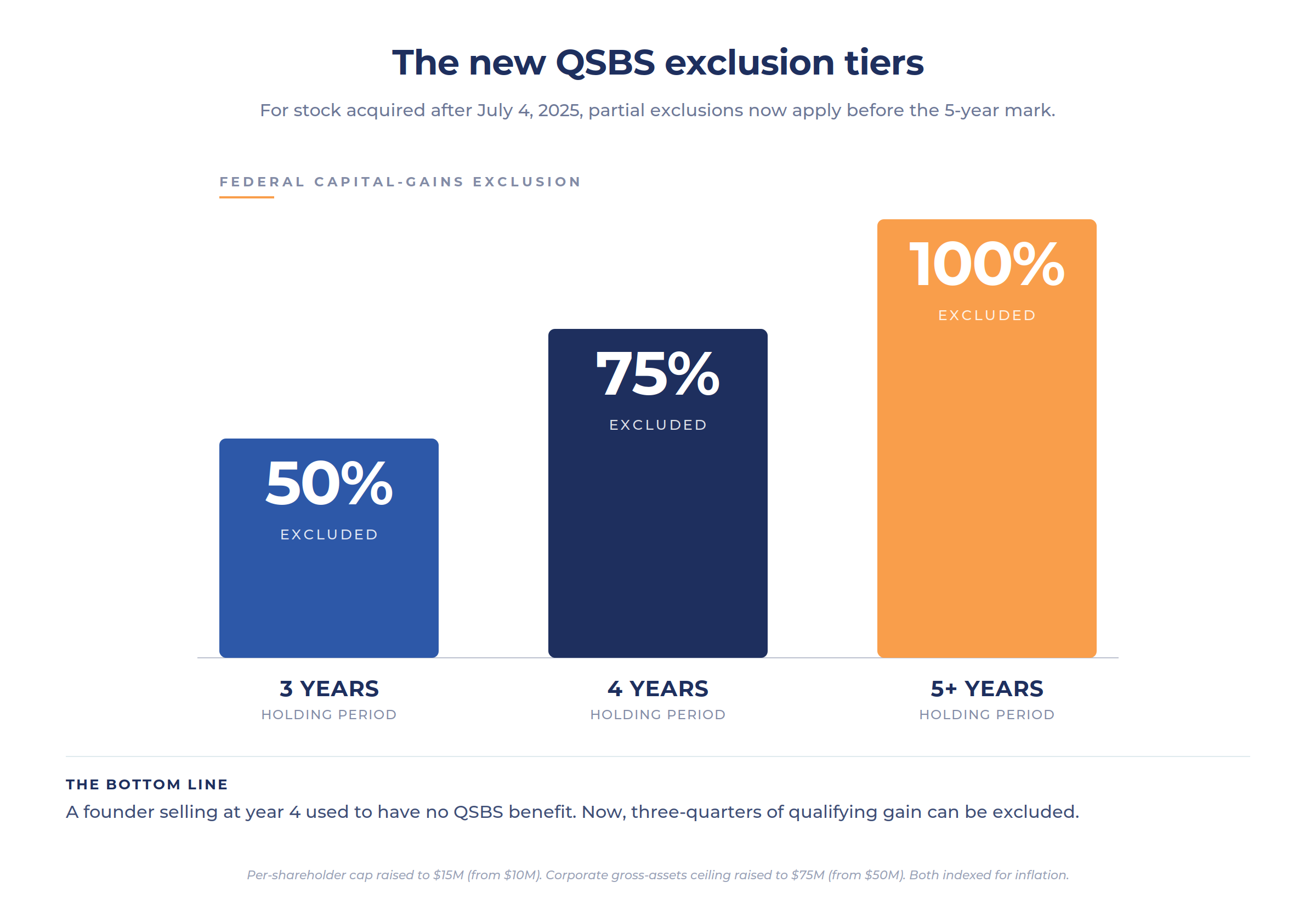
This changes the calculus on secondary transactions, tender offers, and earlier-than-planned exits. A founder selling at year four used to have no QSBS benefit. Now, three-quarters of the qualifying gain can be excluded.
Higher per-issuer cap. The per-shareholder, per-company exclusion cap rose from $10 million to $15 million (or 10× basis, whichever is greater), indexed for inflation. For owners with substantial expected exits, this is meaningful — $5 million more excluded per holder, growing with inflation.
Higher gross-assets threshold. The corporation’s gross-assets ceiling — the test for whether the business qualifies as a “small business” under Section 1202 — rose from $50 million to $75 million, also indexed for inflation. More mid-sized businesses now qualify than under the old rules.
Stock acquired before July 4, 2025 follows the prior rules. The new framework is forward-looking, which means stock issuances made now and over the next several years are the ones that benefit.
What this means for business owners
The expansion is significant. The catch is timing. QSBS eligibility is determined at issuance and over the holding period, not at sale. By the time you’re negotiating a transaction, the answer to “do my shares qualify?” has already been written by years of past decisions about entity structure, capital raises, asset growth, and stock issuance.
That makes QSBS one of the clearest examples of why exit planning starts well before the exit year. The structural decisions that determine whether an owner’s gain will be excluded — entity type, industry classification, when stock is issued, who holds it — are decisions made over years, not in a transaction quarter.
The questions every C-corp owner should be checking now
Four practical questions to verify with your CPA and corporate attorney:
1. Are you actually a C-corporation? QSBS only applies to C-corp stock. S-corp shareholders and LLC members don’t qualify. If you’re considering converting from S-corp or LLC to enable QSBS, the conversion has cascading tax implications that need modeling — but the planning window can be years before exit.
2. Are you in a qualified trade or business? Section 1202 excludes several categories from QSBS treatment: law, accounting, financial services, brokerage, consulting, performing arts, athletics, banking, insurance, financing, leasing, investing, farming, mineral extraction, hotels and restaurants. If your business sits cleanly outside those categories, you’re likely qualified. If it sits ambiguously — for example, a software company that derives meaningful revenue from consulting services — the classification deserves a careful look.
3. When was your stock issued, and how? QSBS applies only to stock acquired at original issuance from the corporation, in exchange for money, property (other than stock), or services. Stock purchased on a secondary basis doesn’t qualify. Different issuances may carry different acquisition dates, which means a single shareholder may hold both qualifying and non-qualifying stock simultaneously.
4. Have you maintained gross assets under the threshold? The corporation must have gross assets under the threshold (now $75 million) at and immediately after each issuance. Once gross assets exceed the threshold, the corporation can’t issue new QSBS-eligible stock — but previously issued QSBS retains its status. The issuance timeline is material.
The planning angle
For business owners with substantial unrealized value in a C-corp, QSBS is one of the highest-value tax planning levers in the code. The structure also benefits from multi-holder strategies: each qualifying shareholder has their own $15 million exclusion cap. With the new $30 million estate exemption framework covered in the prior post in this series, gifting strategies that distribute QSBS-eligible stock to family members or trusts can stack exclusions across multiple holders — sometimes multiplying the available exclusion by a meaningful factor.
That’s where exit planning and estate planning intersect structurally. Decisions about who holds the stock, in what entity, and when transfers happen, can change the after-tax outcome of an eventual sale by millions of dollars. None of those decisions are exit-year decisions. All of them require lead time.
What to do this year
For C-corp owners who haven’t reviewed QSBS recently — or who never have:
• Verify entity status and qualifying-business classification with corporate counsel.
• Document each stock issuance carefully, including dates, basis, and qualification status.
• If gross assets are approaching the $75 million threshold, model the implications of further capital raises or asset accumulation on future issuances.
• Coordinate with your estate attorney on whether multi-holder strategies make sense given the new estate exemption framework.
• If you’re planning to issue new equity to founders, employees, or investors, do it with QSBS qualification in mind from the outset.
For owners who aren’t currently structured as a C-corp but might be a good fit, the entity-conversion question is worth a real look — not a casual one. The implications go well beyond QSBS, and the math depends on the trajectory of the business, the timeline to exit, and family planning goals.
The questions that determine whether your shares qualify aren’t asked at exit. They’re answered years earlier, by decisions you may not have known you were making.
QSBS isn’t a tax loophole. It’s a provision that’s been on the books for decades, under-used because the eligibility rules are technical and the planning has to start years before the payoff. OBBBA made it bigger and more accessible. The timing problem hasn’t changed. The owners who’ll capture the new benefits are the ones checking their position now.
The plan is the residue. The planning is the work.
Key takeaways
• QSBS (Section 1202) lets eligible C-corporation shareholders exclude up to $15 million per holder, per company in federal capital-gains tax on stock sales. OBBBA raised this from $10 million.
• For stock acquired after July 4, 2025, OBBBA introduced tiered exclusions: 50% at 3 years, 75% at 4 years, 100% at 5+ years. Previously, only 5-year holdings qualified for any exclusion.
• The gross-assets ceiling for qualifying corporations rose from $50 million to $75 million, making more mid-sized businesses eligible.
• QSBS eligibility is determined at stock issuance and over the holding period — not at sale. By exit, the answer to “do my shares qualify?” has already been written.
• The highest-value planning move is often multi-holder distribution. Each qualifying shareholder has their own $15M cap, and the new estate exemption framework supports stacking strategies through family transfers.
Common questions about QSBS
What is QSBS (Qualified Small Business Stock)?
QSBS is stock in a domestic C-corporation that meets the requirements of Section 1202 of the Internal Revenue Code. Eligible holders can exclude federal income tax on capital gains from the sale of qualifying stock, up to a per-shareholder cap of $15 million (or 10× the holder’s basis, whichever is greater). The corporation must be engaged in a qualified trade or business with gross assets under $75 million, and the stock must be acquired at original issuance.
What changed with QSBS under the One Big Beautiful Bill Act?
For stock acquired after July 4, 2025, OBBBA introduced tiered partial exclusions (50% at 3 years, 75% at 4 years, 100% at 5 years), raised the per-issuer exclusion cap from $10 million to $15 million, and raised the corporate gross-assets threshold from $50 million to $75 million. All limits are now indexed for inflation. Stock acquired before July 4, 2025 follows the prior rules.
How long do you have to hold QSBS stock?
For stock acquired after July 4, 2025, the holding period determines the exclusion percentage: 50% after three years, 75% after four years, and 100% after five years. For stock acquired before that date, the full 100% exclusion requires a five-year holding period with no partial exclusion for shorter holds.
What is the QSBS exclusion limit?
Each shareholder can exclude up to $15 million of gain per qualifying corporation, or 10 times the shareholder’s adjusted basis in the stock, whichever is greater. The cap applies per shareholder, per company — meaning families with multiple QSBS holders in the same company can stack exclusions across holders.
What types of businesses qualify for QSBS?
The corporation must be a domestic C-corporation engaged in a qualified trade or business. Excluded categories include law, accounting, financial services, brokerage, consulting, performing arts, athletics, banking, insurance, financing, leasing, investing, farming, mineral extraction, and hotels or restaurants. Most technology, manufacturing, and product-based businesses qualify if the other tests are met.
Can you convert an S-corp or LLC to a C-corp to qualify for QSBS?
Yes, but the conversion is structurally significant and has cascading tax implications. QSBS eligibility begins at the date of conversion or issuance of new C-corp stock — not retroactively to the original founding date. The conversion decision should be modeled with corporate counsel and a CPA, accounting for the full set of tax, governance, and planning implications.
This article is for informational and educational purposes only and is not intended as tax, legal, or business succession advice. Section 1202 of the Internal Revenue Code is technical, and qualification depends on specific facts about entity structure, business operations, stock issuance, and holder status that require professional verification. Consult your CPA, corporate attorney, and tax counsel about how QSBS rules apply to your specific situation.
Securities and advisory services are offered through LPL Financial (LPL), a registered investment advisor and broker-dealer (member FINRA/SIPC). Insurance products are offered through LPL or its licensed affiliates. Via Luce Capital is not registered as a broker-dealer or investment advisor. Registered representatives of LPL offer products and services using Via Luce Capital, and may also be employees of Via Luce Capital. These products and services are being offered through LPL or its affiliates, which are separate entities from, and not affiliates of Via Luce Capital.