


A portfolio can hold twelve funds and still behave like one bet. The number of holdings tells you almost nothing about whether you’re diversified — the correlation between them tells you almost everything.
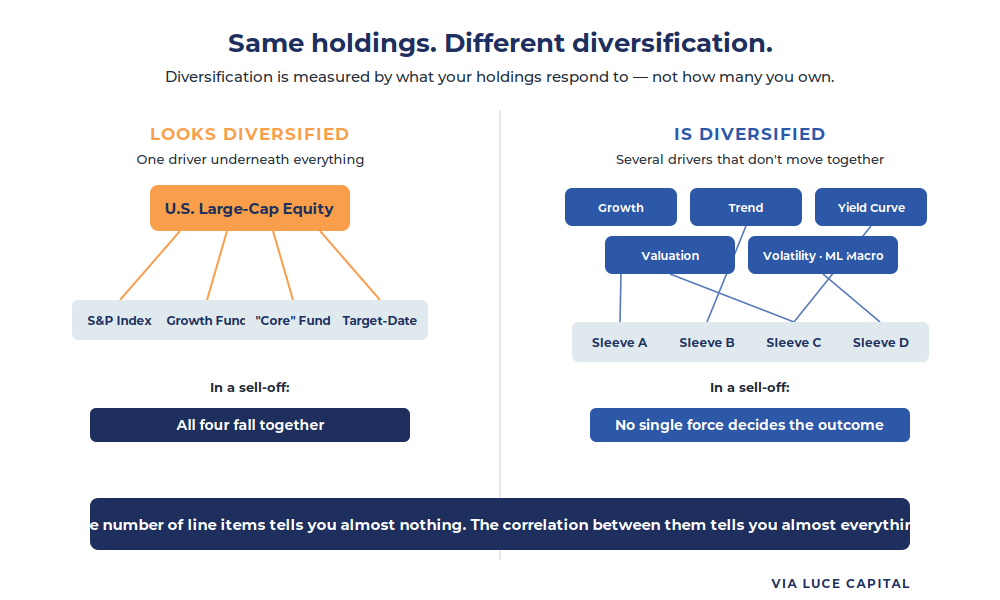
Open most “diversified” statements and you’ll find large-cap U.S. equity wearing a dozen costumes: an S&P index fund, a large-cap growth fund, a “core” fund, a target-date fund built mostly from the same names. That isn’t twelve decisions. It’s one decision, repeated. And when the one thing underneath them falls, all twelve fall together.
That’s the gap between owning different things and being diversified. They aren’t the same, and the difference tends to reveal itself at the worst possible moment — in a drawdown.
What diversification actually measures
Diversification isn’t about how many holdings you have. It’s about whether those holdings respond to the same forces. Two investments that rise and fall in lockstep — high correlation — give you almost no diversification, no matter how differently they’re labeled. Two that respond to genuinely different drivers can cushion each other.
The trap is that correlation hides in calm markets and shows up under stress. In an ordinary year, a growth fund, a value fund, and an international fund can look pleasantly independent. In a real sell-off, correlations across most equities tend to converge — things sell off together. The diversification you thought you had can thin out precisely when you were counting on it.
Different drivers, not different labels
This is why it’s more useful to build around return drivers than fund labels. A driver is the underlying force that makes an investment move: economic growth, the direction and shape of the yield curve, momentum and trend, how cheap or expensive assets are relative to their own history, shifts in market volatility, macro signals surfaced by machine-learning models, and how asset classes rank against one another at a given moment.
These forces don’t all fire at the same time or in the same direction. A trend signal and a valuation signal can point opposite ways in the same market — by design. When a portfolio’s behavior is anchored to several drivers that don’t move together, one lagging input doesn’t drag the whole portfolio with it. The intent is a steadier ride, not a smoother story.
Why it’s a process, not a product
Layering uncorrelated drivers isn’t something you buy once and shelve. Correlations drift — assets that behaved independently for a decade can start moving together as conditions change. A rules-based, regime-aware process is designed to monitor those relationships and adjust exposures as the environment shifts, rather than assuming a mix set on day one stays diversified forever.
That’s the real distinction from “set it and forget it” diversification, where a portfolio gets spread across categories at the start and left alone while the correlations underneath quietly converge.
What it means for you
The question isn’t “how many funds do I own?” It’s “how many different things is my money actually betting on?” A portfolio can look busy and be concentrated. It can look simple and be genuinely diversified. The number of line items tells you almost nothing. The correlation between them tells you almost everything.
If your statements are a wall of funds you can’t quite tell apart, that’s worth a closer look — not because more holdings are bad, but because they may quietly be the same holding.
Diversification isn’t a count of what you own. It’s a measure of how much can go wrong at the same time.
The goal was never a portfolio that looks varied on paper. It’s one built so that no single force gets to decide the whole outcome.
Key takeaways
• Diversification is about the correlation between holdings, not the number of holdings.
• Correlations tend to converge in a sell-off, so the diversification you assumed can thin out under stress.
• Building around uncorrelated return drivers — growth, trend, yield curve, valuation, volatility, machine-learning macro signals — is designed with a goal to reduce reliance on any single force.
• Because correlations drift over time, staying diversified is an ongoing process, not a one-time setup.
Common questions about diversification
Is owning more funds a bad thing?
Not inherently — but more funds don’t automatically mean more diversification. If several funds track the same underlying market, you’re adding line items without adding independence.
How can I tell if my portfolio is actually diversified?
Look past the labels to what each holding responds to. If most of your holdings would fall together in an equity sell-off, you’re more concentrated than the fund count suggests.
Doesn’t diversification limit my returns?
Diversification is about managing the range of outcomes, not maximizing any single one. It’s designed with a goal to reduce dependence on one force being right, which matters most when markets turn.
Does diversification protect against losses?
No. Diversification is a risk-management approach; it does not guarantee a profit or protect against loss in a declining market.
The content is developed from sources believed to be accurate. It is general in nature, not intended as individualized investment advice, and should not be construed as a recommendation. All investing involves risk, including possible loss of principal. No strategy assures success or protects against loss.
This commentary may incorporate research and tools provided by Helios Quantitative Research LLC (“Helios”), which is associated with, and under the supervision of, Clear Creek Financial Management, LLC (“Clear Creek”), a Registered Investment Advisor. Past performance is no guarantee of future returns. Investing involves risk and possible loss of principal capital.
There is no guarantee that a diversified portfolio will enhance overall returns or outperform a non-diversified portfolio. Diversification does not protect against market risk.
Brent Rupnow is a Registered Representative with, and Securities and advisory services are offered through LPL Financial (LPL), a registered investment advisor and broker-dealer (member FINRA/SIPC). Insurance products are offered through LPL or its licensed affiliates. Via Luce Capital is not registered as a broker-dealer or investment advisor. Registered representatives of LPL offer products and services using Via Luce Capital, and may also be employees of Via Luce Capital. These products and services are being offered through LPL or its affiliates, which are separate entities from, and not affiliates of Via Luce Capital.