


Everyone watches their tax bracket. But under today’s tax law, a different number quietly decides how much you actually keep — your adjusted gross income. A widening list of valuable breaks now turns on where your AGI lands, not what rate you pay.
Everyone knows their tax bracket. Almost nobody watches the number that now does more to determine what they keep.
That number is adjusted gross income — AGI. It’s the figure near the bottom of the first page of your return, and under the current tax law it has quietly become the master switch. A widening set of the most valuable breaks in the code no longer depends on your tax bracket. They depend on where your AGI lands relative to a threshold. Cross the line, and a deduction shrinks or disappears — regardless of what marginal rate you’re paying.
Your bracket tells you what your next dollar of income is taxed at. Your AGI increasingly decides which deductions, credits, and surcharges you’re even eligible for. Those are different questions, and the second one has gotten more important.
Where AGI now pulls the strings
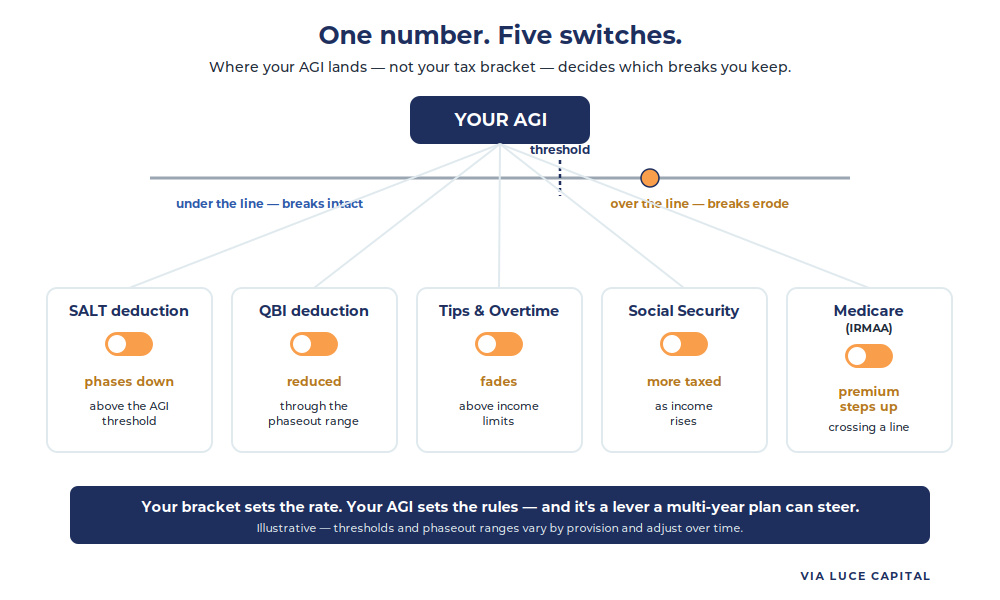
The 2025 tax law leaned hard on income-based phaseouts. A partial tour of what your AGI now governs:
• The SALT deduction. The cap on deducting state and local taxes was raised substantially — a real benefit in a high-tax state — but it phases down for higher earners above an AGI threshold. Land under the line and you capture the expanded deduction; drift over it and it erodes.
• The QBI deduction. The 20% deduction for pass-through business income phases out through defined income ranges. For many owners, whether AGI sits inside or outside those ranges is the difference between a full deduction and a reduced one.
• The new tips and overtime deductions. These come with their own AGI-based phaseouts. Above the threshold, the benefit fades.
• How much of your Social Security is taxed. The taxable share of your benefits rises with income — an AGI question, not a bracket one.
• Medicare premiums (IRMAA). Cross certain income lines and your Medicare Part B and D premiums step up, often two years later. It’s one of the purest AGI cliffs in the system.
None of these care about your marginal rate. They care about a number you have more control over than you might think.
Why this is a multi-year game
Here’s what makes AGI a planning problem rather than a filing problem: much of it is timing, and timing is a lever you control across years — but only if you act before December 31, not in April.
The same total income can produce very different tax outcomes depending on which year it lands in. Realizing a large capital gain, converting to a Roth, taking a business distribution, exercising equity awards, selling a property — each of these lands in AGI, and each can often be pulled forward or pushed back. Bunch too much into one year and you can spike AGI past several thresholds at once, losing deductions and triggering surcharges you’d have kept by spreading the income across two years.
By the time your CPA is preparing the return, the year is closed and the AGI is what it is. The planning window is the year itself.
What managing AGI actually looks like
You don’t control your income entirely, but you control more of its timing and character than most people use. A few of the levers:
• Timing income and gains. Choosing which year to realize a gain, take a distribution, or recognize other income — smoothing it to stay under key thresholds rather than spiking through them.
• Roth conversion sizing. Converting an amount that “fills up” a target band without pushing AGI across the next cliff.
• Deductions that reduce AGI. Pre-tax retirement contributions, HSA contributions, and certain business deductions lower AGI directly — which can be worth more than the deduction itself if it keeps you under a phaseout.
• Charitable timing. Tools like donor-advised funds and qualified charitable distributions can manage the income side in high years.
Each of these is situation-specific, and several interact — which is exactly why AGI planning works best when your advisor, CPA, and the actual numbers are in the same room before year-end.
What it means for you
If you’re a business owner or higher earner, the instinct to focus on your bracket is understandable but incomplete. The bracket sets the rate. AGI increasingly sets the rules — which breaks you get, how much of your Social Security is taxed, what your Medicare costs. And unlike your bracket, your AGI is something a multi-year plan can actually steer.
The bracket tells you the rate on your next dollar. AGI decides how many of your dollars qualify for the breaks in the first place.
The question worth bringing to your planning this year isn’t just “what bracket am I in?” It’s “where is my AGI landing — this year and next — and what does that cost or save me?”
Key takeaways
• Under the current law, a widening set of valuable breaks phase in or out based on AGI thresholds, not your marginal tax bracket.
• AGI now influences the SALT deduction, the QBI deduction, the new tips and overtime deductions, the taxable share of Social Security, and Medicare (IRMAA) premiums.
• Because much of AGI is a matter of timing, it’s a multi-year planning problem — decisions have to be made before December 31, not at filing.
• Levers include timing income and gains, sizing Roth conversions, using AGI-reducing contributions, and coordinating charitable giving.
Common questions about AGI and tax planning
What’s the difference between my tax bracket and my AGI?
Your bracket sets the rate on your next dollar of income. AGI is your total income minus certain adjustments — and it increasingly determines which deductions, credits, and surcharges you qualify for. Two people in the same bracket can have very different outcomes based on AGI.
Why does AGI matter more than it used to?
The 2025 tax law tied more valuable provisions to income-based phaseouts. So crossing an AGI threshold can cost you a deduction or trigger a surcharge even if your tax bracket doesn’t change.
How can I actually lower my AGI?
Common levers include pre-tax retirement and HSA contributions, timing when you realize income or gains, sizing Roth conversions carefully, and coordinating charitable giving. Which apply depends on your situation.
Is this only relevant for high earners?
It’s most impactful for business owners and higher earners near phaseout thresholds, but AGI also drives how much of your Social Security is taxed and your Medicare premiums — so it reaches well into retirement planning too.
Can’t my CPA just handle this at tax time?
By filing season, the year is closed and your AGI is set. The planning happens during the year, which is why coordinating with your advisor and CPA before year-end matters.
This article is for informational and educational purposes only and is not tax, legal, or financial-planning advice. Tax provisions, thresholds, and phaseout ranges are complex, subject to inflation adjustments, and apply differently to each taxpayer’s situation; the law may also change. Consult a qualified tax professional, your CPA, and your financial advisor before acting.
Brent Rupnow is a Registered Representative with, and Securities and advisory services are offered through LPL Financial (LPL), a registered investment advisor and broker-dealer (member FINRA/SIPC). Insurance products are offered through LPL or its licensed affiliates. Via Luce Capital is not registered as a broker-dealer or investment advisor. Registered representatives of LPL offer products and services using Via Luce Capital, and may also be employees of Via Luce Capital. These products and services are being offered through LPL or its affiliates, which are separate entities from, and not affiliates of Via Luce Capital.
Traditional IRA account owners have considerations to make before performing a Roth IRA conversion. These primarily include income tax consequences on the converted amount in the year of conversion, withdrawal limitations from a Roth IRA, and income limitations for future contributions to a Roth IRA. In addition, if you are required to take a required minimum distribution (RMD) in the year you convert, you must do so before converting to a Roth IRA.