You already know which organizations matter to you, and you were going to give anyway. The question arrives when an IRA distribution is also due: should the gift come from the checking account, or should part of the IRA go directly to charity?
That is not a contest between generosity strategies. It is a coordination question. A qualified charitable distribution can be useful when the donor, account, charity, transfer, timing, documentation, and tax reporting all qualify. If one piece does not fit, writing a check—or using another giving route—may remain the cleaner path.
Start with the charitable intention
Before selecting the account, confirm:
- the organization and intended purpose;
- the amount the household wants to give;
- whether the gift should happen now or over time;
- whether recognition, anonymity, or restrictions matter; and
- what records the organization can provide.
The financial tool should serve the charitable decision. It should not manufacture a gift merely because a tax rule exists.
Confirm that the donor and account are eligible
IRS Publication 590-B says an IRA owner must be at least age 70½ when the QCD is made. That age is separate from the age at which an RMD may begin. A household can therefore reach QCD eligibility before an RMD is required.
A QCD generally comes from an IRA. An ongoing SEP or SIMPLE IRA is not eligible under the general rule described in Publication 590-B. Employer plans follow different distribution rules, so do not assume that a charitable payment from a workplace retirement account will qualify as a QCD.
Ask the custodian and tax advisor to confirm the owner’s age on the transfer date, the account type, any IRA basis, and the current indexed annual limit before initiating the transaction.
The money must follow the QCD route
The IRA trustee generally must pay the eligible charity directly. Taking a taxable IRA distribution into a personal account and later writing a check is not the same transaction.
Custodians may process direct charitable transfers in different ways. Some send funds to the organization; some provide checks made payable to the organization. Confirm the custodian’s process, the charity’s legal name and address, any reference needed to identify the donor, and the year in which the payment is completed.
Start early enough to resolve rejected checks, address questions, or year-end processing delays. A charitable intention does not determine the tax year in which a distribution is completed.
Verify the recipient before directing the transfer
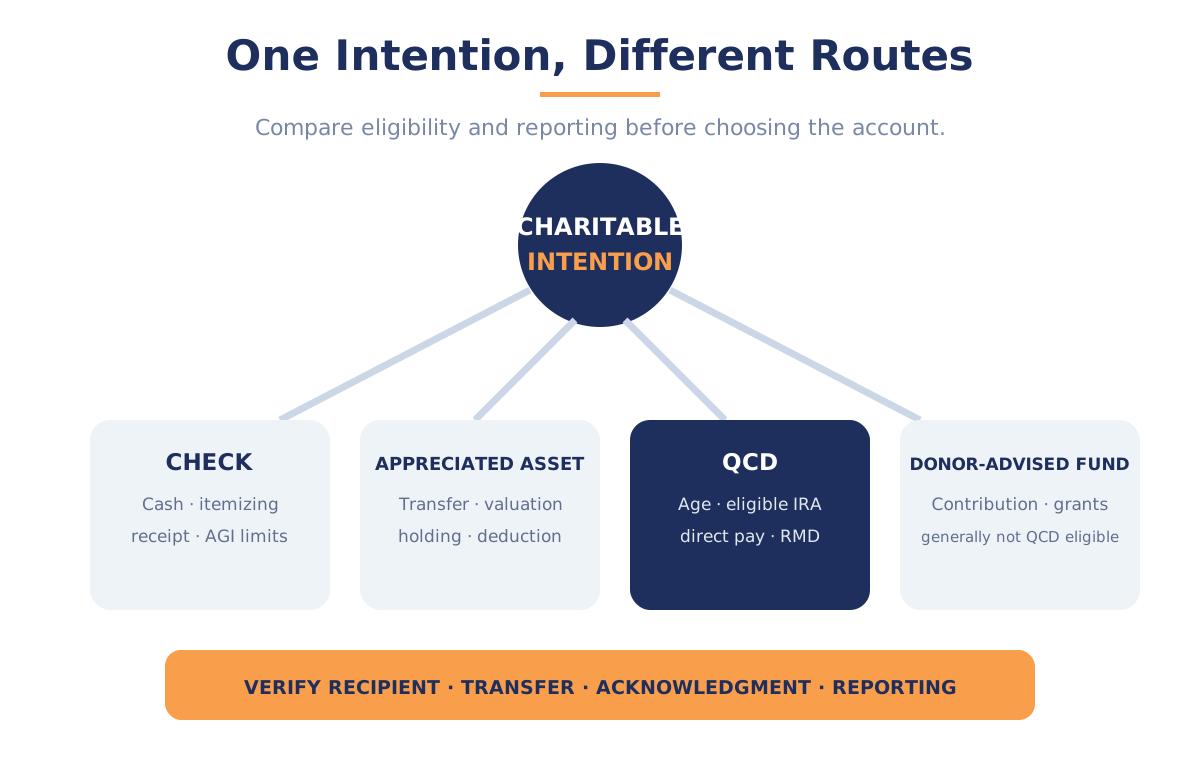
Not every charitable vehicle that can receive a personal gift can receive a QCD. Donor-advised funds and certain supporting organizations are generally excluded from QCD eligibility. Private foundations and split-interest arrangements require separate analysis; a limited one-time QCD election for certain split-interest entities follows specialized rules.
Use the IRS Tax Exempt Organization Search and confirm eligibility with the organization and tax advisor. The legal recipient matters. A familiar program name, fundraiser, or local chapter may not be the entity the IRA custodian should pay.
Understand why a QCD is different from a deduction
A qualifying QCD is generally excluded from income to the extent permitted by the rules. The same excluded amount is not also claimed as a charitable-contribution deduction.
A personal check follows the charitable-deduction rules instead. Whether that deduction changes the tax return depends on itemizing, adjusted-gross-income limits, other gifts, and the taxpayer’s full return. Our article on charitable bunching and the new floor explains why the timing and concentration of deductible gifts can matter under a different giving route.
The practical comparison is not “tax free” versus “deductible.” It is:
- which amount is included in income;
- whether a deduction is available and usable;
- how the gift interacts with an RMD;
- what happens to adjusted gross income; and
- which documentation and reporting path applies.
The CPA should compare the complete return rather than isolate one line.
Coordinate the QCD with the RMD
Publication 590-B states that a QCD can count toward an RMD. But the year’s distribution sequence still matters. A distribution already taken for personal use generally cannot be relabeled later as a QCD.
Before taking the first IRA distribution of the year, map:
- the expected RMD, if any;
- the intended charitable gifts;
- the account and recipient eligibility;
- any IRA basis or deductible IRA contributions that require additional analysis;
- the household’s cash-flow needs; and
- the custodian’s processing timeline.
That sequencing discussion is often more useful than waiting until December to ask whether a completed withdrawal can be changed.
Keep the acknowledgment and tax reporting connected
The charity should provide the same type of contemporaneous written acknowledgment needed for a charitable contribution, including the required statement about goods or services. Keep it with the custodian’s distribution record and evidence that the payment went directly to the eligible organization.
The IRA custodian may report the gross distribution without separately determining the taxpayer’s excludable QCD amount. The tax return must still identify and report the QCD correctly under the current Form 1040 instructions. Give the CPA:
- the Form 1099-R;
- the charity acknowledgment;
- the custodian confirmation;
- the date and amount of each transfer;
- the year’s other IRA distributions; and
- information about IRA basis and any relevant IRA contributions.
Do not rely on the charity receipt alone to produce the tax result.
Compare the available routes without forcing one winner
Writing a check can be simple and flexible. A QCD may coordinate an eligible IRA distribution with a charitable gift. Donating appreciated property may involve a different set of valuation, transfer, and deduction rules. A donor-advised fund can support grantmaking over time but generally cannot receive a QCD.
The best fit can change from one year to another. A retiree may use a QCD for recurring gifts, a separate asset for a larger campaign, and cash for an organization that is not an eligible QCD recipient. Each route needs its own eligibility and reporting review.
The charitable intention can stay constant even when the most workable giving route changes.
What to consider next
Create one charitable-giving schedule before the year’s IRA distributions begin. List the intended recipients, amounts, timing, eligible accounts, and documentation. Ask the CPA which comparisons matter for the current return, then confirm the mechanics with the custodian and each organization.
If a QCD appears to fit, verify the donor’s age, account type, recipient, direct-transfer instructions, current annual limit, RMD interaction, acknowledgment, and tax reporting before the transaction. If those pieces do not line up, use the analysis to choose another route rather than trying to retrofit the gift afterward.
Sources
- QCD eligibility age, eligible IRA, direct transfer, qualified recipient, annual exclusion, IRA basis, acknowledgment, and RMD interaction — Internal Revenue Service, Publication 590-B (2025), Distributions from Individual Retirement Arrangements
- Qualified charitable organizations, substantiation, and charitable-contribution deduction rules — Internal Revenue Service, Publication 526 (2025), Charitable Contributions
- Search tool for an organization’s federal tax-exempt status and eligibility to receive tax-deductible contributions — Internal Revenue Service, Tax Exempt Organization Search
- IRA distribution reporting and QCD identification on the individual income-tax return — Internal Revenue Service, Instructions for Form 1040 and Form 1040-SR (2025)