

A rule that reduces something by two thirty-sevenths sounds like a drafting accident. It is the opposite. The fraction was picked to produce a specific round number, and once you see which one, the rest of the provision explains itself.
For taxable years beginning after December 31, 2025, itemized deductions otherwise allowable are reduced by 2/37 of the lesser of two amounts — the deductions themselves, or the amount by which taxable income, computed without this limitation and with the deductions added back, exceeds the dollar figure where the 37 percent bracket begins.
Where the 35 cents comes from
Take a deduction and cut it by 2/37. What is left is 35/37 of the original.
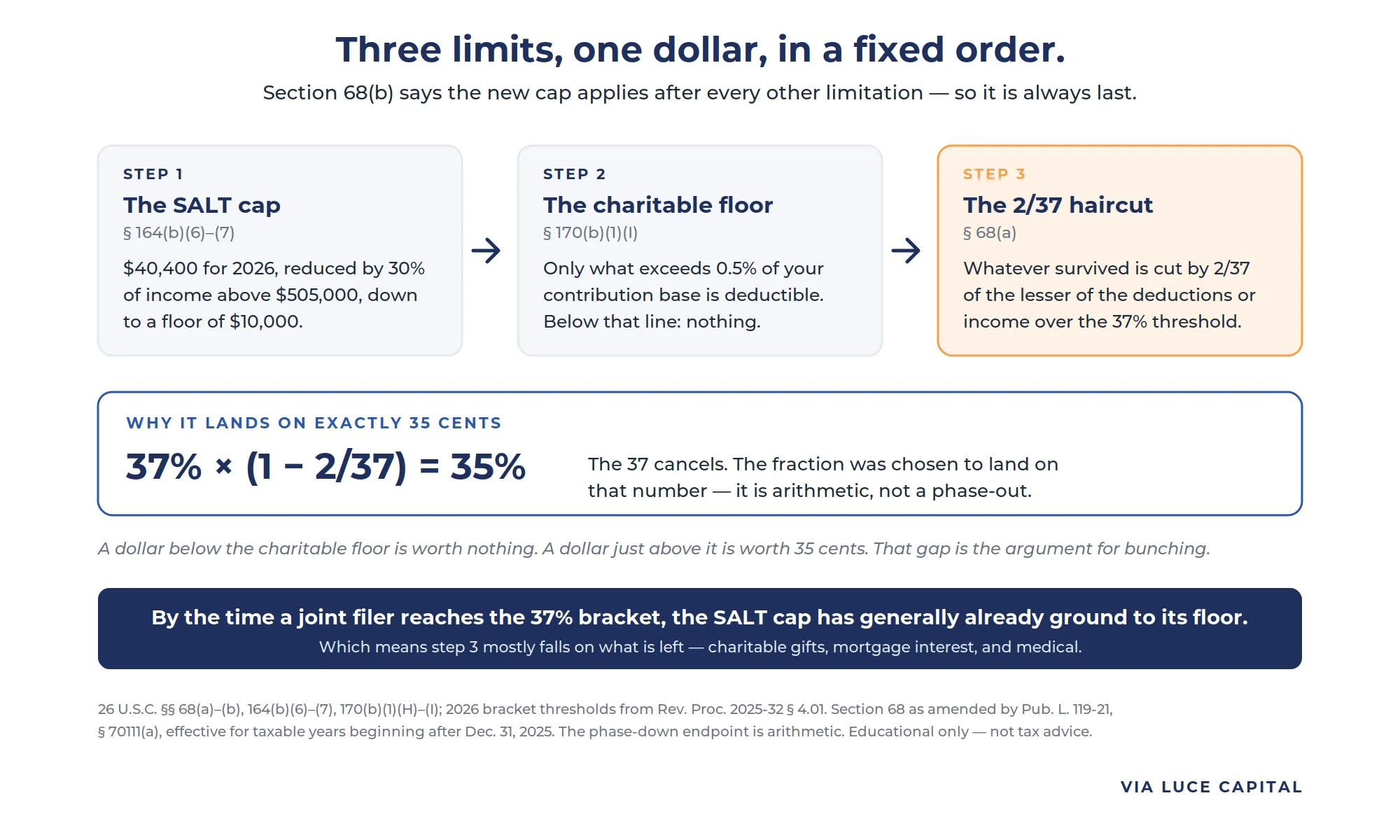
Now apply the top rate to what survived. Thirty-seven percent of 35/37 is exactly 35 percent — the 37 in the rate cancels the 37 in the fraction.
That is the whole design. The provision is not a phase-out and not a percentage haircut chosen for revenue reasons. It is a mechanism for making an itemized deduction worth exactly thirty-five cents on the dollar to someone in the 37 percent bracket, expressed in the only fraction that produces that result.
It is worth noting that the IRS describes the reduction in plain language as roughly 5.4 percent. That is 2/37 rounded. The statute controls, and the statute says 2/37.
Two things about it that catch people
It only reaches the top bracket. If taxable income — computed the way the statute prescribes, without the limitation and with itemized deductions added back — does not exceed the 37 percent threshold, the second prong is zero. Two thirty-sevenths of zero is nothing. For 2026 those thresholds sit above $768,700 for a joint return and above $640,600 for a single filer.
It has no exceptions. The old Pease limitation, suspended through 2025 and due to return in 2026, carved out medical expenses, investment interest, casualty losses and gambling losses. The section was rewritten instead of revived, and the replacement carves out nothing. Every itemized deduction is inside the base.
The order is fixed, and it is the part that matters
The statute is unusually direct about sequencing. Section 68 applies after any other limitation on the allowance of an itemized deduction, and it operates on deductions otherwise allowable — which means anything already eliminated by another rule never enters its base at all.
So the same dollar passes three gates in a set order.
First the SALT cap. For 2026 the limitation is $40,400, reduced by 30 percent of modified adjusted gross income above $505,000, and it cannot be pushed below $10,000.
Second the charitable floor. Contributions are deductible only to the extent they exceed 0.5 percent of the contribution base — adjusted gross income without a net operating loss carryback. Below that line, nothing.
Third, the 2/37 reduction on whatever survived.
Here is the consequence that gets missed. At a 30 percent reduction rate, the SALT limitation grinds from $40,400 to its $10,000 floor over roughly $101,000 of income — meaning it is fully ground down somewhere near $606,000 of modified adjusted gross income. That is below where the 37 percent bracket starts for a joint filer. So by the time a couple is deep enough in the 37 percent bracket for section 68 to bite, their SALT deduction has generally already collapsed to $10,000.
(That endpoint is arithmetic from the statutory rate and threshold, not a figure the statute prints.)
Which means the third limit mostly lands on what is left: charitable gifts, mortgage interest, and medical expenses.
What that does to charitable timing
The two-stage erosion is the sharpest practical point here.
A charitable dollar below the 0.5 percent floor is worth nothing — it never becomes an allowable deduction, so section 68 never sees it. A dollar just above the floor survives step two and then takes the 2/37 cut, leaving it worth 35 cents.
That gap between zero and thirty-five cents is the entire case for concentrating gifts into fewer, larger years. A floor absorbed once costs less than the same floor absorbed twice.
Consider a household that gives roughly the same amount every year and sits just around the floor each time. Split across two years, a meaningful share of the giving is absorbed by the floor twice. Combined into one year, the floor is cleared once and more of the gift becomes deductible — before the 2/37 reduction applies to what remains.
(Illustrative. Not a real client. Whether it works depends on the contribution base, the mix of deductions, and the years involved.)
One thing nobody can answer yet
Whether amounts disallowed by the 0.5 percent floor carry forward has no published answer. The statute does not address it directly and IRS Publication 526 is silent.
That is not a small gap for anyone planning around the floor, and it argues for building flexibility rather than a fixed multi-year schedule until guidance appears.
The pattern
The instinct with a new limitation is to ask how much it costs. The more useful question is where it sits in the sequence, because a rule that runs last operates on a number that two earlier rules have already changed.
A deduction is not worth its face amount. It is worth whatever survives the order of operations.
Most of what looks like tax complexity is really sequencing — the same inputs producing different answers depending on what happens first. The plan is the residue. The planning is the work.
Sources
- Itemized deductions otherwise allowable are reduced by 2/37 of the lesser of that amount of itemized deductions, or so much of taxable income — determined without regard to this section and increased by those deductions — as exceeds the dollar amount at which the 37 percent rate bracket begins — 26 U.S.C. § 68(a), as amended by Pub. L. No. 119-21, § 70111(a), 139 Stat. 72, 164 (2025), effective for taxable years beginning after December 31, 2025
- This section shall be applied after the application of any other limitation on the allowance of any itemized deduction — 26 U.S.C. § 68(b)
- 2026 rate tables, with the 37 percent bracket beginning above $768,700 for married taxpayers filing jointly and above $640,600 for unmarried individuals — IRS Revenue Procedure 2025-32, § 4.01, Tables 1 and 3
- The state and local tax deduction limitation, the applicable limitation amount of $40,400 for 2026, its reduction by 30 percent of the excess of modified adjusted gross income over $505,000, and the provision that the reduction shall not bring the limitation below $10,000 — 26 U.S.C. § 164(b)(6)–(7), as amended by Pub. L. No. 119-21, § 70120
- Charitable contributions are allowed only to the extent the aggregate exceeds 0.5 percent of the taxpayer's contribution base, which is adjusted gross income computed without regard to any net operating loss carryback — 26 U.S.C. § 170(b)(1)(H)–(I), as added by Pub. L. No. 119-21, § 70425
- The charitable contribution floor and the itemized deduction limitation take effect beginning in 2026 — Internal Revenue Service, Publication 505 (2026), What's New for 2026