

The retirement paperwork offers one clean instruction: roll the entire 401(k) into an IRA. Buried inside the account, however, are shares of the company that helped build the balance. Moving those shares may answer a tax question permanently before the household ever saw it.
Net unrealized appreciation—usually shortened to NUA—is a special tax framework for qualifying employer securities distributed from certain workplace plans. It is not a shortcut, and it is not automatically favorable. It is a reason to pause before treating every asset in the plan the same way.
Identify employer securities before signing the rollover form
Start with the statement and plan records. Confirm:
- the number and type of employer shares;
- the plan’s recorded cost basis;
- the current value and reported NUA;
- the rest of the plan balance and its asset types; and
- any prior distributions, rollovers, or plan events.
Do not reconstruct basis from memory or assume the current market value is the NUA. The plan administrator’s records and eventual Form 1099-R reporting matter. The IRS instructions use box 6 of Form 1099-R for net unrealized appreciation in employer securities.
Understand the tax distinction without turning it into a recommendation
Under a qualifying NUA transaction, the cost basis of distributed employer shares is generally included in ordinary income at distribution, while the plan-era appreciation is generally deferred until the shares are sold and then follows the applicable capital-gain framework. Appreciation after distribution follows separate holding-period rules.
That description can sound automatically attractive. It is not a conclusion. Compare current tax on basis, future tax on a sale, the amount of NUA relative to basis, California and federal treatment, planned sale timing, concentration risk, and the alternative of continued IRA tax deferral.
Tax rates are only one part of the analysis. A concentrated position held for tax reasons can create a different problem for the retirement plan.
Confirm whether the distribution can qualify
NUA treatment has specific statutory requirements. A qualifying lump-sum distribution generally involves the participant’s entire balance from the relevant plan within one taxable year following an eligible triggering event, subject to the governing rules and facts.
Potential triggering events and distribution requirements should be confirmed with the plan administrator and tax advisor. Prior distributions can matter. So can multiple plans of the same type maintained by the employer.
Create a dated checklist showing:
- the triggering event being relied upon;
- the plan or plans included;
- all assets to be distributed during the taxable year;
- the destination of employer shares;
- the destination of other plan assets; and
- the planned tax reporting.
Recognize what an IRA rollover changes
If employer shares are rolled into an IRA, they become IRA assets. The special NUA opportunity generally is no longer available for those shares later.
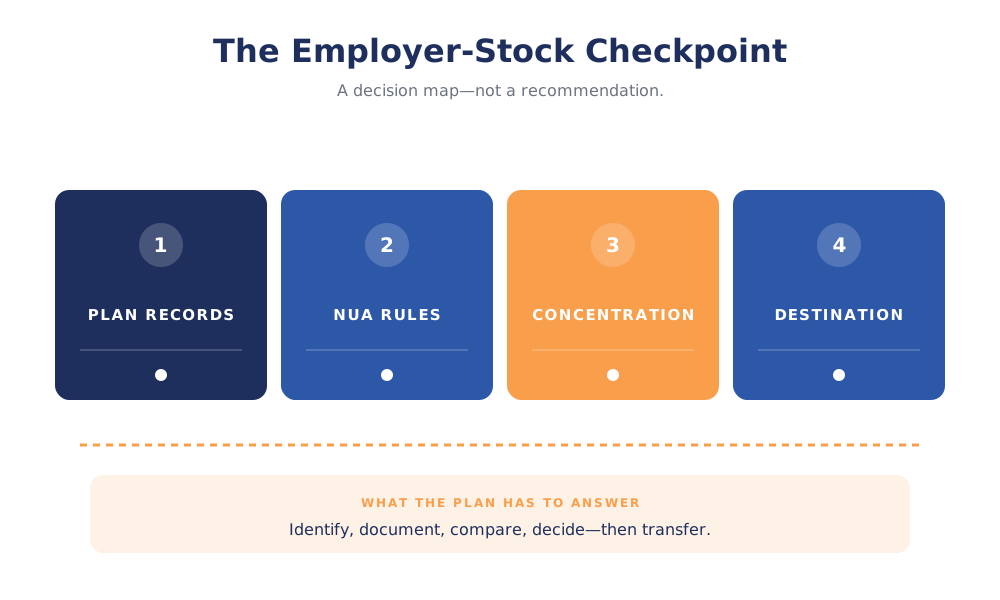
That does not mean the shares should be distributed in kind. It means the order matters: identify, document, compare, decide, then transfer. An automatic full rollover reverses that order.
Our related article, “I’m Retiring. Should I Leave My 401(k) Where It Is or Roll It Into an IRA?”, compares the broader plan-versus-IRA decision.
Keep concentration in the center of the decision
Employer stock can represent years of compensation and loyalty. It can also create a large exposure to one company as paychecks and benefits are ending.
Tax treatment cannot be evaluated apart from the amount of stock, liquidity needs, planned sales, other holdings, and the household’s tolerance for a decline. NUA is not a reason to keep shares indefinitely. It is one input in a larger investment and retirement decision.
Build one decision record
Put the alternatives on one page: keep assets in the plan, roll eligible non-stock assets, distribute employer shares under a qualifying NUA approach, or use another plan-permitted path. For each, record current tax, future tax, withholding, investment exposure, liquidity, administration, and estate considerations.
Have the plan administrator confirm mechanics and records. Have a qualified tax advisor verify the statutory and reporting treatment. Coordinate the investment and cash-flow consequences separately.
NUA is not a rollover strategy. It is a tax question that must be answered before the rollover removes it.
What to consider next
Gather the plan statement, summary plan description, employer-stock basis record, distribution history, and written rollover instructions. Ask the plan administrator for the information expected in Form 1099-R box 6 and whether the plan can process the contemplated destinations within the required period.
Do not direct a sale, distribution, or rollover until the written comparison has been reviewed by the appropriate tax, financial, and legal professionals.
Sources
- NUA in employer securities received as part of a qualifying lump-sum distribution is generally deferred until disposition; basis is generally taxed under ordinary-income rules — Internal Revenue Service, Publication 575, Pension and Annuity Income
- Form 1099-R box 6 reports net unrealized appreciation in employer securities — Internal Revenue Service, Instructions for Forms 1099-R and 5498
- Eligible rollover methods and withholding treatment — Internal Revenue Service, Rollovers of Retirement Plan and IRA Distributions
- Tax treatment and elections for lump-sum distributions — Internal Revenue Service, Instructions for Form 4972