The June 15 date passed, and someone discovered that the California PTE elective tax payment was late, short, or never designated correctly. The old conclusion arrives quickly: “Then the election is gone.” For 2026, that may be the wrong conclusion—but it is not the same as saying nothing changed.
California changed the rule for taxable years beginning on or after January 1, 2026 and before January 1, 2031. Under current Franchise Tax Board guidance, a qualified entity that misses the required June payment may still make a PTE elective tax election if the other requirements are met.
The owners’ credits may be lower.
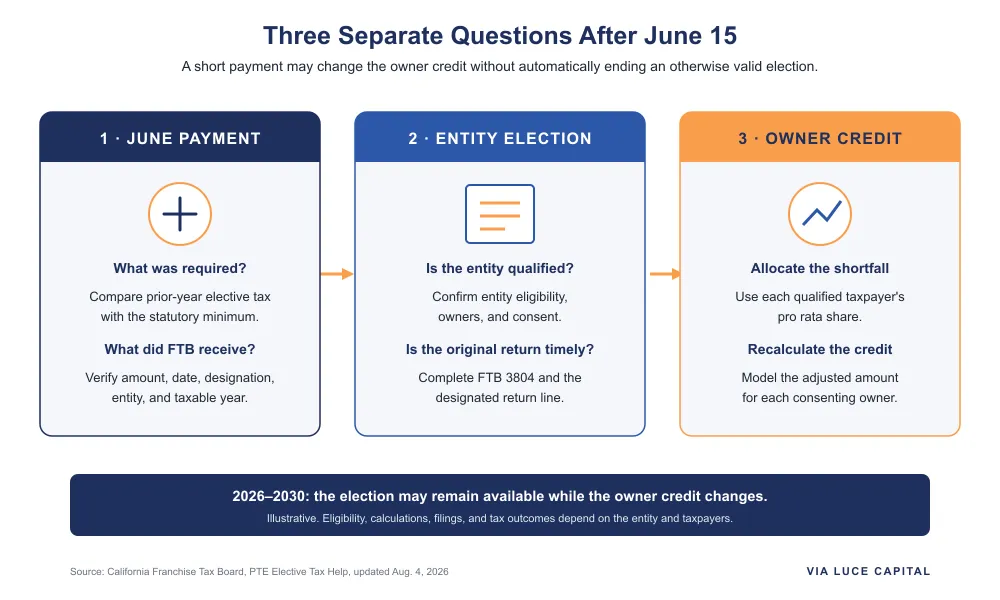
That makes this a three-part review rather than a yes-or-no answer. The entity needs to separate the June payment requirement, the return election, and the credit allocated to each qualified taxpayer.
The rule changed beginning with 2026 taxable years
For taxable years before 2026, a missed or short required June payment generally barred the entity from making the election for that year. Senate Bill 132 changed that result for taxable years beginning in 2026 through 2030.
FTB’s current guidance says an otherwise qualified entity may still make the election when the required June payment was missed or underpaid. The qualified amount of each consenting owner’s PTE elective tax credit is then reduced by 12.5% of that owner’s pro rata share of the amount that was due on June 15 but not paid.
That wording matters. It is not a flat 12.5% reduction of every owner’s entire credit. The formula begins with the unpaid required amount and allocates the relevant share to each qualified taxpayer. The entity’s CPA should calculate the result using the current FTB forms and the entity’s actual ownership and consent information.
First determine what was actually due and paid
FTB states that the June payment is the greater of:
- 50% of the PTE elective tax paid for the prior taxable year; or
- $1,000.
The entity’s records need to answer more than whether money left the bank. Confirm:
- the PTE elective tax actually paid for the prior year;
- the entity’s taxable year and whether June 15 fell within it;
- the amount, date, and method of the current-year payment;
- whether the payment was designated as a PTE payment for the correct entity and year; and
- whether any attempted correction occurred by the deadline.
FTB’s May 2026 reminder said payment errors had to be corrected by June 15 to meet the statutory payment requirement. A later payment may still relate to the entity’s remaining elective tax obligation, but it should not be assumed to erase the credit reduction tied to the June shortfall.
The election happens on the return, not through the June payment alone
The June payment and the election are connected, but they are separate acts.
FTB says a qualified entity makes the election on a timely filed original return by filing a completed FTB 3804 with the entity return and including the elective tax amount on the designated line. The election cannot be made on an amended return.
That means the missed payment does not remove the need to meet the remaining election requirements. The tax professional still needs to confirm that the entity is qualified, identify qualified taxpayers who consent, calculate qualified net income, complete the forms, report the elective tax, and file the original return on time.
Superseding-return rules can be technical. If a return has already been filed, the question is not simply whether another return can be sent. FTB distinguishes some superseding returns from amended returns based on when the original and replacement filings occurred. That fact pattern belongs with the entity’s CPA or tax counsel immediately.
The entity answer and the owner answer may differ
Even when the entity remains eligible to elect, the decision may not have the same value for every owner.
The credit belongs to qualified taxpayers who consent to include their share of qualified net income in the entity’s election. Owners can have different California filing positions, residency, other-state tax credits, PTE credit carryovers, and current-year cash needs. The credit reduction also follows each qualified taxpayer’s pro rata share of the unpaid required amount.
Before the return is filed, ask the CPA to show the analysis by owner:
- Who is eligible and who intends to consent?
- What qualified net income is included for each person or entity?
- What is each owner’s calculated credit before the shortfall adjustment?
- How is the unpaid June amount allocated under the FTB formula?
- What credit remains after the reduction?
- When would the owner expect to use the current credit or a carryover?
- How do other California and other-state tax items interact with the result?
This is where a firm-level label such as “we are still electing” can hide different household outcomes. The entity makes the election, but the owners need to understand their own credit and cash-flow consequences.
Keep this narrow question separate from the broader SALT plan
The PTE elective tax is often discussed as part of a federal state-and-local-tax deduction strategy. That broader context still matters, especially for California business owners navigating the current SALT cap and income phase-down described in our SALT cap article.
But the missed-payment review has a narrower job. It should establish whether the entity may still elect, quantify the owner-level credit reduction, and identify the return and payment steps that remain.
Do not let the broader tax narrative substitute for the current calculation. A PTE election may affect entity cash, owner estimates, deductions, basis, credit use, and coordination among owners. The relevant outcome depends on the entity and taxpayers, not on a general statement that PTE tax is helpful or unhelpful.
Avoid three quick conclusions
“The election is automatically gone.” For 2026–2030, current FTB guidance says a missed or short June payment does not by itself prohibit an otherwise qualified entity from electing.
“We can just catch up and receive the full credit.” FTB says payment errors must be corrected by the June deadline to meet the statutory payment requirement. The remaining elective tax and any penalty or interest questions still need professional handling, but a later payment should not be assumed to reverse the statutory credit adjustment.
“The haircut is 12.5% of the whole credit.” FTB describes a reduction based on each qualified taxpayer’s pro rata share of the unpaid amount that was due in June. The actual owner-level calculation matters.
The new rule may keep the election available. It does not make the missed payment irrelevant.
What to consider next
Ask the entity’s CPA for a one-page reconciliation with four sections: prior-year PTE elective tax paid, current June requirement, amount and designation actually received by FTB, and the remaining election timeline.
Then add an owner schedule showing consent, qualified net income, the preliminary credit, the share of the June shortfall, and the adjusted credit. If the original return has already been filed or is close to filing, flag that fact at the top because the valid-election requirement is time-sensitive and cannot be repaired through an ordinary amended return.
Finally, connect the entity schedule to each owner’s personal tax and liquidity plan. The entity’s decision may require cash before an owner receives or uses a credit, and the value of that credit can vary by taxpayer.
The immediate work is not to recreate the payment from memory. It is to document what was due, what FTB received, what election steps remain, and what the current statute does to each consenting owner’s credit.
Sources
- For taxable years beginning on or after January 1, 2026 and before January 1, 2031, SB 132 permits an otherwise qualified entity that missed the June 15 payment to make a PTE elective tax election; the qualified taxpayer's credit is reduced by 12.5% of that taxpayer's pro rata share of the unpaid required amount — California Franchise Tax Board, Help with Pass-Through Entity Elective Tax, updated August 4, 2026
- The June 15 payment is the greater of 50% of the prior year's elective tax paid or $1,000; a valid election is made on a timely filed original return with FTB 3804 and cannot be made on an amended return — California Franchise Tax Board, Help with Pass-Through Entity Elective Tax, updated August 4, 2026
- FTB's May 27, 2026 reminder stated that errors in the June 15 payment must be corrected by the deadline to meet the statutory payment requirement and a missed or short payment may produce a reduced credit under the new rule — California Franchise Tax Board, Pass-Through Entity Elective Tax June 15th Payment Approaching