What changed in 2026
For years, charitable giving had a simple tax story: if you itemized, you deducted what you gave. The One Big Beautiful Bill Act added three wrinkles, all effective with the 2026 tax year.
First, a floor. Itemizers can now only deduct charitable contributions to the extent they exceed 0.5% of adjusted gross income. The first half-percent of your AGI in giving is simply non-deductible. On a $400,000 income, that’s the first $2,000 of donations gone from your deduction — every year.
Second, a cap for top earners. For donors in the 37% bracket, the value of itemized deductions, charitable ones included, is now capped at 35 cents on the dollar rather than 37. A $100,000 gift that once cut taxes by $37,000 now cuts them by $35,000.
Third, a small break for non-itemizers. If you take the standard deduction, you can now also deduct up to $1,000 (single) or $2,000 (married) of cash gifts to qualifying charities — a modest but permanent benefit that didn’t exist before. It doesn’t apply to gifts made to donor-advised funds, though.
None of this is a reason to give less. It’s a reason to give deliberately.
Why bunching got more powerful
The floor changes the math in a way that rewards concentration. If you give roughly the same amount every year, you absorb that 0.5% haircut annually, and if your total giving plus other deductions doesn’t clear the standard deduction, you get no itemized benefit at all.
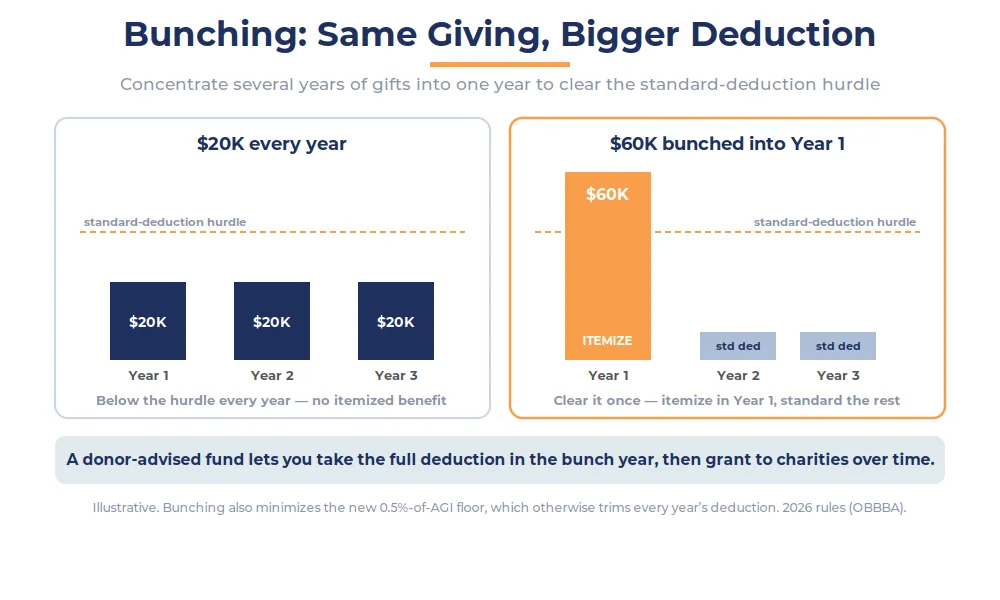
Bunching flips that. Instead of giving $20,000 a year for three years, you give $60,000 in one year and nothing the next two. In the bunch year, you sail past both the 0.5% floor and the standard-deduction threshold, itemize, and capture a real deduction. In the off years, you simply take the standard deduction. Same total given, far more deducted — because you only pay the floor’s toll once instead of three times, and you only need to clear the itemizing hurdle once.
The catch is logistical: most people don’t want to dump three years of giving on their favorite charity in a single January and leave it dry the next two. That’s where the donor-advised fund comes in.
Where the donor-advised fund fits
A donor-advised fund solves the timing problem. You contribute a lump sum in your bunch year — and take the full deduction that year — then recommend grants out to the charities you support on whatever schedule you like, over the following years. The charities still receive a steady stream; you get the concentrated deduction. The fund can also invest the balance while it waits to be granted.
It pairs especially well with one more move: funding the DAF with appreciated stock rather than cash. Donate a long-held position that’s gained value, and you generally skip the capital gains tax entirely and deduct the full market value. In California, where capital gains are taxed as ordinary income at rates up to 13.3%, sidestepping that gain is often worth more than the income-tax deduction itself. And notably, the new 35% cap doesn’t touch the capital-gains savings — that benefit is untouched.
The move for retirees: QCDs
If you’re 70½ or older, there’s a lever that sidesteps all of this. A qualified charitable distribution sends money directly from your IRA to a charity — up to $108,000 in 2025, a limit indexed annually for inflation — and it never lands in your income at all. Because it reduces your AGI rather than working as an itemized deduction, the QCD skips the 0.5% floor and the 35% cap completely. It can also count toward your required minimum distribution.
For a retiree who’s charitably inclined and taking RMDs, the QCD is frequently the single most tax-efficient way to give a dollar to charity under the new rules — more efficient than writing a check and deducting it. The one limitation: it has to go to an operating charity, not to a donor-advised fund.
The new rules don’t punish generosity. They reward the donor who gives the same amount with a plan instead of on autopilot.
Putting it together
The right approach depends on your situation, and the pieces combine. A working high earner might bunch several years of appreciated-stock gifts into a donor-advised fund in a high-income year — clearing the floor, beating the standard deduction, and dodging the capital gains tax all at once. A retiree might lean on QCDs to give straight from an IRA while keeping AGI down, which has the added benefit of easing Medicare surcharges and other income-driven costs. A couple who gives modestly and takes the standard deduction can simply use the new non-itemizer deduction.
What ties them together is intent. The 2026 rules added friction to casual, year-after-year giving and left the rewards for donors who plan the timing, the vehicle, and the asset. Map your giving against your income years with your CPA and advisor, and the same generosity does more — for the causes you care about and for your tax bill.
Sources
- 0.5% AGI floor on itemized charitable deductions (2026) — IRC §170(b)(1)(I), added by the One Big Beautiful Bill Act, P.L. 119-21 §70425
- 35% cap on the value of itemized deductions for top-bracket filers (2026) — IRC §68(b), as amended by the One Big Beautiful Bill Act, P.L. 119-21 §70111
- $1,000 (single) / $2,000 (married filing jointly) deduction for non-itemizers — IRC §170(p), added by the One Big Beautiful Bill Act, P.L. 119-21 §70424, effective for tax years beginning after December 31, 2025
- Qualified charitable distribution limit ($108,000 in 2025, indexed for inflation) — IRC §408(d)(8)(A), as amended by the SECURE 2.0 Act of 2022 §307; 2025 amount per IRS Publication 590-B
- QCD eligibility age 70½ — IRC §408(d)(8)(B)(ii); IRS Publication 590-B