

The question often begins with a house that no longer fits: too many stairs, too much upkeep, too far from family, or simply more space than the next chapter needs. Then comes the worry: “If we move, do we give up the property-tax value we have had for years?”
For an eligible California homeowner, Proposition 19 may allow the factored base-year value of an original primary residence to transfer to a replacement primary residence anywhere in the state. That possibility can matter to the ongoing cost of a move.
It does not make the move work by itself.
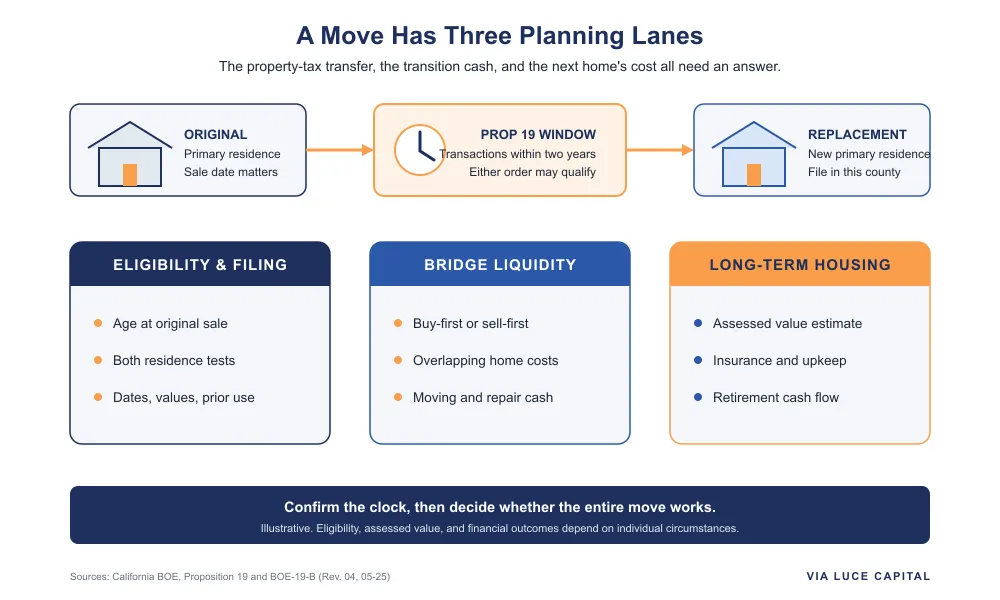
The planning question has two parts. First, do the age, residence, timing, value, and filing facts fit the current rule? Second, after the property-tax treatment is estimated, does the move still fit the household’s liquidity, housing budget, and retirement plan?
Start with five facts, not a tax estimate
The California State Board of Equalization identifies several conditions for the age-based transfer. In plain language, the starting questions are:
- Age at the original home’s sale. Was at least one claimant age 55 or older when the original primary residence was sold?
- Original residence status. Was the original California home owned and occupied as the claimant’s principal residence under the applicable exemption rules?
- Replacement residence status. Will the claimant own and occupy the replacement property as a principal residence when the claim is filed?
- Transaction timing. Was the replacement residence purchased or newly constructed within two years before or after the original residence was sold?
- Prior use of the benefit. Has the claimant already used a Prop 19 age- or disability-based transfer? Current BOE guidance permits up to three such transfers.
Those are screening questions, not a self-approval checklist. The assessor in the county of the replacement home reviews the claim and the supporting facts.
The current BOE-19-B posted online is marked as a sample. The BOE directs homeowners to obtain the actual form from the county assessor. That is a useful reason to contact the assessor early, especially if the properties are in different counties, the transaction includes co-owners, or construction is part of the replacement plan.
The order of the transactions changes the cash-flow story
Prop 19 allows the replacement home to be purchased before or after the original home is sold, as long as the qualifying transactions fall within the required two-year period. The two orders do not create the same planning problem.
Sell first, then buy. This may make the net proceeds available for the replacement purchase, but it can create a temporary housing need and pressure to find the next home before the household is ready.
Buy first, then sell. This may make the physical move easier, but it can require cash or interim financing before the original sale closes. BOE guidance also says the replacement home is generally taxed at full fair market value for the period before the original home is sold, without a refund for that interval.
That temporary tax treatment belongs in the bridge-liquidity estimate. So do two sets of housing costs, moving expenses, repairs, and the possibility that the original sale takes longer than expected.
“Equal or lesser value” depends on when the replacement is acquired
An eligible transfer is not limited to a less expensive replacement home. Current BOE guidance allows a replacement home of any value, but the transferred base-year value is adjusted when the replacement exceeds the applicable value test.
The BOE defines “equal or lesser value” by reference to the original home’s full cash value and the timing of the replacement:
- 100% when the replacement is purchased or completed before the original home is sold;
- 105% when it occurs within the first year after the sale; and
- 110% when it occurs within the second year after the sale.
When the replacement home’s full cash value is above the applicable threshold, the excess is added to the transferred factored base-year value. That means a more expensive home may still receive partial relief, but it does not simply inherit the original home’s taxable value unchanged.
Ask the assessor or a qualified property-tax professional to apply the rule to the actual dates and values. A listing price, an online estimate, and the assessor’s full cash value are not necessarily interchangeable.
The filing window is not the transaction window
The two-year period governs the relationship between the sale and replacement transaction. The current BOE-19-B instructions separately state that a claim filed within three years of the replacement purchase or completion of new construction generally receives relief from the qualifying transfer date.
A later filing may receive relief beginning with the calendar year in which the claim is filed. That is why “we can file later” is incomplete. A later claim may not produce the same historical treatment.
The BOE also says the claim is filed only after both transactions are complete and the claimant is living in the replacement home. It is not handled through escrow. Put the expected claim step on the closing calendar, but have the eligibility conversation before signing the transaction documents.
Model the move without the tax benefit first
Before making the Prop 19 estimate the reason to move, compare the household’s position both with and without the expected transfer.
Start with the net cash needed to complete the move:
- expected sale proceeds after debt, preparation, commissions, and closing costs;
- replacement purchase price and closing costs;
- repairs, accessibility work, furnishings, and moving expenses;
- cash needed if the purchase and sale do not close in the preferred order; and
- a reserve for taxes, insurance, maintenance, and surprises during the transition.
Then compare the ongoing housing costs. Property tax matters, but it sits beside insurance, association dues, utilities, maintenance, travel, and future repairs. A smaller home may cost more to insure or maintain than expected. A home near family may change transportation or caregiving costs in ways a property-tax calculation does not show.
Finally, place the net housing change into the retirement income plan. If the move requires a larger portfolio withdrawal, the timing and account source can create tax and investment tradeoffs. Our discussion of turning a portfolio into retirement income explains why a recurring withdrawal decision needs more context than a single percentage.
A transferable tax base may change the cost of the move. It does not answer where to live, how much cash to commit, or what the household wants the next home to make possible.
Use a coordinated sequence
A practical sequence keeps the tax rule connected to the larger decision:
- Ask the replacement county’s assessor to confirm the current form and process. Bring the likely sale and purchase dates, ownership, occupancy, and prior-transfer facts.
- Have the CPA and attorney identify tax and legal questions. Ownership, title, gain, basis, trust terms, and co-ownership can affect more than the Prop 19 claim.
- Ask the real-estate and lending professionals to map both transaction orders. Include timing ranges, cash needs, contingencies, and interim financing terms.
- Compare the long-term housing budgets. Use the expected assessed value as one line, then add the rest of the home’s recurring and irregular costs.
- Record the filing follow-through. After both transactions and occupancy are complete, confirm that the claim reached the correct county and retain the assessor’s response.
What to consider next
Create one page with the original home’s current tax bill, estimated sale value, debt, likely sale window, claimant ages, prior Prop 19 use, and two or three plausible replacement scenarios. For each replacement, list the price, county, likely purchase date, cash needed before the original sale, and annual housing costs beyond property tax.
Mark which facts came from documents and which are still estimates. Then take the same page to the assessor, CPA, attorney, and financial advisor. The assessor clarifies the property-tax process; the CPA and attorney address tax and ownership questions; the financial plan tests liquidity and the ongoing housing range.
The next home can be a lifestyle decision and a financial decision at the same time. The useful order is to confirm the clock, understand the claim, and then decide whether the move works even when the rest of the household balance sheet is included.
Sources
- Prop 19 base-year-value transfer rules for homeowners at least age 55, including the two-year replacement period, statewide portability, up to three transfers, and the 100%, 105%, and 110% equal-or-lesser-value tests — California State Board of Equalization, Proposition 19
- Current BOE-19-B instructions: both homes must meet principal-residence conditions, the claimant must be at least age 55 when the original home is sold, the claim goes to the replacement property's county assessor, and filing within 3 years generally provides relief from the qualifying transfer date — California State Board of Equalization, BOE-19-B, Rev. 04 (05-25)
- BOE-19-B is the current statewide form template; the BOE directs homeowners to obtain the actual form from the county assessor — California State Board of Equalization, Property Tax Forms for County Assessors