
For 40 years, the job was simple: one number, going up. The day you retire, the job inverts — and the instincts that built the wealth quietly start working against you.
The hardest problem in personal finance isn’t growing your money. It’s the part almost no one rehearses: turning a portfolio you spent a career building into a paycheck that aims to last as long as you do — without running out, and without living so cautiously you never enjoy it. That second job runs on entirely different rules than the first.
The rules quietly invert
While you were saving, market drops were a gift. A down year meant your contributions bought in cheaper, and time did the healing. In retirement, that same down year is dangerous — because now you’re selling, not buying. Pulling living expenses from a portfolio that’s fallen locks in the loss and leaves less behind to recover.
Two retirees can earn the identical average return over 30 years and end up worlds apart, purely from the order those returns arrived in. Bad years early do lasting damage; the same bad years late barely register. That’s sequence-of-returns risk, and it’s the single biggest reason accumulation math doesn’t carry into retirement.
Why a single number was never a plan
You’ve heard the 4% rule: withdraw 4% of your portfolio the first year, adjust for inflation after, and history says you won’t run out over 30 years. It’s a useful reference. It’s a poor operating system.
Even its creator has moved off it. Bill Bengen, who introduced the rule in 1994, revisited his own work in 2025 — his new worst-case “safe” figure is closer to 4.7%, and he points out the historical average was north of 7%. Meanwhile, forward-looking research from Morningstar, which models future returns instead of past ones, lands more cautiously, in the high-3% range. So the “right” number runs from under 4% to over 7% depending on whose model and which decade — which is exactly the point. A safe withdrawal rate isn’t a constant. It depends on what markets do in your first few years, what inflation does, how long you live, and what you want the money to accomplish. A number someone else used, in another era, tells you almost nothing about yours.
The two real enemies
Strip it down and retirement income faces two genuine threats — and neither is “the market will fall someday.” It will, and a sound plan expects that. The first is when it falls: a steep drop in the first few years, while you’re drawing income, is the scenario that breaks plans. The second is inflation. Bengen calls it the retiree’s greatest enemy, and he’s right — a sustained stretch of high inflation forces your withdrawals up year after year, draining a portfolio far faster than any single scary headline.
A plan that flexes
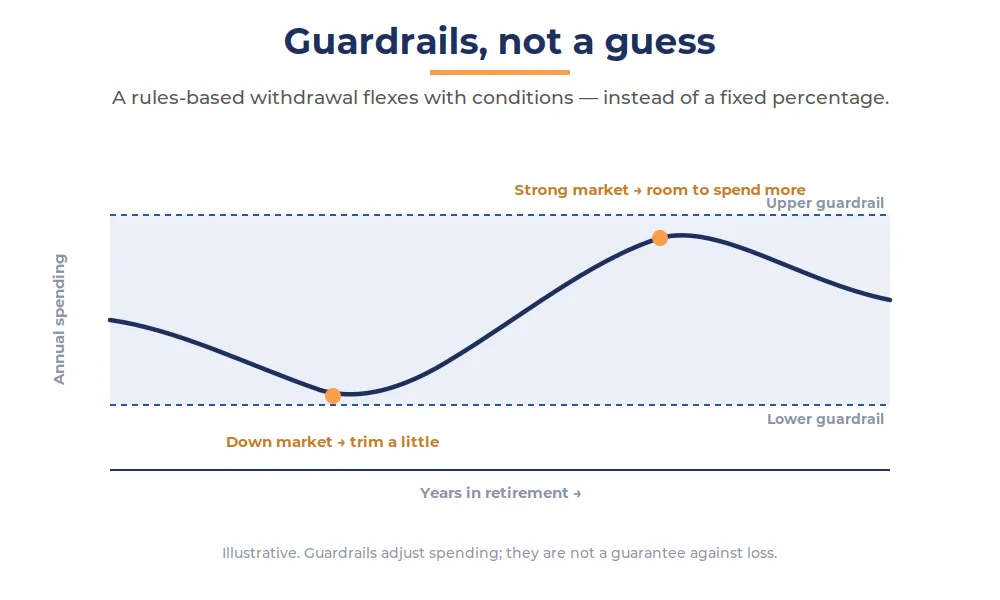
If the safe number isn’t fixed, the strategy shouldn’t be either. The approach that holds up is rules-based and dynamic: set guardrails around your spending, then adjust within them as conditions change. After a bad stretch, you trim a little — often just skipping an inflation raise. After a strong stretch, you give yourself room to spend more. The decisions are defined in advance, by rule, not improvised in the moment when emotion is highest.
That’s the same discipline that governs a well-run portfolio: regime-aware, rules-based, built with a goal to behave consistently across conditions rather than react to them. An income strategy deserves the same engineering — coordinated with the tax sequencing of which accounts to draw from, and when.
The risk no one warns you about
Here’s what gets lost in all the fear of running out: most disciplined savers have the opposite problem. They spend a lifetime building the habit of saving, can’t switch it off, and end up under-spending — dying with a large balance and a longer list of things they meant to do. Bengen’s own conclusion after rerunning the data was that many retirees are “cheating themselves.” A real income plan isn’t only safeguarding from ruin. It’s permission — the confidence to spend what you’ve earned, because the plan tells you that you can.
Where this leaves you
The portfolio’s hardest job starts the day the paychecks stop. It deserves more than a rule of thumb from 1994. The retirees who get this right don’t find a magic percentage — they run a process: a dynamic, rules-based income strategy, integrated with tax, that adapts as life and markets do.
The number that was safe for someone else, in another decade, tells you almost nothing about yours.
You spent a career turning a paycheck into a portfolio. Retirement is turning it back — and that’s the harder trick.
Sources
- The original 4% safe withdrawal rate — William P. Bengen, Determining Withdrawal Rates Using Historical Data, Journal of Financial Planning, October 1994
- Bengen's revised safe withdrawal rate of approximately 4.7% — William P. Bengen, A Richer Retirement (2025)