
Between the day someone stops working and the day Medicare starts, health coverage usually comes from the individual marketplace. For years, that stretch was also the best conversion window a household would ever get. In 2026 those two facts started pulling against each other.
A couple retires at 61. Income drops to whatever they draw from cash and a taxable account, which is not much. Their tax brackets have never been this low and will never be this low again, because required distributions and Social Security are still years away. This is the window — the one where filling the lower brackets with Roth conversions does the most work.
It is also the window where they buy their own health insurance, and where a premium tax credit is doing a lot of the paying.
Those are the same dollars. They always were. What changed in 2026 is how sharply the second one responds to the first.
Two changes landed in the same year
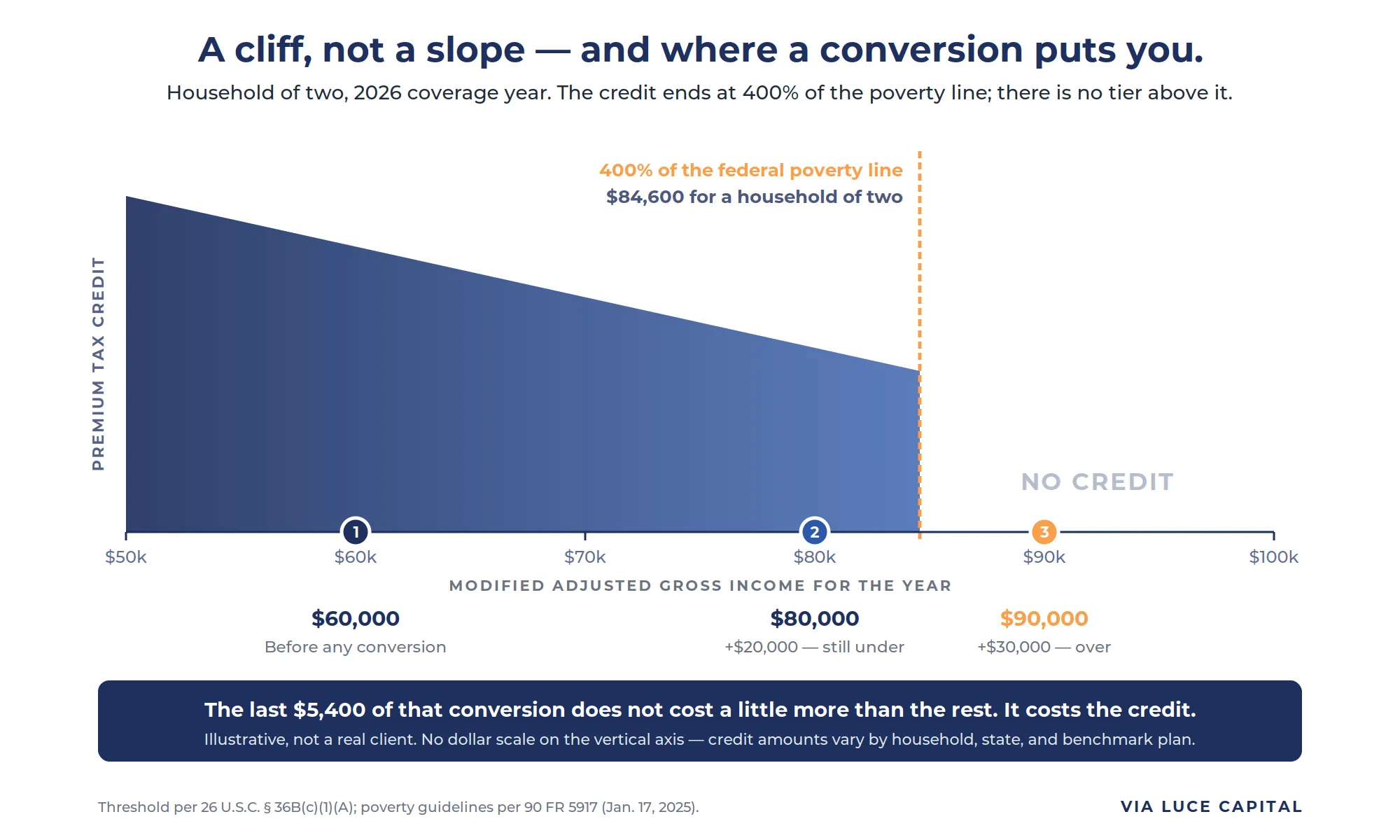
The first is a ceiling. To be an applicable taxpayer for the premium tax credit, household income has to be at least 100 percent and not more than 400 percent of the federal poverty line. That upper limit is visible in the structure of the 2026 applicable percentage table, which tops out at 9.96 percent in a tier defined as at least 300 percent but not more than 400 percent. Above the top of that tier there is no tier. There is no credit either.
The second is the repayment rule. Advance credits are paid to the insurer month by month based on an income estimate given during enrollment, then reconciled against actual income on the return. Through 2025, a household that ended up earning more than it estimated repaid the excess subject to a limitation — a table of graduated caps that kept a missed estimate from turning into a full clawback. That limitation was struck for taxable years beginning after December 31, 2025. Excess advance payments now increase the tax for the year by the full amount of the excess.
A cliff existed before. What has changed is that nothing catches you at the bottom of it.
The number being measured is broader than taxable income
Eligibility is measured against modified adjusted gross income, which starts at adjusted gross income and adds back three things: foreign earned income excluded under section 911, tax-exempt interest, and the portion of Social Security benefits not included in gross income.
Two of those catch people. Municipal bond interest does not show up in taxable income and does count here. So does the untaxed part of a Social Security benefit for anyone who claimed early. And because the base is adjusted gross income, everything above the line lands in it — the conversion, a realized capital gain, a distribution taken to cover a roof.
What 400 percent actually is
The figure moves, and a coverage year uses the guidelines published before its enrollment period rather than the ones published during the year. For the 2026 coverage year the 2025 guidelines apply — $15,650 for a household of one and $21,150 for a household of two — which puts the ceiling at $62,600 and $84,600. For the 2027 coverage year the 2026 guidelines apply, at $15,960 and $21,640, putting the ceiling at $63,840 and $86,560.
Take the couple at 61. Suppose their income for the year, before any conversion, is $60,000, and the ceiling for their household is $84,600. The distance between those two numbers — roughly $24,600 — is not conversion headroom in the usual sense. It is the width of a step. A $20,000 conversion sits inside it. A $30,000 conversion does not, and the second one does not cost incrementally more than the first. It costs the credit. All of it, for the whole year, repaid on the return.
It is not the same problem as IRMAA, and the difference is the calendar
Retirees who have been through Medicare’s income-related surcharge tend to assume this works the same way. It does not, in the one respect that matters for planning.
The Medicare surcharge runs on a two-year lookback. The income that sets a 2026 premium was earned in 2024 and reported on a return filed in 2025. By the time the premium arrives, the decision that caused it is two years cold. Planning around it means planning for the year after next.
The premium tax credit runs on the current year. The income that determines it is the income being earned right now, and it is settled on the return for that same year. The decision and the consequence sit inside one twelve-month box.
That makes it a harder problem to notice and an easier one to fix. Harder, because nothing arrives in the mail to warn you. Easier, because as long as the year is still open, the inputs are still yours.
What this changes in the planning, and what it does not
It does not take conversions off the table. The gap years are still the low-bracket years, and the arithmetic that made them attractive has not been repealed.
What it does is add a second term to the comparison. A conversion in these years now has to be weighed against a credit that may be reduced or lost in the same year, and the answer is not uniform — it depends on household size, the benchmark plan where they live, how far under the ceiling they already are, and how many years remain before Medicare takes the question away entirely.
A few things follow from that:
- The comparison is annual, not permanent. A household might convert aggressively in one year, stay well under the ceiling the next, and convert again the year after. Treating the window as a single decision misses most of the available room.
- Coverage costs belong in the conversion model. A model that stops at federal and state income tax is answering a narrower question than the one being asked.
- Income estimates can be revised mid-year. A household whose income is running ahead of what it told the marketplace in November is not stuck with that estimate.
- The professionals have to be in the same conversation. The CPA running the projection and whoever is sizing the conversion are working on one problem, not two.
The pattern
The conversion was never the decision. The decision is which year the income lands in, and that has always depended on everything else happening in the same year — brackets, surcharges, deductions, and now the cost of a health insurance policy that a household has to buy for itself until 65.
A cliff you can see is a planning problem. A cliff you find out about in April is an outcome.
None of this is exotic. It is the ordinary work of looking at a full year before it closes rather than after. The plan is the residue. The planning is the work.
Sources
- Eligibility for the premium tax credit requires household income at or above 100 percent but not exceeding 400 percent of the federal poverty line — 26 U.S.C. § 36B(c)(1)(A)
- Modified adjusted gross income is adjusted gross income increased by income excluded under section 911, tax-exempt interest, and the portion of Social Security benefits not included in gross income — 26 U.S.C. § 36B(d)(2)(B)
- Excess advance payments increase the tax imposed for the taxable year by the amount of the excess, with no income-based limitation; the former subparagraph (B) limitation was struck for taxable years beginning after December 31, 2025 — 26 U.S.C. § 36B(f)(2), as amended by Pub. L. 119-21, § 71305(a), (b)(1)
- Applicable percentage table for taxable years beginning in 2026, ranging from 2.10 percent to 9.96 percent, with the highest tier defined as at least 300 percent but not more than 400 percent of the federal poverty line — IRS Revenue Procedure 2025-25, § 3.01
- Applicable percentage table for taxable years beginning in 2027, ranging from 2.15 percent to 10.22 percent — IRS Revenue Procedure 2026-26, § 3.01
- 2025 federal poverty guidelines for the 48 contiguous states and the District of Columbia — $15,650 for a household of one and $21,150 for a household of two — U.S. Department of Health and Human Services, Annual Update of the HHS Poverty Guidelines, 90 FR 5917 (January 17, 2025)
- 2026 federal poverty guidelines for the 48 contiguous states and the District of Columbia — $15,960 for a household of one and $21,640 for a household of two — U.S. Department of Health and Human Services, Office of the Assistant Secretary for Planning and Evaluation, 2026 Poverty Guidelines