

An annuity may have a role in funding a specific retirement income need during uncertain markets. Its usefulness depends on the contract and the household. A payment obligation, an investment account value, and a credited interest formula are different features. None should be evaluated without the associated costs, restrictions, and risks.
A volatile week can make a contractual payment sound appealing. The longer-term question is whether the arrangement fits the household after that week has passed. A decision that commits capital for years should be evaluated against years of income, access, inflation, and survivor needs.
Begin by stating the problem precisely. Is the concern a recurring spending gap, possible longevity, a fluctuating account balance, or money needed for an upcoming expense? An annuity may address some of these concerns under specific terms. It is not a universal substitute for the rest of the financial plan.
Define the income question before requesting a quote
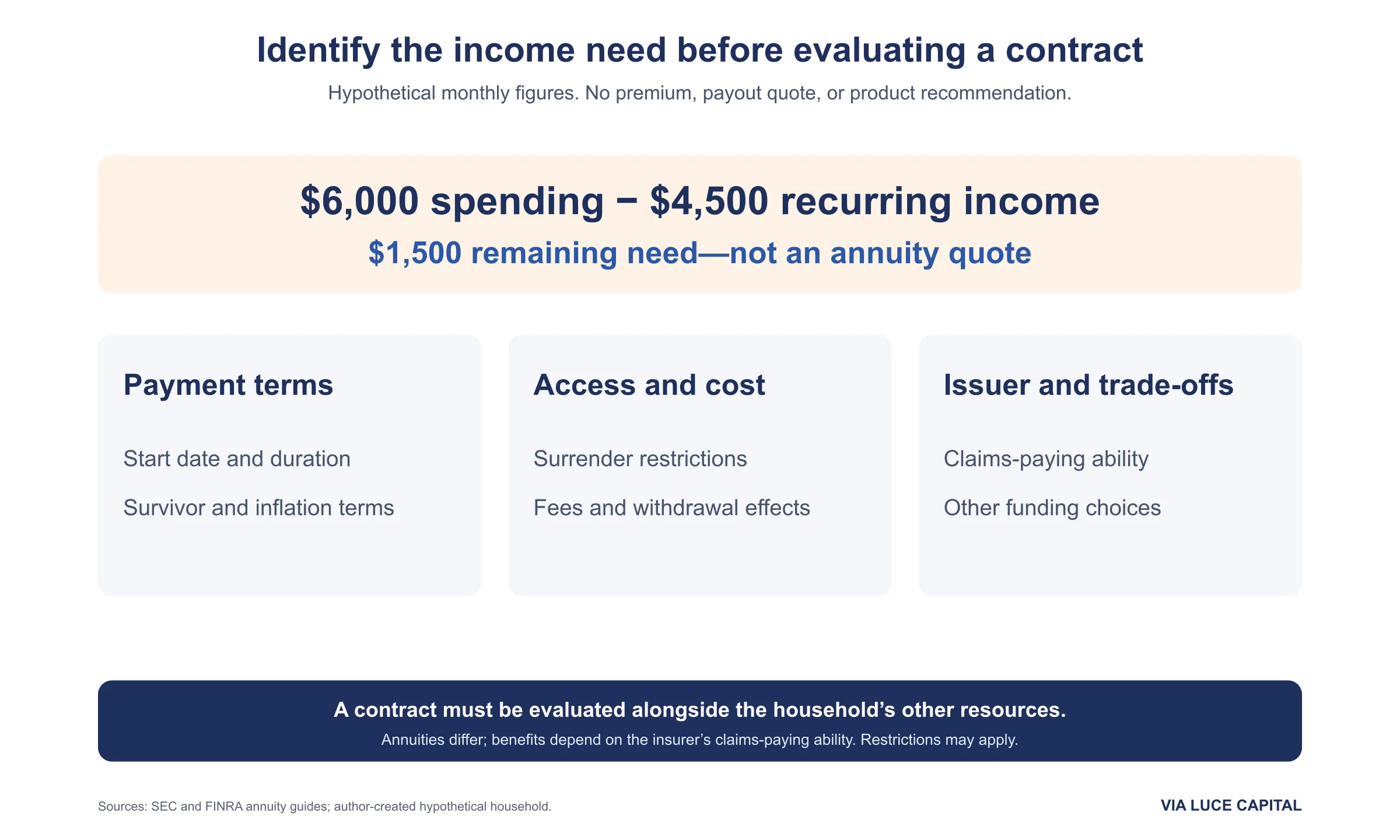
Hypothetical illustration, not a real client or an annuity quote: A household identifies $6,000 of essential monthly spending and $4,500 of spendable recurring income. Assume spending includes taxes not already withheld. The identified gap is $1,500 per month.
That arithmetic defines a question. It does not establish that the household should buy an annuity, what premium would be required, or what payment any insurer would offer. Those answers require actual terms and a broader review of assets, ages, health considerations, preferences, and other resources.
Also list the expenses that do not fit a monthly payment pattern. A major home repair, family commitment, or medical expense may require access to capital. Before allocating money to a contract, identify how those needs would be handled and what remains accessible elsewhere.
Know which type of risk the contract carries
An annuity is an insurance contract. A fixed annuity generally credits interest under insurer-set terms. A fixed indexed annuity uses a formula linked to an index, often with limits on the interest credited. It does not directly own the index for the contract owner, and its terms differ from owning an index investment.
A registered index-linked annuity can experience losses under its specified provisions. A variable annuity’s investment options can also decline. A feature limiting certain losses over a stated term should not be interpreted as a general promise about every withdrawal date or every source of loss.
Even a fixed indexed contract with a zero floor on an index credit can have charges or surrender effects that reduce accessible value. Review the actual formula, term dates, withdrawal treatment, and renewal provisions. The product category is the beginning of the comparison, not a substitute for reading the contract.
Separate income from accessible account value
Annuitization generally exchanges contract value for a selected stream of payments and is often irrevocable. The payment form determines whose life is covered, how long payments continue, and what happens after death. Access to the original capital may be substantially limited or unavailable.
An income rider uses different mechanics. It may allow contractual withdrawals without annuitization, subject to charges and conditions. An illustrated income benefit base may be used to calculate payments while having no equivalent cash withdrawal value. Ask for the contract value and cash surrender value separately.
A payment percentage is not an investment return. Payments may include a return of principal, and insurance features affect their calculation. Comparing that percentage directly with a bond yield or portfolio return can therefore be misleading. The annuity income article explains the payment choices in more detail.
Read what can change the payment
Ask whether payments are fixed, variable, or conditional. Identify the start date and what happens after an excess withdrawal, a change in covered lives, or failure to meet a rider requirement. The effect on future income can be more important than the immediate amount withdrawn.
Compare single-life and survivor provisions using the household’s needs after either spouse dies. A larger initial payment may provide less continuation. A fixed payment also loses purchasing power when prices rise; an adjustment feature can change the starting amount or involve additional conditions.
Request explanations in writing. A useful comparison records the payment obligation, the value that remains accessible, the survivor outcome, the relevant costs, and the actions that can alter benefits. An attractive headline number cannot communicate all of those relationships.
Keep insurer obligations and liquidity visible
Contractual benefits depend on the issuing insurance company’s claims-paying ability and the contract terms. An annuity is not an FDIC-insured bank deposit, even if sold through a bank. Review the insurer and the obligation being relied upon rather than treating the contract label as a measure of financial strength.
Surrender charges, market value adjustments, and rider charges may affect withdrawals or value. Variable contracts can have additional insurance and investment expenses. Ask how the professional is compensated and which costs are embedded in the terms rather than shown as a separate fee.
If replacing an existing contract is proposed, compare benefits being surrendered, new restrictions, and any restarted surrender period. A newer contract or a different advertised rate does not by itself establish an improvement. Existing benefits may be valuable even if they are less visible in a sales comparison.
Coordinate taxes and the remaining investments
Tax treatment depends on how the contract was funded and how distributions occur. Taxable gains generally receive ordinary-income treatment. Withdrawals before age 59½ can also incur an additional federal tax, subject to exceptions. The tax adviser should review the actual facts rather than assume every payment is entirely taxable or entirely tax-free.
An IRA already provides tax deferral; an annuity inside it does not add another layer of that benefit. Its insurance features, costs, and restrictions need an independent rationale. Required distributions and other account obligations also belong in the review.
Finally, evaluate what remains outside the contract. How will discretionary spending, emergencies, inflation, and longer-term goals be funded? Changing the source of some income changes the household’s overall structure. It does not eliminate the need to review the risks and purpose of the remaining investments.
Compare responsibilities before signing
Compare the proposed arrangement with the option of keeping assets accessible and funding the same need through planned withdrawals or other available income. The alternatives carry different responsibilities, including investment decisions, spending discipline, and the possibility of living longer than expected. Neither set of responsibilities disappears because one choice has a more appealing initial payment.
Before signing, be able to explain the contract in plain language: what is paid, when it begins, what can be withdrawn, what ends at death, and what could change the result. If those answers are unclear, the comparison is not yet complete.
Sources
- Annuities are long-term insurance contracts with different immediate/deferred and accumulation features; payment obligations depend on insurer financial strength and claims-paying ability. — U.S. Securities and Exchange Commission, Annuities; reviewed October 17, 2026.
- Indexed contracts differ in crediting methods, caps, participation rates, loss provisions, term dates, and withdrawal effects; RILAs may lose money. — U.S. Securities and Exchange Commission, Updated Investor Bulletin: Indexed Annuities; reviewed October 17, 2026.
- Variable annuities carry investment risk and fees; insurance features require review, and an IRA already provides tax deferral. — U.S. Securities and Exchange Commission, Variable Annuities; reviewed October 17, 2026.
- Annuitization differs from withdrawal riders; payment choices, contract replacement, surrender charges, compensation, and liquidity affect suitability. — FINRA, Annuities; reviewed October 17, 2026.
- California consumer guidance addresses payment forms, surrender costs, and evaluating the actual contract and insurer. — California Department of Insurance, Annuities: What Seniors Need to Know; reviewed October 17, 2026.
- Tax treatment depends on contract funding and distribution form; taxable early distributions can incur additional tax, subject to exceptions. — Internal Revenue Service, Publication 575; reviewed October 17, 2026.
- Annuities are not FDIC-insured bank deposits, even when sold through a bank. — Federal Deposit Insurance Corporation, Deposit Insurance FAQs; reviewed October 17, 2026.
- Hypothetical income-gap arithmetic: $6,000 of monthly essential spending minus $4,500 of spendable recurring income leaves $1,500. No annuity quote or funding recommendation is implied. — Via Luce Capital, author-created household illustration; reviewed October 17, 2026.