

Before treating a Roth balance as next year’s spending money, identify which dollars a withdrawal would reach and which rules apply to them.
The conversion has been completed. The income tax has been accounted for. Months later, a retirement expense arrives, and the Roth looks like a possible source of cash.
That raises a different question from whether the conversion made sense: what happens if money leaves the Roth now?
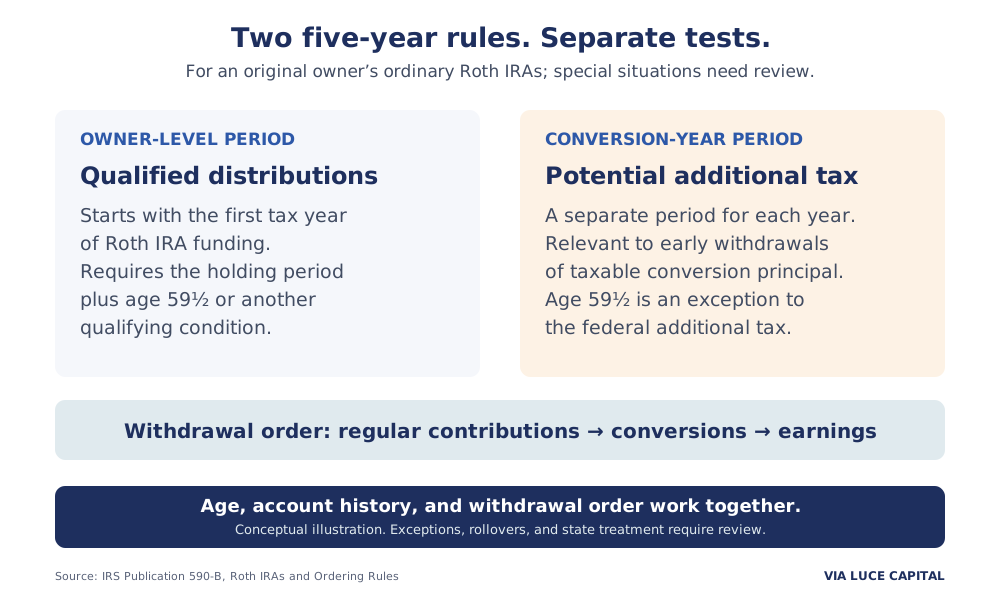
The familiar instruction to “wait five years” is incomplete. Roth IRAs have two distinct five-year rules, and withdrawal ordering determines which part of the account is treated as distributed. An owner over age 59½ may have a different answer from an early retiree, even when they converted on the same date.
This discussion concerns an original owner’s ordinary Roth IRAs. Inherited accounts, employer plans, and special distributions require their own review.
First identify what the balance contains
A Roth IRA statement shows a total market value. Tax records divide its history into regular contributions, conversion or rollover contributions, and earnings. Those categories matter when a withdrawal is not a qualified distribution.
Under the IRS ordering rules, regular contributions generally come out first. Conversions and rollovers follow in order by year, with the taxable portion of a year’s conversion coming before its nontaxable portion. Earnings come last. The owner’s Roth IRAs are generally considered together for these purposes. IRS Publication 590-B
You cannot select the tax character of a withdrawal simply by pointing to one investment or one Roth account. Likewise, an old Roth account does not prove that enough regular contributions remain to cover a proposed withdrawal. Prior distributions may already have used them.
The practical starting point is a history of money going in and out, not just today’s account balance.
The first clock concerns qualified distributions
A qualified Roth IRA distribution is generally tax-free. It requires a five-tax-year period beginning with the first tax year for which a contribution was made to a Roth IRA for your benefit, plus a qualifying condition. For retirement planning, the most familiar condition is reaching age 59½. Other statutory conditions exist, with their own requirements.
Opening an empty account does not start the period. A qualifying contribution or conversion establishes the relevant history. Once that owner-level period has begun, opening another Roth IRA generally does not restart it.
Reaching age 59½ answers the age question. It does not independently satisfy the holding-period question. If the period is still incomplete and a withdrawal reaches earnings, those earnings may be taxable even though the age exception removes the federal early-distribution tax.
That distinction is relevant for someone who opens and funds a first Roth IRA after retiring. The account may have a retirement purpose from the beginning, but its tax history begins with actual funding. IRS qualified-distribution requirements
The second clock concerns converted principal
Each conversion has a separate five-tax-year period for potential early-distribution tax treatment. If a withdrawal reaches the part of a conversion that was taxable when converted, taking it within that period may trigger the federal 10% additional tax unless an exception applies.
This does not mean the converted principal becomes ordinary income a second time. It is a separate additional-tax question attached to an early distribution. Earnings remain a different category.
Age 59½ is an exception to that additional tax. An owner who has reached that age generally does not need to wait out each conversion’s separate period to avoid this particular federal tax. The owner-level qualified-distribution rule still matters if a withdrawal reaches earnings.
For someone retiring earlier, the separate conversion years deserve careful records. An older Roth IRA does not automatically make every recent taxable conversion available without additional tax. IRS conversion-distribution rules and exceptions
Put the rules on an actual calendar
Illustrative timing example, not a real client: Assume an owner age 62 makes a first-ever Roth IRA conversion in November 2026 and has no earlier Roth IRA contribution history.
The qualified-distribution period starts January 1, 2026. Its five tax years are 2026 through 2030. January 1, 2031 is the first date after that period. The age requirement is already satisfied, but the holding period remains relevant until then.
If that owner takes a distribution before 2031 that reaches previously taxed conversion principal, that principal generally is not included in income again. The age exception applies to the federal 10% additional tax. If the withdrawal reaches earnings while the qualified-distribution period remains incomplete, those earnings may be taxable.
An owner with a Roth IRA funded many years earlier would start with a different first-clock answer. An owner below age 59½ would also need to examine the separate conversion periods and any applicable exception. The illustration supplies a calendar, not a recommendation to withdraw.
Match the withdrawal rules to the spending need
An early retirement plan may contemplate converting amounts in successive years and using them later. Before relying on that sequence, map the actual funding available for the years before each planned withdrawal. Include the cash used to pay conversion tax as well as ordinary spending.
Separate intended living expenses from possible one-time needs: a home project, support for a family member, or a business obligation. If those needs arrive sooner than expected, another source of cash may be necessary or a Roth withdrawal may have costs not included in the original plan.
Ask what would happen if the household had to spend earlier. The account’s legal withdrawal treatment and the investment’s current value are different issues. Waiting out a tax period does not determine whether an investment has gained or lost value, or whether selling it fits the spending plan.
For the broader cash-flow framework, see the first five years of retirement withdrawals. The Roth decision belongs inside that schedule of income, expenses, and account access.
Assemble the records before requesting cash
Gather evidence of the first Roth IRA funding year, regular contributions, previous withdrawals, and each year’s conversions. Retain the taxable and nontaxable portions of conversions, along with Forms 8606 and 5498. Current custodians may not hold all records from accounts opened or transferred elsewhere.
Check employer-plan history separately. A Roth 401(k) is a designated Roth account, not a Roth IRA. Years in the employer plan do not automatically carry over to the Roth IRA qualified-distribution period after a rollover. An existing Roth IRA’s earlier funding history may matter. IRS designated Roth account FAQs
California generally follows federal Roth IRA treatment, but basis differences and certain historical transactions merit review. Confirm the state result with the tax professional along with the federal one. FTB Publication 1005
Bring the proposed amount and withdrawal date to that review. Ask which category of money the distribution reaches, whether it is qualified, what additional-tax exception applies if needed, and which forms document the result.
The next decision may be to use the Roth, choose another account, change the amount, or defer the expense. What matters is that the spending decision follows the account history and the household plan.
Sources
- A qualified Roth IRA distribution requires the five-tax-year holding period and a qualifying condition such as age 59 1/2; a separate five-year period applies to each conversion for potential 10% early-distribution recapture; age 59 1/2 is an exception to that additional tax — IRS Publication 590-B, Roth IRAs: Qualified Distributions and Additional Tax on Early Distributions
- For nonqualified Roth IRA distributions, regular contributions come first, then conversion and rollover contributions by year with taxable portions first, then earnings; the owner's Roth IRAs are aggregated — IRS Publication 590-B, Ordering Rules for Distributions and Aggregation Rules
- Conversion methods and taxable income; direct Roth IRA contributions and conversions have different rules; conversions made in 2018 or later cannot be recharacterized — IRS Publication 590-A, Roth IRAs and Conversions
- Form 8606 records conversions and calculates taxable amounts for applicable Roth IRA distributions — IRS Instructions for Form 8606, Parts II and III
- A rollover from a designated Roth employer-plan account to a Roth IRA uses the Roth IRA qualified-distribution holding-period rules rather than automatically carrying over the plan's period — IRS Retirement Plans FAQs on Designated Roth Accounts, Rollovers
- California generally conforms to federal Roth IRA rules; basis and specified historical conversion differences may require separate review — California FTB Publication 1005, Roth IRAs
- Illustrative calendar arithmetic: a first Roth IRA conversion in 2026 starts the qualifying-distribution period January 1, 2026; five tax years are 2026 through 2030, making January 1, 2031 the first date after that period. The assumed owner is 62. This is not a client example or a return projection — Author-created hypothetical timeline applying the IRS Publication 590-B five-tax-year rule