

During market volatility, a retiree needs to know which dollars will fund upcoming expenses. A withdrawal calendar connects spending, recurring income, accessible assets, and replenishment decisions. It complements the investment process, but it does not make the portfolio immune to losses or establish how long retirement savings will last.
An account balance is a snapshot. A property-tax installment, insurance renewal, or scheduled transfer to checking has a date. The practical problem is connecting the two without requiring every spending decision to become a fresh opinion about the stock market.
That connection deserves attention even when a headline index looks calm. Different assets may be having different experiences, and the household may need cash before the next investment review. A spending plan should identify those needs rather than assume a favorable market will arrive at the right time.
Start with the amount investments must supply
List recurring spending and the income already available to meet it. Use matching conventions: either compare gross income with a budget that includes all taxes, or compare spendable income with spending that includes taxes not already withheld. Mixing those approaches can create a misleading gap.
Then separate irregular expenses. For an Orange County household, property costs, insurance, home repairs, travel, and help for family members can arrive unevenly. An annual average may be useful for planning, but the checking account still needs the money when the payment is due.
Label which spending is essential, which has flexibility, and which is a one-time commitment. This is not a judgment about what matters to the household. It identifies the choices that remain available if income changes or investments decline more than expected.
Build a cash calendar without making a return forecast
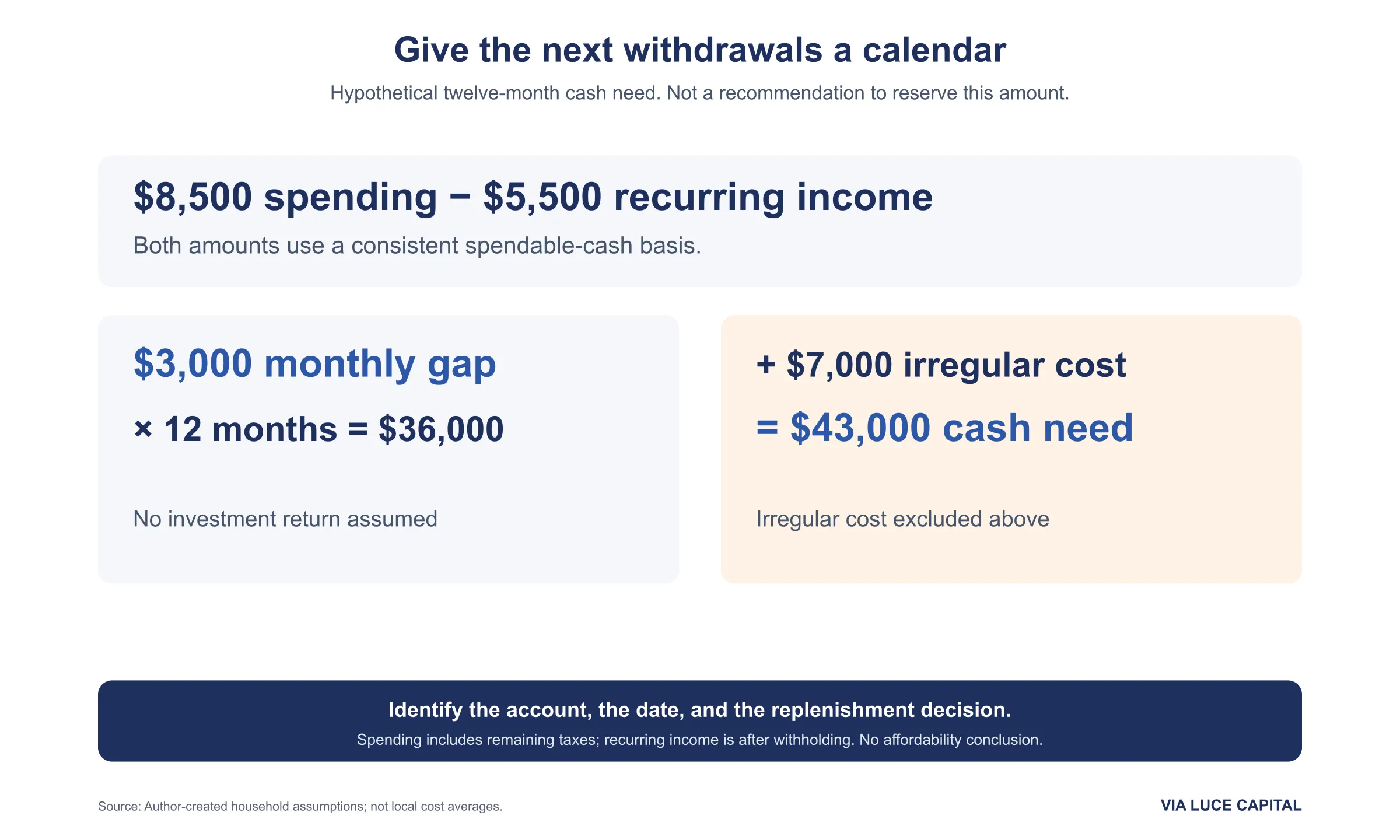
Hypothetical illustration, not a real client or a reserve recommendation: Assume a household spends $8,500 each month, including any taxes not already withheld from its income. It receives $5,500 of spendable recurring income after withholding. The monthly gap is $3,000.
Over the next twelve months, that gap totals $36,000. Add a separate $7,000 home expense that is not included in the monthly budget. The identified cash need is $43,000. This is a list of assumed obligations, not a conclusion that $43,000 is the right reserve or that the household can afford retirement.
Next, assign actual dates and potential funding sources. A bank balance, a planned bond maturity, and a taxable investment sale have different access, price, and tax considerations. Do not assume they are interchangeable simply because all three appear on the household balance sheet.
Distinguish accessible cash from an asset labeled conservative
Cash in an insured bank deposit has different terms from a money market mutual fund. FDIC coverage depends on the institution, ownership category, and applicable limits. A money market fund is an investment and is not FDIC-insured. Its yield and liquidity provisions require their own review.
An individual bond may provide a stated maturity payment subject to the issuer meeting its obligations. Selling before maturity exposes the owner to the market price available then. A conventional bond fund does not generally promise the shareholder a specified principal amount on a household-selected date.
The relevant question is what will be available when needed, after any restrictions, taxes, or sale costs. An investment’s historical stability or conservative label does not answer that question. Neither does a large account balance if most of it has already been assigned to other obligations.
Give the reserve a replenishment policy
A reserve can potentially reduce the need to sell a particular investment immediately after a decline. But spending the reserve also changes the household’s asset mix. If cash is used while other holdings remain, the remaining portfolio may have a greater proportion in risk assets.
Discuss when that change will be reviewed and how replenishment would be considered. Possible sources include incoming cash, maturities, or sales made as part of an allocation review. Each has conditions and trade-offs. Rebalancing can create transaction costs and taxable gains and does not assure a favorable result.
“We will refill it when markets recover” leaves several questions unanswered. How much recovery? What if the next expense arrives first? What if the holdings being sold have a different experience from the headline index? A useful policy makes those questions discussable before the reserve is nearly exhausted.
Plan for a prolonged decline
Holding cash has costs. Inflation can reduce purchasing power, and money held outside longer-term investments may miss potential gains. Holding too little can leave the household dependent on sales at an inconvenient time. The appropriate balance depends on the plan, rather than a universal number of months.
Discuss a prolonged period of weak markets without assuming a recovery date. Which discretionary expenses could be postponed? Which family commitments are firm? Is another income source available, and under what conditions? These are contingency questions, not forecasts that those events will happen.
Selling investments while prices are depressed leaves fewer shares available for any later recovery. This is one reason the timing of returns matters when withdrawals occur. A cash reserve may address part of that timing problem, but it cannot repair an unaffordable spending plan or remove investment losses.
Coordinate the withdrawal with the account
The amount leaving an account may differ from the cash reaching checking. Withholding, fees, and taxes can change the spendable amount. Review which account is funding the payment and whether additional tax payments belong in the calendar. Avoid counting withholding twice.
Required distributions and other account rules also need attention. A difficult market does not itself suspend an applicable deadline. Ask the appropriate professional about the account’s requirements and how they interact with planned withdrawals. There is no single account order that fits every household.
Finally, specify who will initiate transfers and when a new request should be communicated. A change in retirement timing or a large home expense can require a planning decision even when the investment framework calls for no change. The retirement income organizer is a starting point for putting the amounts in one place.
Turn the plan into an operating record
A simple operating record can list each expected payment, its due date, the funding account, the amount needed after withholding, and the person responsible for the transfer. Mark estimated amounts and confirm them as bills arrive. If a maturity or expected receipt is delayed, the calendar should show which payment would need a different source.
Review that record after an unusually large withdrawal or a material change in income. The original reserve decision may no longer describe the remaining assets. Revisiting the calendar is a planning task; it does not require a prediction about whether the market will be higher next month.
Sources
- Retirement income requires consideration of spending, investment allocation, and changing circumstances over a potentially long retirement. — U.S. Securities and Exchange Commission, Managing Lifetime Income; reviewed October 17, 2026.
- Time horizon, risk tolerance, allocation, and rebalancing must be considered together; rebalancing may have tax and transaction consequences. — U.S. Securities and Exchange Commission, Asset Allocation and Diversification; reviewed October 17, 2026.
- Money market funds are investment funds, not FDIC-insured deposits; their risks and liquidity provisions differ from bank accounts. — U.S. Securities and Exchange Commission, Money Market Funds: Investor Bulletin; reviewed October 17, 2026.
- Deposit coverage depends on ownership category, bank, and coverage limits; securities and annuities are not FDIC-insured deposits. — Federal Deposit Insurance Corporation, Deposit Insurance FAQs; reviewed October 17, 2026.
- Retirement-account distributions can create taxable income, withholding, and required-distribution obligations depending on the account and circumstances. — Internal Revenue Service, Publication 590-B; reviewed October 17, 2026.
- Hypothetical cash calendar: $8,500 monthly spending minus $5,500 spendable recurring income leaves $3,000; twelve months equals $36,000, plus a separate $7,000 expense equals $43,000. No return, tax projection, or sustainability result. — Via Luce Capital, author-created household illustration; reviewed October 17, 2026.