
The renewal notice is open on the counter. The premium moved, the deductible changed, or a familiar policy was replaced with something less familiar. The immediate question is insurance. The next question is retirement.
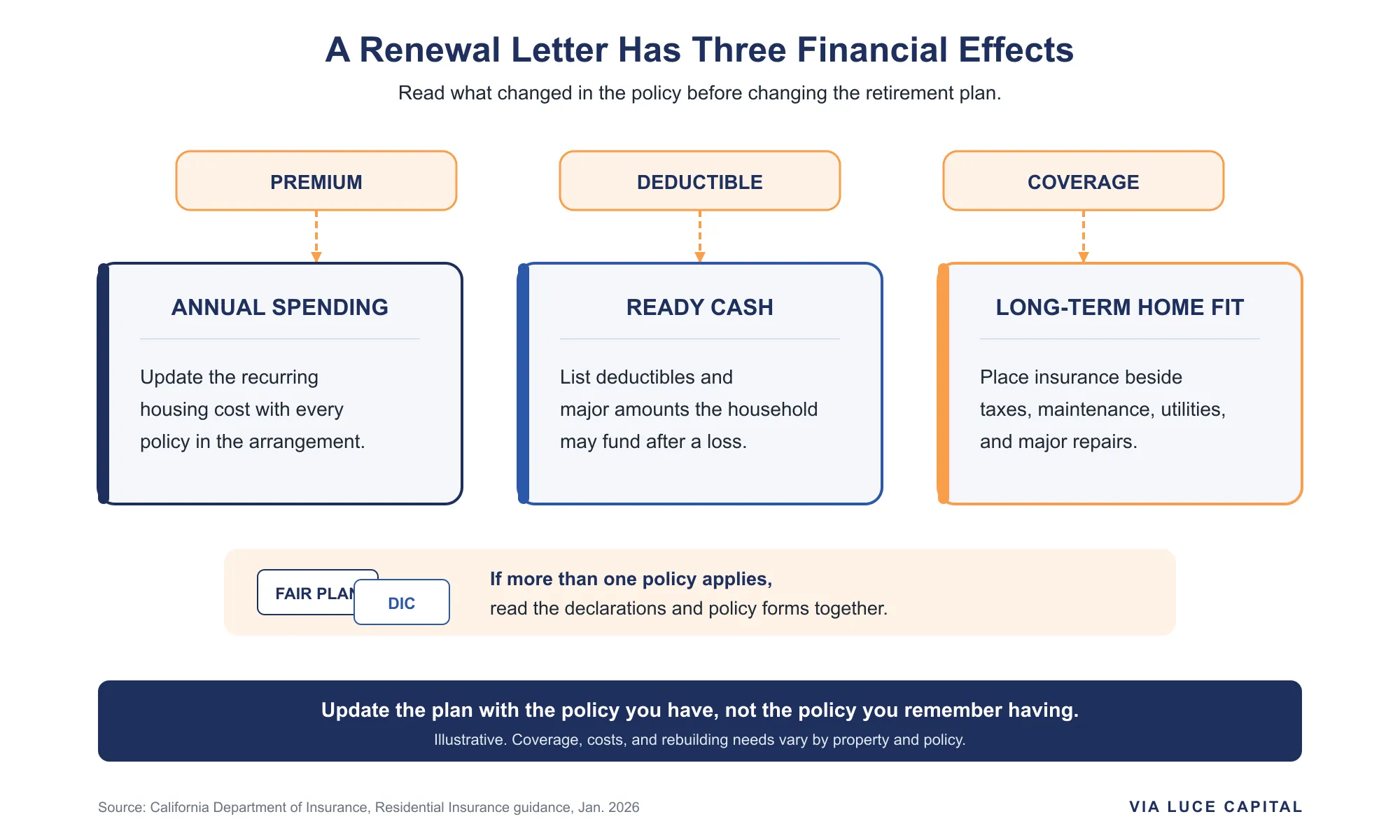
A homeowners policy is easy to treat as a bill: update the annual amount and move on. But a meaningful policy change can reach three parts of a retirement plan at once. It can change recurring spending, the cash a household may need after a loss, and the long-term cost of remaining in the home.
That does not mean one renewal letter should trigger a move, a portfolio change, or a prediction about California’s insurance market. It means the policy deserves to be read as part of the household balance sheet rather than as a line item someone renews automatically.
The market signal is real, but it is not a household forecast
California’s insurance market has been changing, and the public data provide useful context. The California Department of Insurance’s February 2026 snapshot reported 668,609 FAIR Plan homeowner and commercial policies in December. A later department update said the FAIR Plan added approximately 16,000 residential policies in the first quarter of 2026, about 2.4 percent growth from the previous quarter.
Those are statewide figures, not Orange County figures. They do not tell any household what its next premium will be, whether a carrier will renew a particular property, or which policy will be available. They show why renewal terms deserve attention and why an old planning assumption may need a current document behind it.
Read the change through three balance-sheet questions
What changed every year? A higher premium changes recurring housing spending. If the increase is material, update the retirement cash-flow estimate rather than hiding it inside a broad inflation assumption. Include separate FAIR Plan and DIC premiums if both are needed.
What changed after a loss? A larger deductible, lower sublimit, narrower list of covered causes of loss, or different settlement terms may increase the cash a household needs on short notice. That is a liquidity question, not merely an insurance question.
What changed about the home decision? Insurance is one component of the ongoing cost of the property, alongside taxes, maintenance, association dues, utilities, and major repairs. A persistent change may affect how the home fits the retirement plan, but it should be evaluated with all those costs rather than in isolation.
This is similar to the distinction between a retirement-income rule and a retirement-income process. Our discussion of turning a portfolio into retirement income starts with the same principle: recurring withdrawals, uncertain events, and flexibility have to be considered together.
Replacement cost is not the home’s market value
One of the easiest policy numbers to misunderstand is the dwelling limit.
The California Department of Insurance explains that this limit should reflect the estimated labor and material cost to rebuild the dwelling. It may have little relationship to the purchase price or current market value because the land is generally not what the homeowners policy is covering.
That difference matters in both directions. A highly valued Orange County property may have a market price far above the structure’s rebuilding cost because of the land. A home with custom materials, difficult site access, updated building requirements, or high local labor costs may be expensive to rebuild even when its recent market value moved differently.
Insurers use their own replacement-cost formulas, so estimates can differ. Ask for the estimate behind the dwelling limit, review the inputs, and keep records of renovations and unusual features. A contractor’s current rebuilding perspective may also help identify whether the estimate still reflects the house.
Then read beyond the dwelling limit. Ordinance-or-law coverage, debris removal, extended or limited replacement terms, personal-property settlement, loss-of-use coverage, and deductibles can all affect the cash required after a major loss. Names alone do not establish what a policy pays; the contract language does.
FAIR Plan and DIC should be read as a pair when both apply
The California Department of Insurance describes the FAIR Plan as narrower than a traditional homeowners policy. Its basic covered causes of loss include fire or lightning, internal explosion, and smoke. Certain extended causes of loss and vandalism or malicious mischief may be added for an additional premium.
The department also notes that a FAIR Plan policy does not include every peril commonly found in a traditional homeowners policy, including theft or liability. A separate Differences in Conditions policy may add coverage for some items not included in the FAIR Plan contract.
The important word is some. A DIC policy is not evidence that every gap has been addressed. Review the two declarations pages and policy forms together:
- Which property and people are named on each contract?
- Which causes of loss appear in one policy, the other, both, or neither?
- Are the dwelling, personal-property, liability, and loss-of-use limits coordinated?
- Which deductibles could apply to the same event?
- Are there separate exclusions, sublimits, or waiting periods?
- Do the mortgage lender’s requirements match the coverage in place?
This is a document comparison for a licensed insurance professional. It is not a product recommendation, and the answer may differ by carrier, property, and policy form.
Translate the policy into retirement planning inputs
Once the coverage is understood, the planning update is straightforward in structure even when the decision is not.
Update recurring housing spending
Replace the old premium assumption with the actual annual cost. If multiple policies are involved, include all of them. Keep the change visible for the next review rather than blending it into miscellaneous spending.
Revisit the liquidity reserve
List the deductibles and the major amounts the household might have to fund before reimbursement—or for an item outside the policy. The result is not a prediction that a loss will occur. It is a test of whether accessible cash still matches the risks the household has chosen to retain.
Revisit the long-term housing range
Add insurance to the wider cost of keeping the home. If taxes, repairs, utilities, and premiums are all moving, the useful question is not “Can we pay this bill?” It is “Does this home still fit the range we intended for housing over the next several years?”
Keep market decisions separate
An insurance renewal is not a reason by itself to change investments. If a higher recurring expense changes planned withdrawals, then it belongs in the same multi-year review as taxes, spending, and sequence-of-returns risk. The adjustment starts with the cash-flow need, not a reaction to the letter.
The renewal notice is an insurance document. Its financial meaning appears only after you place it beside the household’s cash flow, liquidity, and housing plan.
What to consider next
Put the old and new declarations pages side by side. Mark every change in premium, deductible, limit, endorsement, covered cause of loss, and exclusion. If the arrangement includes both FAIR Plan and DIC coverage, map which policy addresses each major category and write down any unanswered gap.
Ask a licensed insurance professional to explain the differences in plain language and provide the replacement-cost estimate behind the dwelling limit. Then give the resulting annual cost, deductibles, and major retained exposures to the person maintaining the retirement plan.
The goal is not to predict what California insurance will do next. It is to make sure today’s housing and liquidity assumptions describe the policy the household actually has—not the policy it remembers having.
Sources
- California's February 2026 market snapshot reported 668,609 FAIR Plan homeowner and commercial policies in December — California Department of Insurance, Sustainable Insurance Strategy: California Homeowners Insurance Market Snapshot
- The FAIR Plan added approximately 16,000 residential policies in the first quarter of 2026, about 2.4 percent growth from the prior quarter — California Department of Insurance, Q1 2026 Sustainable Insurance Strategy update
- FAIR Plan covered perils, optional extensions, and the role of separate Differences in Conditions coverage — California Department of Insurance, Home/Residential Insurance
- A dwelling limit should reflect estimated rebuilding costs rather than purchase price or market value; insurer replacement-cost estimates can differ — California Department of Insurance, Residential Insurance: Homeowners and Renters, Form 401 Revised January 2026