

A recurring family question arrives with a home listing attached: “They found a place nearby. We can help—but should the money be a gift, a loan, or our share of the house?”
The desire is personal. Living near an adult child may mean more time together, help with grandchildren, or simply fewer freeway hours between households. The decision is also financial, and Orange County prices can make a seemingly modest gap large enough to affect both generations.
In June 2026, the California Association of REALTORS reported a $1.49 million median sale price for an existing single-family home in Orange County. That is a market measure, not a budget for any particular buyer. Statewide, C.A.R.’s first-quarter affordability index found that 22 percent of California households could afford the state’s median-priced existing single-family home under its assumptions. That statewide figure is not an Orange County affordability rate, but it helps explain why family assistance is part of more conversations.
The question is not only which structure gets the purchase across the finish line. It is which arrangement the family can understand, document, and live with after closing.
“Least complicated” depends on where you look
A gift may be simple for the child and consequential for the parents. A loan may be clear economically and demanding administratively. Co-ownership may reduce the child’s initial capital need while adding decisions that last as long as the shared title.
Compare the three paths across five dimensions:
- Parental liquidity: How much cash leaves, and does any of it return?
- Child’s housing budget: What mortgage, payment, and maintenance responsibility remains?
- Tax and reporting: What needs to be valued, documented, reported, or tracked?
- Control: Who decides about renovations, refinancing, renting, or selling?
- Family exit: What happens after a job change, marriage, divorce, disability, death, or a request to move?
The path with the fewest papers today may carry the most ambiguity later.
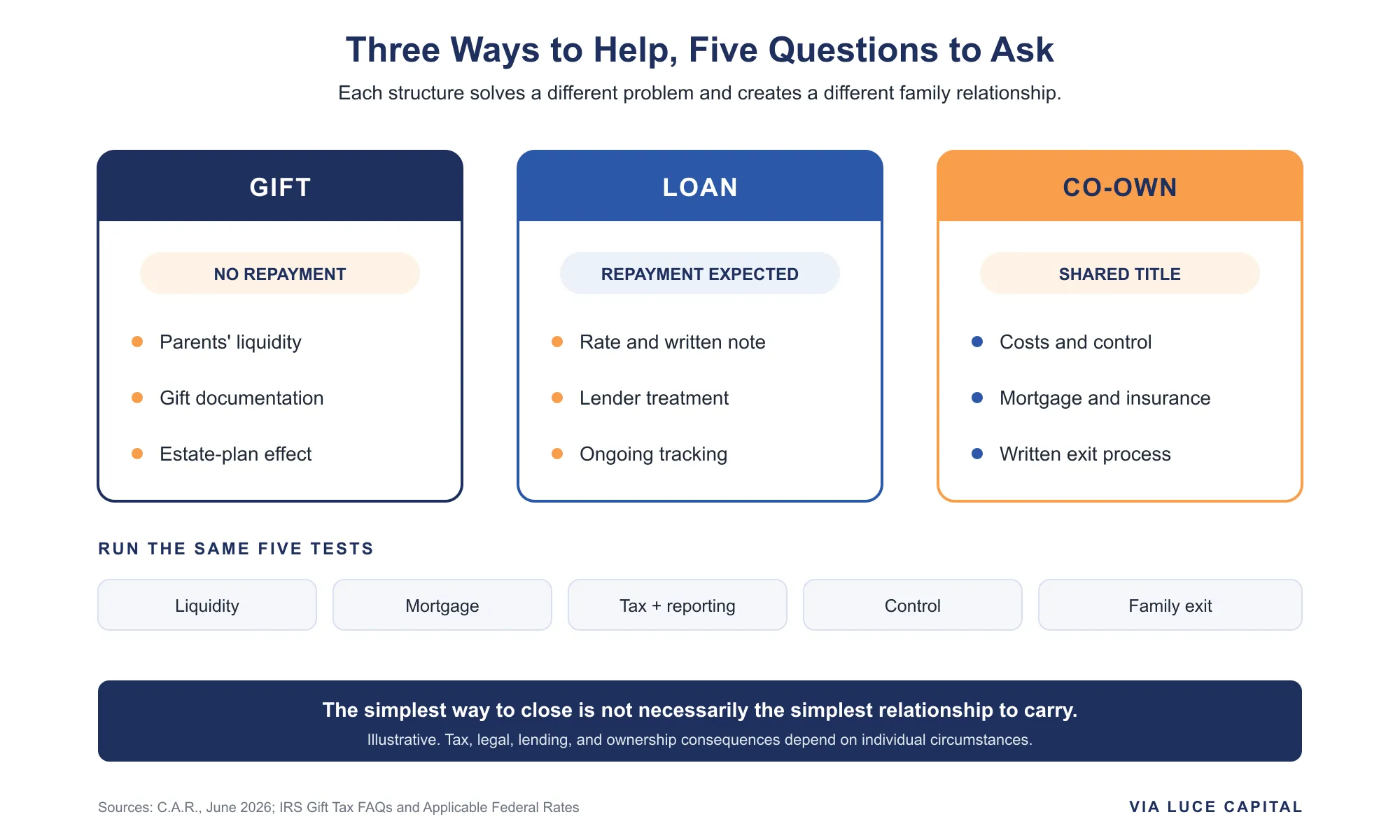
Path one: a gift
A gift draws a bright economic line: the parents transfer funds without an expectation of repayment. That can make monthly budgeting simpler for the child because there is no family payment layered beside the mortgage.
For the parents, the first question is not the annual gift-tax exclusion. It is whether the money is genuinely available to give. The transfer may reduce cash reserves, future spending capacity, or flexibility for health, housing, or family needs. A tax rule does not answer that planning question.
The federal gift-tax system also separates reporting from tax due. Depending on the amount and the family’s circumstances, a gift may require a federal gift-tax return even when no current gift tax is owed. The donor is generally responsible for the gift-tax reporting. The CPA should determine the treatment rather than relying on a remembered annual limit.
The lender will have its own documentation process for gifted funds and the source of the money. A gift letter written for underwriting is not a substitute for the family’s tax records or estate-plan documentation.
If the support would come from appreciated property rather than cash, basis becomes a separate issue. Our step-up-in-basis overview explains why a lifetime transfer and an inheritance can have different income-tax results. That decision belongs with the CPA and estate attorney before an asset is sold or transferred.
Path two: a family loan
A loan keeps an expectation of repayment. That may better match parents who want to help with timing rather than make a permanent transfer. It also creates a real creditor-and-borrower relationship inside the family.
A useful loan discussion goes beyond “they will pay us back.” It addresses:
- principal amount, interest rate, term, and payment schedule;
- whether the note is tied to the property as collateral;
- whether payments begin immediately or later;
- what happens after a missed payment;
- whether early repayment is allowed;
- what happens if the home is sold or refinanced; and
- how the note is handled in the parents’ estate.
Federal below-market loan rules are why the interest rate should not be chosen casually. The IRS publishes applicable federal rates each month. The CPA and attorney can identify the relevant rate and reporting, and a qualified attorney can put the agreement in writing.
The mortgage lender needs to see the structure early. A family loan may count as debt in underwriting, and its terms cannot be hidden behind a gift letter. The cleanest family conversation will not rescue a structure that conflicts with the primary lender’s requirements.
There is also a practical burden: someone must track payments, interest, tax reporting, and the remaining balance. Decide who will do that while everyone is enthusiastic, not after the first late payment.
Path three: co-ownership
With co-ownership, the parents contribute capital and keep an interest in the property. That can align the contribution with an asset rather than a promise to repay. It also turns a housing purchase into a shared governance arrangement.
The deed answers who owns the property. It does not answer enough on its own. A separate agreement may need to cover:
- who may occupy the home and whether anyone pays rent;
- how mortgage payments, property tax, insurance, repairs, and renovations are divided;
- who chooses contractors and approves large expenses;
- whether either owner may borrow against the property;
- how a sale decision is made;
- how a buyout price is determined; and
- what happens after incapacity, death, divorce, a creditor issue, or a move.
Title form can affect estate, income-tax, creditor, and succession questions. Mortgage and insurance documents also need to match the actual owners and occupants. This is not a fill-in-the-blank decision; it needs attorney, lender, and insurance review.
Co-ownership can also change the emotional vocabulary. A parent may think, “We helped with the down payment,” while the adult child hears, “This is our home.” If the documents say both parties are owners, the family needs a shared understanding of what that means in ordinary life—not only after a dispute.
Test the parents’ plan before solving the purchase
Family help is often evaluated from the buyer’s side: the down payment gap, the monthly payment, the offer deadline. The parents’ balance sheet deserves an equally serious review.
Ask how the assistance would affect:
- cash available for the next several years;
- retirement withdrawals and taxes;
- planned home repairs or a future move;
- support the family may want to offer other children;
- the estate plan’s intended division among heirs; and
- the ability to respond if the child’s housing arrangement changes.
No formula makes those tradeoffs identical across families. The point is to see them before the purchase creates a deadline.
Use a coordinated decision sequence
- Define the child’s actual purchase gap. Separate the down payment from closing costs, reserves, repairs, and a workable monthly budget.
- Set the parents’ liquidity boundary. Identify the amount that could leave without making the rest of their plan depend on repayment or a future sale.
- Ask the lender to test all three structures. Do this before choosing language or moving funds.
- Have the CPA compare reporting and cash-flow effects. Include gift, interest, basis, and estate considerations that apply to the actual facts.
- Have the attorney document the chosen relationship. A gift, note, and shared deed are not interchangeable paperwork.
- Write down the family understanding. Include what happens if the original plan changes.
The simplest way to close is not necessarily the simplest relationship to carry.
What to consider next
Before discussing a number, have each generation answer one question privately. The adult child: “What help would make the purchase workable without making the monthly plan fragile?” The parents: “What amount could leave our balance sheet without requiring repayment, appreciation, or a sale to keep our own plan on track?”
Bring those answers, the proposed purchase budget, and the three possible structures to the lender, CPA, and estate attorney. Their work is connected: the lender defines what can close, the CPA identifies reporting and cash-flow consequences, and the attorney aligns the documents with what the family actually intends.
A gift, loan, or shared title can each be workable in the right circumstances. The better starting point is not naming a favorite. It is naming which complications the family is willing and able to carry after the excitement of the purchase has passed.
Sources
- Orange County June 2026 median sale price of $1.49 million for existing single-family homes — California Association of REALTORS, June 2026 County Sales and Price Activity
- In the first quarter of 2026, 22 percent of California households could afford the state's median-priced existing single-family home under C.A.R.'s methodology — California Association of REALTORS, First-Quarter 2026 Housing Affordability Index
- Federal gift-tax treatment, annual-exclusion framework, donor reporting, and documentation considerations — Internal Revenue Service, Frequently Asked Questions on Gift Taxes
- The IRS publishes applicable federal rates monthly for federal tax purposes — Internal Revenue Service, Applicable Federal Rates