

Your parents are paying their bills, driving to appointments, and making their own decisions. Nothing is wrong today. That can make one question feel awkward: if something changed tomorrow, would anyone know how to help without searching through drawers, inboxes, and old statements?
Organizing before a crisis is not the same as transferring control. A parent can remain fully in charge while choosing who should know where the important information lives, what authority may be available if needed, and which professionals should be called first.
That distinction matters because a health event compresses time. Bills continue. Tax notices arrive. Insurance and care decisions may overlap. Family members can be willing to help and still lack the information or legal authority to do what they assumed would be simple.
The local caregiving signal is already visible
Orange County’s Older Adults Needs Assessment included 935 valid caregiver survey responses. Those participants reported providing care for an average of seven years. Among their common concerns were having enough time and knowing which resources were available.
The survey was voluntary and does not describe every Orange County family. It does show that caregiving often develops over years rather than in one dramatic moment. Financial continuity belongs in that longer runway.
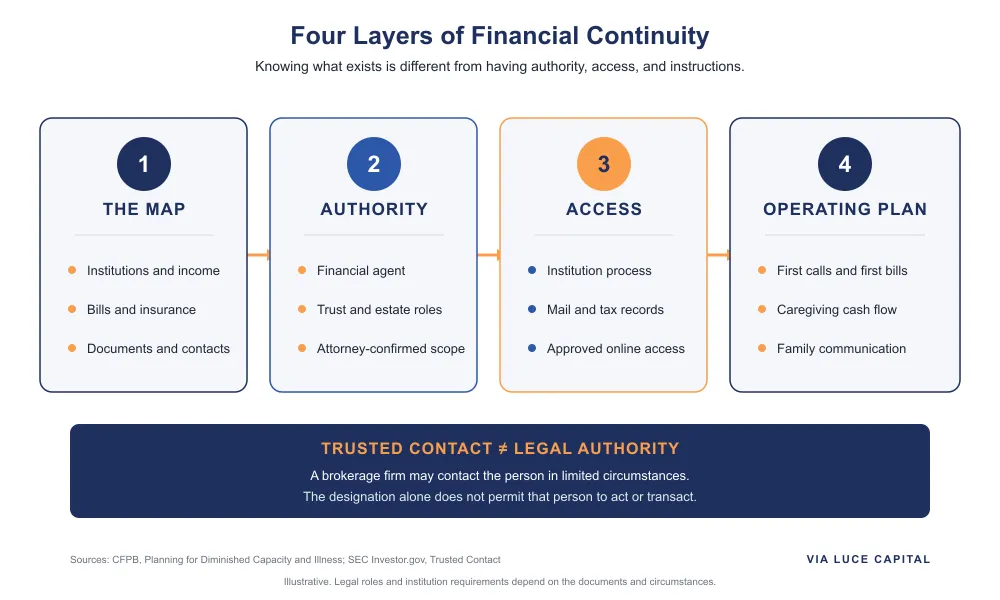
The most useful preparation has four separate layers: the map, the authority, the access, and the operating plan. They connect, but none substitutes for the others.
Layer one: create a map without demanding every detail
The first version of a financial map does not need account balances or a list of passwords. It needs enough information for an authorized helper to know what exists and whom to contact.
Consider listing:
- banks, brokerage firms, retirement-plan custodians, and pension administrators;
- Social Security and other recurring income sources;
- insurance policies and the professionals who service them;
- real estate, loans, credit cards, and recurring household bills;
- the CPA, estate attorney, financial advisor, and primary care contacts;
- the location of the trust, will, powers of attorney, health-care documents, deeds, and recent tax returns; and
- any bills or renewals that would create an immediate problem if missed.
The parent decides how much to share and with whom. One adult child may know where the map is kept while a different person holds a legal role. A professional may retain the current documents. The map’s job is to show the route, not to place every private detail in one person’s hands.
This is also a good time to review beneficiary designations. A family map can point to an account, but the account’s own form may control who receives it.
Layer two: confirm who actually has authority
Being a child, spouse, emergency contact, or trusted contact does not automatically grant financial authority.
The CFPB explains that a financial power of attorney may give an agent legal authority to make financial decisions if the principal cannot. It is separate from a health-care power of attorney. The document, the timing of its effectiveness, the powers granted, and the state-law requirements belong with an estate attorney.
Trust roles are separate as well. A successor trustee’s authority comes from the trust and applicable law, not from a family understanding. An executor or personal representative generally acts in an estate after death and subject to the governing process. These titles should not be treated as interchangeable.
Ask the parents’ attorney to review the current documents and answer practical questions:
- Who holds each role today?
- When does that person’s authority begin?
- Is a backup named?
- Do the documents reflect the parents’ current wishes and state of residence?
- Do account titles and beneficiary forms align with the documents?
- What evidence would an institution need before recognizing the person?
The goal is not for the family to interpret legal documents on its own. It is to leave the attorney’s meeting knowing which role applies to which task.
Layer three: test access with the institutions
A valid document is important, but the first attempt to use it should not occur during an emergency if an earlier administrative review is available.
Institutions may have their own forms, review processes, account features, and rules for online or delegated access. Ask each bank, custodian, insurer, and benefits administrator what it requires for an authorized helper. Do not assume a shared password or a copy of a document will be treated as sufficient.
Brokerage trusted contacts deserve special clarity. Investor.gov explains that naming a trusted contact lets the brokerage firm reach that person in limited circumstances, such as difficulty contacting the account owner or concern about possible exploitation. It does not give the trusted contact authority to transact or act for the account owner, and it does not make that person an agent, guardian, trustee, or executor.
That makes a trusted contact useful, but different from legal authority. A parent may want both arrangements, with the same person or different people, depending on the family and professional guidance.
Access also includes ordinary operations. Who receives paper mail? Where do tax documents arrive? Which bills are automatic and which require action? How is multi-factor authentication handled if a phone is lost or inaccessible? The approved answer may differ by institution, so document the process rather than improvising it.
Layer four: write the operating plan
The financial map says what exists. Authority says who may act. Access says how an institution will recognize that person. The operating plan says what should happen first.
Keep it concise. It might identify:
- the parent or family member who should be contacted first;
- the attorney, CPA, financial advisor, and care professional to call;
- the bills, income deposits, insurance, and property items that cannot wait;
- where near-term cash is expected to come from;
- who coordinates updates among siblings or other family members; and
- which decisions require the parent, an authorized agent, a trustee, or another professional.
The plan should also address caregiving expectations before they harden into assumptions. If one child lives nearby, does the family expect that person to handle appointments, bills, home maintenance, or paid-care coordination? Will the parent reimburse expenses? Would reduced work hours affect the caregiver’s household? Which siblings need information even if they are not making decisions?
Naming those questions is not a promise that care will unfold in one particular way. It gives the family a place to begin if circumstances change.
Keep the parent at the center
Financial continuity works best when it begins as the parent’s plan, not the adult children’s inspection.
Ask what matters to them. Some parents care most about remaining at home. Others want one child to handle finances and another to coordinate care. Some want the family to know account locations but not balances. Some prefer a professional in a key role.
The conversation can begin with a modest request: “If you wanted help for a week, whom should we call and where would we find the instructions?” That question respects current independence while revealing whether the map and roles are clear.
It also connects to the broader work of preparing heirs and family decision-makers. Documents move authority and assets. Preparation helps people understand how to carry the responsibilities that come with them.
The purpose of continuity planning is not to decide that a parent needs help. It is to keep a future request for help from beginning with a search for basic facts and authority.
What to consider next
Invite your parents to a one-hour continuity meeting with a narrow agenda. Start with names and locations: institutions, income, recurring bills, insurance, real estate, professional contacts, and governing documents. Do not begin by asking for balances or passwords.
Make a second list of roles: trusted contact, financial agent, health-care agent, trustee, executor, and any backups. Put a question mark beside any title the family is interpreting from memory.
Then let the estate attorney confirm the legal documents and roles, and let each institution explain its access process. The CPA and financial advisor can help connect taxes, cash flow, accounts, and caregiving assumptions without replacing the attorney’s or care professional’s work.
The finished plan does not need to predict a crisis. It needs to tell an authorized person what exists, what role they hold, how to begin, and whom to call next.
Sources
- Orange County's caregiver survey received 935 valid responses; participants reported providing care for seven years on average, and common concerns included time and knowing which resources were available — Orange County Office on Aging, Orange County Older Adults Needs Assessment — Executive Summary
- A financial power of attorney may grant an agent authority during incapacity, is separate from a health-care power of attorney, and should be discussed with a lawyer — Consumer Financial Protection Bureau, Planning for Diminished Capacity and Illness
- A brokerage trusted contact may be contacted in limited circumstances but has no authority to act, transact, or serve as an agent, guardian, trustee, or executor by reason of that designation — U.S. Securities and Exchange Commission, Investor.gov, Trusted Contact
- Older adults and families may organize important documents, account information, professional contacts, and trusted contacts in advance of illness or diminished capacity — U.S. Securities and Exchange Commission, Investor.gov, Information for Older Investors