

December 31 is a deadline. It is not the deadline — and treating it as though it were is what turns November into a scramble and April into a missed opportunity.
There are two calendars inside a financial year.
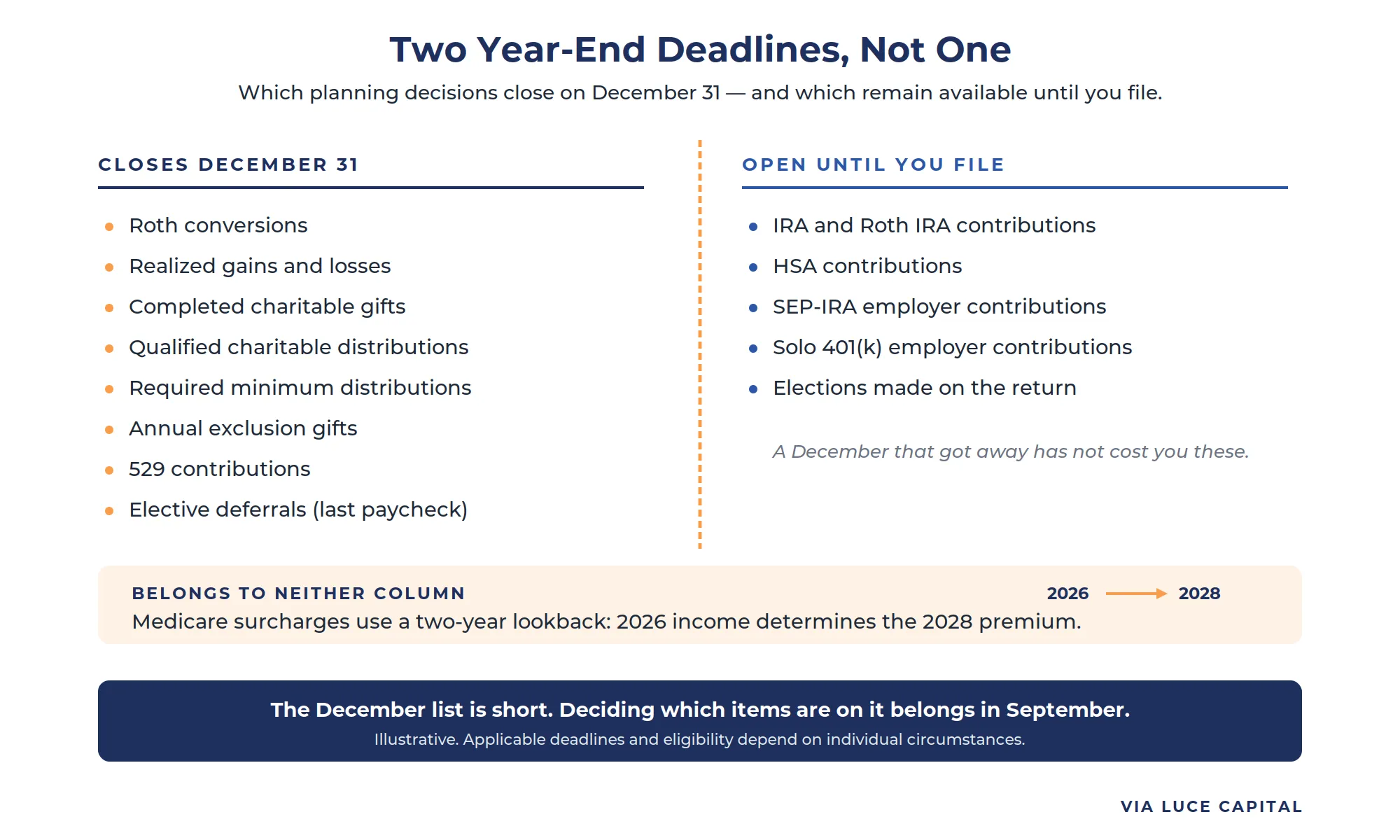
One closes at midnight on December 31 and takes a specific, short list of decisions with it. The other stays open until you file — often into April, sometimes later — and holds a set of decisions most people assume they have already lost.
Knowing which calendar an item sits on is most of the skill. The December list is shorter than almost anyone expects. The April list is longer.
What actually closes on December 31
The common thread is a transaction. If the decision requires money to move, a position to be sold, or a distribution to leave an account, it has to happen inside the tax year.
Roth conversions. A conversion is a taxable event dated to the day it occurs, and it is final. Recharacterizing a conversion — undoing it after the fact — is no longer available. A conversion executed on December 30 is a permanent feature of that year’s return, which is precisely why it deserves to be decided in the autumn rather than the last week of December.
Realized gains and losses. Harvesting a loss, or deliberately realizing a gain in a lower-income year, requires the sale to occur inside the year. The wash-sale rule then governs what can be repurchased and when, which means the decision has a tail into January.
Charitable gifts. The gift has to be complete in the year you intend to deduct it. For cash that is straightforward. For appreciated securities, a donor-advised fund contribution, or a gift of anything that has to be valued or retitled, “complete” can take weeks — and custodians and charities both slow down in late December.
Qualified charitable distributions. A QCD has to leave the IRA and reach the charity inside the year. The annual limit is indexed for inflation and published by the IRS each year.
Required minimum distributions. Once you have a required beginning date, the distribution for that year has to be taken by December 31.
Annual exclusion gifts. The exclusion is $19,000 per recipient for 2026. It is per recipient, per year, and it does not carry forward — an unused 2026 exclusion is simply gone on January 1. For a married couple gifting to three children, that is $114,000 that either moves this year or does not.
Funding a 529. Contributions are gifts, so they run on the same December 31 clock and the same annual exclusion. The wrinkle worth knowing is the five-year election: a contributor can treat a single large contribution as though it were spread evenly over five years for exclusion purposes, which allows five years of exclusion to be used at once — $95,000 per beneficiary from one donor at the 2026 amount, or $190,000 from a couple. The election is made on a gift tax return, and it consumes those five years, so it is a sequencing decision rather than free capacity.
Elective deferrals to an employer plan. These run through payroll, so the real deadline is the last paycheck of the year, not December 31.
What stays open until you file
Every one of these can still be done after the year ends, which means a December that got away from you has not cost you as much as it feels like it has.
IRA and Roth IRA contributions remain available until the filing deadline for the year — the original deadline, not the extended one.
HSA contributions follow the same timing.
SEP-IRA employer contributions can be made through the extended due date of the return, which gives business owners a genuinely long runway.
Solo 401(k) employer contributions work similarly, though the employee deferral side has its own earlier timing.
A number of elections are made on the return itself and therefore cannot be missed in December by definition.
If the year closes without an IRA contribution, nothing has been lost yet. If it closes without a Roth conversion, that year’s conversion window is gone.
The decision that closes now and arrives in two years
Medicare premium surcharges use a two-year lookback. Income reported for 2026 is what determines Part B and Part D surcharges in 2028.
That changes how a December decision should be weighed. A Roth conversion, a large realized gain, or a business distribution taken in the last week of the year does not only move the current tax bill — it can potentially move a Medicare premium two years out, for someone who may not be on Medicare yet when the decision is made.
For 2026, the surcharge brackets begin at $109,000 for a single filer and $218,000 for a joint return. The thresholds are indexed and republished annually, so the figures that will govern 2028 are not yet known. The structure is what matters for planning: the decision is made now and the consequence is invoiced later.
Charitable giving works differently this year
Two changes deserve attention from anyone who gives regularly.
First, a floor. Beginning in 2026, an itemizer can deduct charitable contributions only to the extent they exceed 0.5% of adjusted gross income. The statute puts it as contributions “allowed only to the extent that the aggregate of such contributions exceeds 0.5 percent of the taxpayer’s contribution base for the taxable year,” and the IRS states the rule plainly: amounts falling under the 0.5% floor cannot be deducted.
Illustratively, at $400,000 of adjusted gross income the first $2,000 of giving produces no deduction at all. That is a hypothetical figure used to show the arithmetic, not a projection.
The practical consequence is that bunching became more valuable. Concentrating two or three years of intended giving into a single year clears the floor once rather than three times, and the donor-advised fund is the usual mechanism for separating the timing of the deduction from the timing of the grants.
Second, and also beginning in 2026, a deduction for people who do not itemize: up to $1,000, or $2,000 on a joint return, for cash contributions — and the statute exempts it from the 0.5% floor.
The pattern
The December list is short and mostly irreversible. The April list is longer and forgiving.
What separates a calm year-end from a frantic one is not effort in December. It is having decided in September which items are actually on the December list — and then giving the irreversible ones the deliberation they deserve while there is still time to change your mind.
That is the whole argument for a mid-year checkpoint. By the time the December list is urgent, the only thing left is execution.
The December list is short. It is the assumption that everything is on it that makes the month feel so long.
The plan is the residue. The planning is the work.
Sources
- Charitable contributions are allowed only to the extent the aggregate exceeds 0.5 percent of the taxpayer's contribution base for the taxable year — 26 U.S.C. § 170(b)(1)(I)
- Deduction of up to $1,000 ($2,000 for a joint return) for cash contributions by taxpayers who do not itemize, allowed without regard to the 0.5 percent floor — 26 U.S.C. § 170(p)
- Beginning in 2026, an itemizer may deduct charitable contributions only to the extent they exceed 0.5 percent of adjusted gross income; amounts below the floor are not deductible. The $1,000 and $2,000 non-itemizer deduction also begins in 2026. — IRS Publication 505 (2026), Tax Withholding and Estimated Tax
- Annual gift tax exclusion of $19,000 per recipient for 2026 — IRS Rev. Proc. 2025-32
- Election to treat a contribution to a qualified tuition program as made ratably over five years for annual exclusion purposes — 26 U.S.C. § 529(c)(2)(B)
- 2026 Medicare Part B and Part D income-related monthly adjustment brackets begin at $109,000 for a single filer and $218,000 for a joint return — CMS, 2026 Medicare Parts A & B Premiums and Deductibles fact sheet