
A payroll rule took effect in January, and it is being discussed as a decision about this year. It isn’t one. For everyone it reaches, the determination was made by a number printed on a form last year — and for a lot of owners, by a structure chosen long before that.
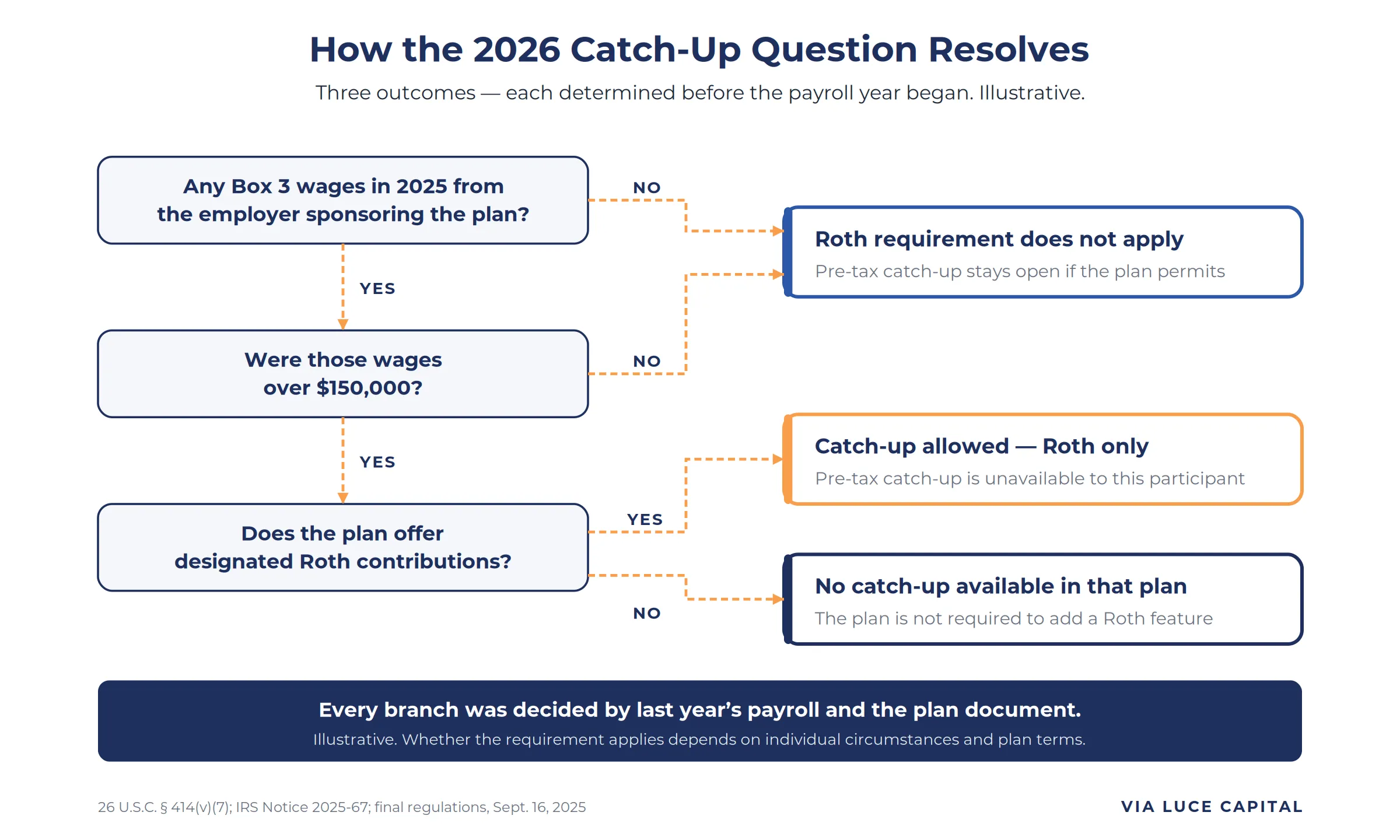
The mandatory Roth catch-up is live. Starting with the 2026 tax year, a participant whose prior-year wages from the employer sponsoring the plan exceeded the threshold may make catch-up contributions only as designated Roth contributions. Pre-tax catch-up is unavailable to that person. The two-year administrative transition period that had allowed those contributions to stay pre-tax ended December 31, 2025.
The 2026 numbers: the elective deferral limit is $24,500, the age-50 catch-up is $8,000, and the catch-up for participants who turn 60, 61, 62, or 63 during the year is $11,250.
The threshold is $150,000 — and it is measured on 2025
The threshold indexes. $145,000 was the amount used for the 2025 determination; the IRS set the figure that governs 2026 at $150,000 of 2025 wages.
Two consequences follow, and both are easy to miss. The test is retrospective, so no action taken during 2026 changes whether the rule applies in 2026. And it resets annually — a year with lower wages produces a different answer the following year.
Box 3, not your salary
The statute uses wages as defined in section 3121(a) — FICA wages. The final regulations tie the determination to the amount reported in Box 3 of Form W-2.
Box 3 is not base salary, and it is not Box 1:
- It includes elective deferrals. Money going into the 401(k) reduces Box 1 and leaves Box 3 alone.
- It excludes cafeteria-plan amounts — pre-tax health premiums and HSA contributions routed through a section 125 plan.
- It stops at the Social Security wage base, which was $176,100 for 2025. Anyone whose Box 3 is capped is above the threshold by definition.
The practical version: pull the 2025 W-2 that employer issued and read Box 3. Not the offer letter, not the payroll summary.
The test runs per employer — on wages some owners don’t have
Section 3121(a) wages are employment wages. Self-employment earnings are not.
Under the final regulations, a participant with no FICA wages from the employer sponsoring the plan for the preceding calendar year is not subject to the Roth catch-up requirement — and the regulations name a partner with only self-employment income as the example. The relevant employer is the participant’s common law employer contributing to the plan.
Which produces this: an S corporation owner-employee drawing W-2 wages above the threshold is subject to the rule. A sole proprietor, or a partner whose income arrives on Schedule C or a K-1 and who sponsors a solo plan, has no Box 3 — and is not subject. Same economics, opposite answer, decided by an entity election that was almost certainly made for reasons unrelated to catch-up contributions.
Entity structure is discussed here as education, not as a recommendation, and it should never be chosen around a single payroll rule. But if the structure is already in place, it has already answered this question, and knowing which side of the line you are on is worth ten minutes.
The per-employer point carries its own wrinkle. The wages that matter are the ones from the employer sponsoring that plan. Someone with large W-2 wages at a primary job and a modest side business sponsoring its own plan is tested separately in each.
If the plan has no Roth feature, the catch-up disappears
A plan that permits catch-up contributions but has no qualified Roth contribution program is not obligated to add one. Under the final regulations it may instead stop permitting catch-up contributions for participants subject to the requirement.
For a business owner who sponsors the plan and is also its highest-paid participant, that is not a technicality. It is a design decision with a direct cost: no Roth feature means the affected participants — likely including the owner — lose access to the catch-up entirely. Adding a designated Roth program is the alternative, and it takes plan-document and payroll work that has a lead time.
2026 is a good-faith year, which is not the same as a grace year
The statutory requirement applies now. The final regulations generally apply to contributions in taxable years beginning after December 31, 2026, with later dates for governmental and collectively bargained plans. For periods before that, a reasonable, good-faith interpretation of section 414(v)(7) applies.
Read plainly: the obligation is real in 2026, and the detailed rulebook becomes mandatory in 2027. The regulations also permit a plan to apply a deemed Roth election — treating a subject participant’s catch-up election as a Roth election, provided the participant has an effective opportunity to elect otherwise — and they set out correction methods for failures. Which of these a plan and its payroll provider have actually implemented is worth confirming rather than assuming, because a deemed election changes a participant’s tax result without any new paperwork from the participant.
The part that is actually planning
Losing a pre-tax deduction of $8,000, or $11,250 in the 60-through-63 window, is not a large number by itself. What it changes is sequencing.
Consider an illustrative case, not a real client: an S corporation owner, 61, whose 2025 Box 3 wages cleared the threshold, who had planned an $11,250 pre-tax catch-up alongside a Roth conversion sized to fill the rest of a target bracket. The catch-up is now Roth. The deduction that would have made room for the conversion is gone, so either the conversion shrinks or the bracket gives.
That is the real interaction. The same dollars now raise adjusted gross income relative to the pre-tax alternative, and AGI is what drives a long list of thresholds — including the Medicare income-related surcharges that key off a return filed two years earlier. Coordinating the catch-up with a conversion plan can potentially produce a better multi-year result than treating them as separate decisions — the same argument that runs through the case for Roth conversions after OBBBA and why AGI now behaves like a second bracket.
The pattern
Every part of this was settled before January. The wage figure was settled by 2025 payroll. Whether a catch-up is available at all was settled by plan design. Whether the rule reaches you was settled, for many owners, by an entity election made years ago.
Nothing done in 2026 changes whether the 2026 rule applies. That was decided by a number on last year’s W-2.
The rule is a line in a payroll file. Everything that determined it happened somewhere else, earlier, in decisions that looked like they were about something else entirely.
The plan is the residue. The planning is the work.
Sources
- 2026 elective deferral limit of $24,500; age-50 catch-up limit of $8,000; catch-up limit of $11,250 for participants who attain age 60, 61, 62, or 63 in 2026; Roth catch-up wage threshold used for the 2026 determination increased from $145,000 to $150,000 of 2025 wages — IRS Notice 2025-67, 2026 Amounts Relating to Retirement Plans and IRAs
- Statutory requirement that catch-up contributions by participants whose prior-year wages, as defined in section 3121(a), from the employer sponsoring the plan exceed the indexed threshold be designated Roth contributions — 26 U.S.C. § 414(v)(7)
- Administrative transition period under which catch-up contributions were treated as satisfying section 414(v)(7)(A) through taxable years beginning before January 1, 2026 — IRS Notice 2023-62
- Use of prior-year FICA wages reported in Box 3 of Form W-2; exclusion of participants with no FICA wages from the employer sponsoring the plan, including a partner with only self-employment income; the common law employer rule; treatment of plans without a qualified Roth contribution program; deemed Roth elections; correction methods; general applicability to taxable years beginning after December 31, 2026, with a reasonable, good-faith interpretation standard for earlier periods — Final regulations, Catch-Up Contributions, 90 Fed. Reg. (Sept. 16, 2025)
- 2025 Social Security contribution and benefit base of $176,100 — Social Security Administration, Contribution and Benefit Base