

The education plan changed. A child chose a different school, received aid, delayed enrollment, pursued a credential, or simply did not use the full account. The first reaction is often blunt: “Did we save too much, and is the money trapped now?”
Money left in a 529 plan is not yet a tax result. It is an account with history, an owner, a beneficiary, and several possible uses. The choices do not follow the same rules, and California does not follow every federal rule.
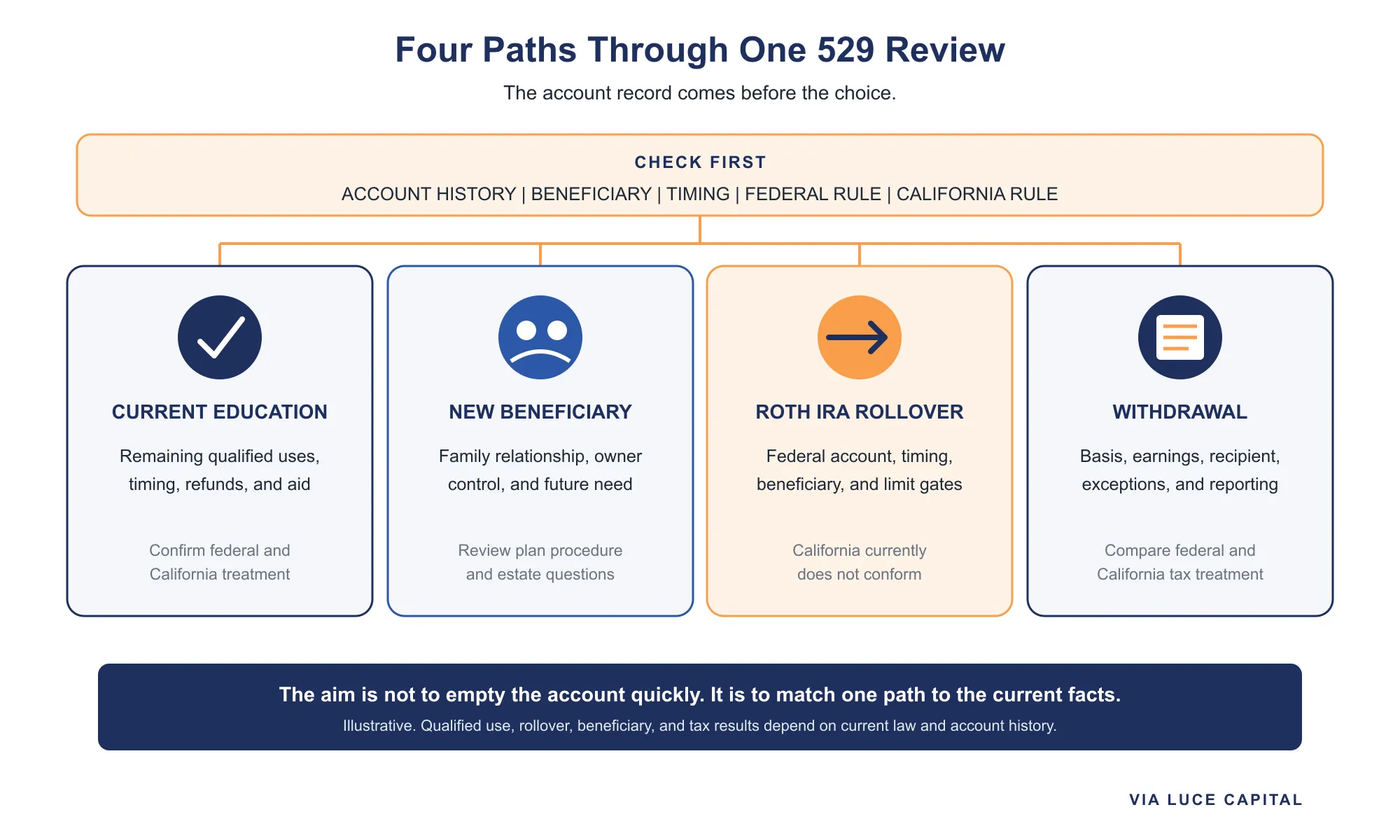
Before choosing a beneficiary change, rollover, or withdrawal, start with what the account actually contains and what the family may still need.
“Unused” may still have an education purpose
The current beneficiary’s education path may not be finished. Graduate school, eligible postsecondary programs, certain apprenticeship expenses, and other federally qualified uses may remain relevant. Federal law also expanded some education uses, but California’s current conformity may differ.
Do not begin with the question, “How do we empty the account?” Begin with a timeline:
- Is the current beneficiary still considering education or training?
- Are there unpaid or future expenses that the plan administrator identifies as qualified?
- Was any tuition or other expense refunded?
- Did a scholarship, employer benefit, or other aid change the expected need?
- Does federal treatment differ from California treatment for the intended expense?
The same expense should not be used twice to claim incompatible tax benefits. The CPA should coordinate 529 distributions with education credits, scholarships, reimbursements, and the tax year in which expenses were paid.
Start with the account record
The decision tree depends on details that may not appear on a current balance page.
Ask the plan administrator for the account-opening date, current owner and successor owner, beneficiary history, contribution history, basis and earnings, recent contributions, prior rollovers, and prior distributions. Confirm which person would receive any distribution and how the plan reports it.
The contribution history matters because the federal 529-to-Roth IRA rollover rule looks back at recent contributions and earnings. The account-opening date matters because the federal rollover rule includes an account-age requirement. The beneficiary matters because the Roth IRA must be maintained for that same person.
This is one reason not to rename the account “overfunded” too quickly. The useful facts are not just the balance and the original tuition estimate.
A beneficiary change may keep the education purpose intact
IRS Publication 970 says changing the designated beneficiary to a qualifying member of the beneficiary’s family generally has no federal income-tax consequences. The federal definition includes several family relationships, but the exact relationship and any generation change should be checked before the change is submitted.
A beneficiary change also raises family questions beyond current income tax. Who owns and controls the account? Is the new beneficiary expected to use the funds? Does the change fit the account owner’s broader gift and estate plan? Could the change create a generation-skipping transfer question?
The plan administrator can explain the account procedure. The CPA and estate attorney should address the federal, California, gift, and estate considerations. The family should not assume that the person with the next education expense is automatically the appropriate beneficiary.
A 529-to-Roth IRA rollover has several federal gates
Federal law permits some 529 funds to move by direct trustee-to-trustee transfer to a Roth IRA for the same beneficiary. This is not a Roth conversion. It is a separate rollover rule with its own conditions.
Current IRS guidance identifies several gates:
- the 529 account must have been maintained for more than 15 years;
- the Roth IRA must be for the same designated beneficiary;
- the transfer must be direct from the 529 trustee to the Roth IRA trustee;
- recent contributions and related earnings from the preceding five years are excluded from the eligible amount;
- the rollover for the year shares the annual Roth IRA contribution limit with other IRA contributions;
- the beneficiary needs compensation sufficient for the amount; and
- total qualifying rollovers for the beneficiary are subject to a $35,000 lifetime cap.
Every gate needs account history or current-year tax information. A plan administrator may also have procedures for documenting the rollover. Ask the CPA to confirm the beneficiary’s compensation, other IRA contributions, eligible amount, reporting, and remaining lifetime capacity before requesting the transfer.
California is a separate decision point. Current Franchise Tax Board guidance says California does not conform to the federal 529-to-Roth IRA rollover exclusion. FTB Publication 1005 states that the rollover is includible in California taxable income and subject to an additional 2.5% California tax.
That difference may materially change the family’s evaluation. It should be modeled by a California tax professional using the current tax-year forms and guidance.
A nonqualified withdrawal is not the same as losing the account
A distribution that is not matched to qualified expenses may create tax, but the entire distribution is not automatically income. Federal rules generally distinguish the return of contributions from the earnings portion. The earnings portion may be included in income, and an additional federal tax may apply unless an exception fits.
Exceptions can involve circumstances such as scholarships, disability, death, or attendance at a U.S. military academy, but each has conditions and limits. Do not assume that an exception removes ordinary income tax or that the full distribution qualifies.
California requires another calculation. Current FTB instructions say the earnings portion of a nonqualified 529 distribution is includible in California taxable income and may be subject to an additional 2.5% tax. California also does not conform to every federal expansion of qualified education expenses.
Before a distribution, have the plan administrator identify basis and earnings and ask the CPA to compare the federal and California treatment, recipient, reporting, and any available exception.
A 529 balance does not need a quick exit. It needs a path whose education purpose, account history, federal rules, and California treatment all agree.
Put the choice inside the broader family plan
The best use of the account may depend on decisions outside the account.
If the current beneficiary expects more education, preserving the education purpose may remain practical. If another family member is considered, the owner should understand control and estate implications. If the Roth IRA path is considered, the beneficiary’s compensation, other contributions, retirement timeline, and California tax cost enter the analysis. If a withdrawal is considered, the family should understand the after-tax amount and what the cash would support.
Our article on preparing heirs explains why a financial resource and the recipient’s readiness should be discussed together. A 529 decision can be part of that conversation without becoming a promise that the account belongs to someone other than its legal owner.
If a taxable distribution may affect the household’s broader income picture, AGI Is the New Tax Bracket explains why one item of income may interact with several planning thresholds. The CPA should make the actual calculation.
What to consider next
Build a one-page 529 review with four sections.
- Account record: owner, successor owner, beneficiary, opening date, basis, earnings, contribution history, and prior activity.
- Education timeline: remaining needs for the current beneficiary and any plausible future education use.
- Possible paths: current education, eligible family beneficiary, federal 529-to-Roth IRA rollover, or distribution.
- Rule check: plan procedure, federal tax treatment, California treatment, reporting, and the professional responsible for confirmation.
Ask the plan administrator for the source records. Ask the CPA to compare the current-year federal and California results. Involve the estate attorney if ownership, successor ownership, beneficiary changes, gifts, or generation changes are part of the decision. Then connect the after-tax choices to the family’s financial plan.
Saving for education was a decision made with the information available at the time. If the student’s path changed, the next step is not to label the saving a mistake. It is to match the remaining account to a current family purpose and the rules that apply to that purpose.
Sources
- Federal qualified tuition program rules for qualified expenses, taxable distributions, exceptions to the additional federal tax, rollovers, and beneficiary changes — Internal Revenue Service, Publication 970 (2025), Tax Benefits for Education, Chapter 7
- Federal conditions for a direct section 529-to-Roth IRA rollover, including the same-beneficiary rule, more-than-15-year account period, five-year contribution lookback, annual Roth IRA contribution limit, compensation limit, and $35,000 lifetime cap — Internal Revenue Service, Publication 590-A (2025), Contributions to Individual Retirement Arrangements
- California does not conform to the federal section 529-to-Roth IRA rollover exclusion; the rollover is includible in California taxable income and subject to an additional 2.5% California tax under current guidance — California Franchise Tax Board, Publication 1005 (2025), Pension and Annuity Guidelines
- California's 2025 instructions state that California does not conform to specified 2025 federal expansions of qualified 529 expenses and that earnings in a nonqualified distribution are includible in California taxable income and subject to an additional 2.5% tax — California Franchise Tax Board, 2025 Instructions for Form FTB 3805P