

The will you wrote isn’t the whole story
Most people think of the will as the master document — the thing that says who gets what. It is, but only for part of the estate. Your will controls assets that pass through probate: property titled in your name alone, personal belongings, a solo bank or brokerage account.
It does not control your 401(k), your IRA, your Roth, your life insurance, your annuities, or any account with a payable-on-death or transfer-on-death instruction. Those pass by beneficiary designation — a separate form on file with the custodian — and the designation beats the will every time.
For a lot of families, that’s not a footnote. Retirement accounts and life insurance are often the largest pieces of the balance sheet. Which means the document deciding where the majority of the money goes isn’t the one the lawyer drafted. It’s the form you filled out years ago and probably haven’t looked at since.
Why the beneficiary form wins
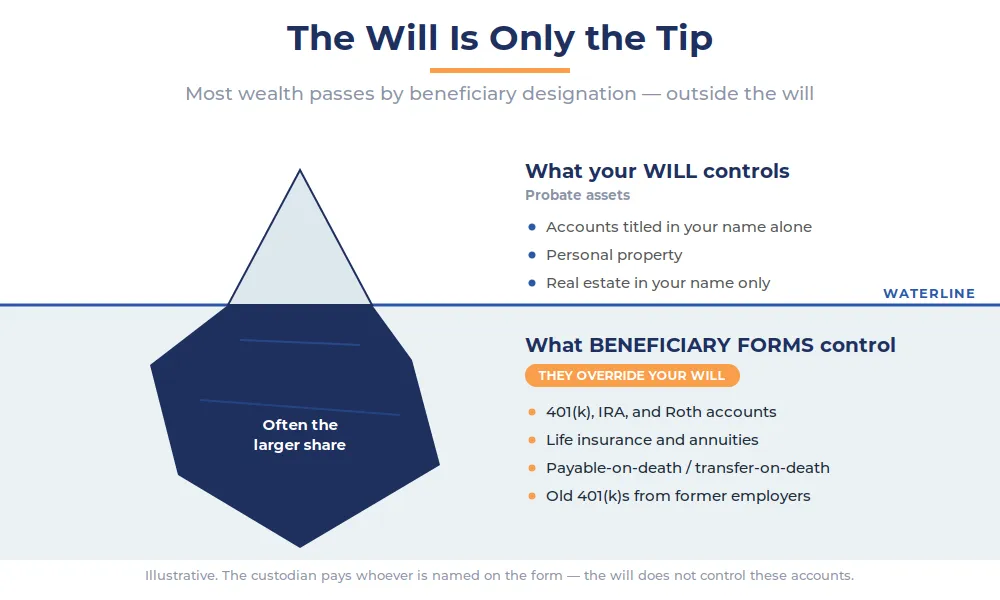
These are what the law calls non-probate transfers. The account doesn’t flow into the estate and get distributed by the will — it goes directly to whoever is named on the form. The custodian pays the named beneficiary. It doesn’t read your will, and in most cases it isn’t allowed to.
That’s efficient when the form is right. It’s a problem when it isn’t — because nothing in your will can fix it after the fact.
The mistakes that actually happen
The form is out of date. This is the big one. An ex-spouse still listed as beneficiary, a deceased parent, a child born after the form was signed and never added. For employer plans governed by federal law, courts have repeatedly required the plan to pay the named beneficiary — even an ex-spouse — regardless of a later divorce decree or will. Updating the form is the only fix.
No beneficiary, or the estate is named. Leave the form blank or name your estate, and the account usually lands in probate. For a retirement account, that’s worse than slow — it can collapse the payout window and accelerate the income tax, because an estate doesn’t get the favorable options an individual does.
A minor is named outright. A minor generally can’t legally receive a large account. Without a named custodian or an appropriate trust, a court may have to appoint a guardian to manage it — slow, costly, and rarely what the parent intended.
The SECURE Act 10-year rule is ignored. Since 2020, most non-spouse heirs must empty an inherited retirement account within 10 years. Under the 2024 final regulations now in effect, if you’d already started your required distributions, your heir also has to take annual withdrawals during that window. A handful of eligible beneficiaries — a spouse, a minor child, the disabled or chronically ill, someone close to your age — can still stretch withdrawals over a lifetime. Who you name directly shapes the tax bill they inherit.
The 401(k) spousal rule is overlooked. If you’re married, most 401(k) plans require your spouse to be the primary beneficiary unless your spouse signs a written, notarized waiver. You can’t simply name someone else. (IRAs generally don’t carry this requirement.)
What to actually do
The fix is unglamorous and fast. Pull every beneficiary form — retirement accounts, old 401(k)s from former employers, life insurance, annuities, HSAs, and any POD/TOD accounts — and confirm the primary and contingent beneficiaries are who you’d want today. Do it after every major life event: marriage, divorce, a birth, a death, a job change.
Then make sure the designations and the will actually agree with each other, and that neither one quietly undoes your estate plan. If a trust is part of the picture, whether a retirement account should name that trust is a real question with real tax consequences under the 10-year rule — one to work through with your estate attorney and CPA, not to guess at. Keep copies, and confirm with each custodian that the forms on file match what you intend.
Your estate plan is only as good as the forms nobody looks at — the beneficiary designations that quietly outrank your will.
The will gets the meeting, the signatures, the binder on the shelf. The beneficiary forms get ignored. But they’re the documents that move most of the money, and reviewing them is the highest-leverage, lowest-cost hour in estate planning. It’s also the one almost nobody schedules. Put it on the calendar.