
A remarried couple may agree that both the surviving spouse and children from prior relationships matter. Then the word “fair” enters the conversation. One person means a home and ongoing cash flow for the survivor. The other means confidence that family property eventually reaches the children. Neither person is necessarily asking for more. They may be asking different questions with the same word.
That tension is not evidence that the family is failing. It is a reason to make the decisions more precise.
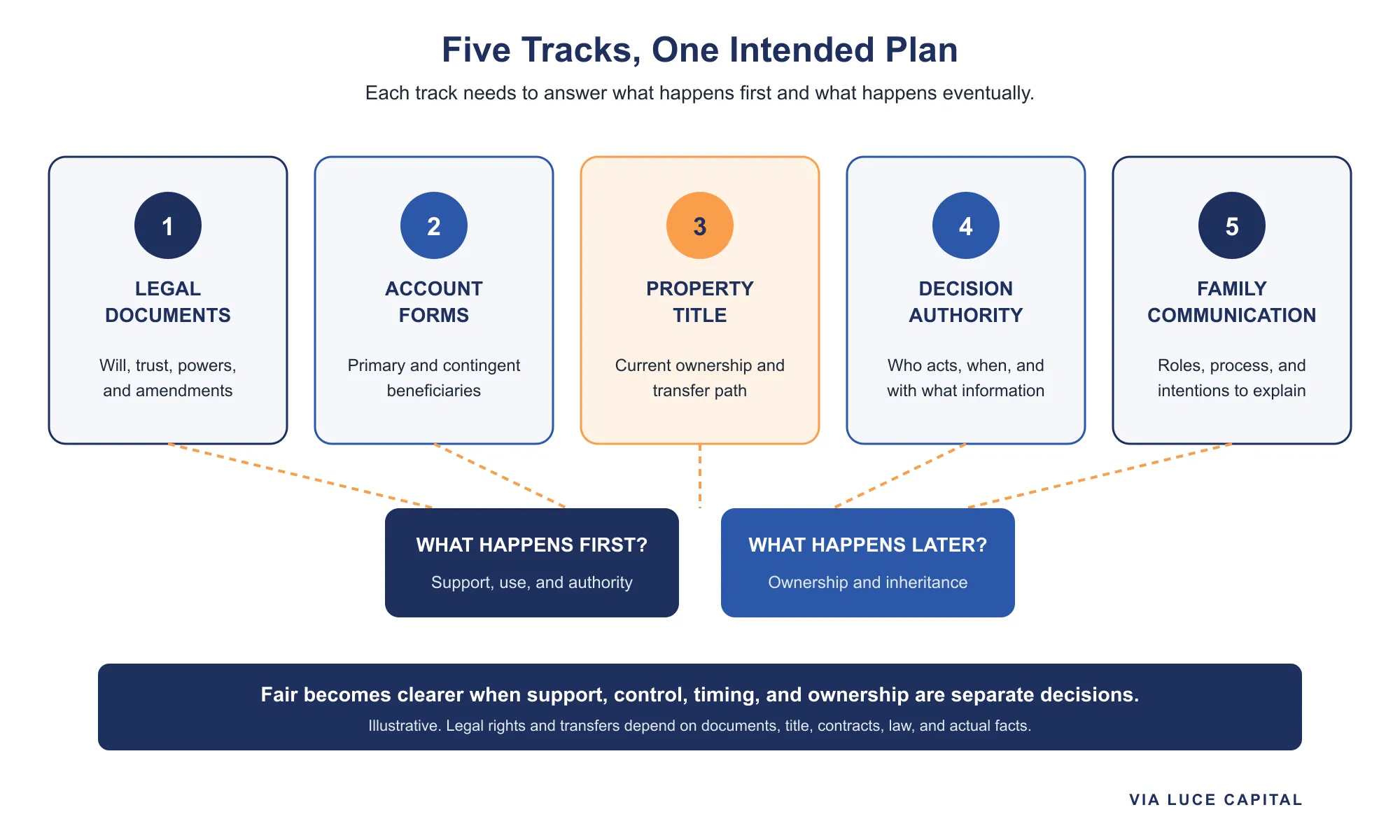
A blended-family estate plan has several tracks: legal documents, account and policy beneficiary forms, property title, decision authority, and family communication. A will or trust may be central, but it does not automatically reconcile every track.
Define “fair” before choosing tools
Before discussing document design, separate the objectives that are often bundled together.
- What housing should be available to the surviving spouse?
- What ongoing cash flow or access to assets does the survivor need?
- Which property has family, business, or emotional significance?
- What should eventually pass to children or other beneficiaries?
- Who should make financial, health-care, trust, or business decisions?
- What does each spouse want the family to understand while both spouses can explain it?
These questions do not have to produce equal answers. They do need answers that are specific enough for an attorney to draft and for account forms and ownership records to support.
Avoid beginning with a product or a trust acronym. A particular tool may address one objective while creating new questions about control, access, taxes, administration, or communication. Define the result first. Let qualified counsel evaluate the tools.
Map how each asset actually transfers
The asset list is more useful when each item shows the instruction that governs it.
Some property may pass under a will or trust. Jointly owned property may pass by title. Retirement accounts and life-insurance policies generally have beneficiary designations. Bank or brokerage accounts may have payable-on-death or transfer-on-death instructions. Business interests may be subject to a buy-sell agreement, operating agreement, or shareholder agreement.
The name on an account statement does not always reveal the complete transfer path. Ask the institution for its current ownership and beneficiary confirmation. Note primary and contingent beneficiaries, and record whether the form has been accepted.
Our article on beneficiary designations explains the core problem: the estate document and the account form may be valid instructions that operate on different assets. A blended-family plan raises the stakes because a designation that once made sense may now sit beside a new marriage, a former spouse, children from different relationships, or a new property-title choice.
Marriage and divorce deserve a document-level review
California law contains rules for a surviving spouse who married the decedent after the decedent signed the relevant testamentary instruments. Probate Code sections 21610 through 21612 describe a potential statutory share and several exceptions. Those provisions are not a substitute for updating the plan, and they do not tell a particular family how every asset will pass.
California also addresses certain nonprobate transfers and joint-tenancy interests involving a former spouse after dissolution or annulment. Those statutes contain exceptions. They also do not govern every life-insurance contract, retirement plan, court order, or federal rule.
Employer retirement plans deserve separate attention. The IRS notes that a qualified domestic relations order may affect plan benefits and directs participants who divorce to request beneficiary-change forms from the employer or plan administrator. A divorce judgment, beneficiary form, plan document, and later marriage should be reviewed as a set, not as interchangeable instructions.
The cautious planning assumption is simple: a life event should trigger a document-by-document review. It should not trigger a confident guess about what the law changed automatically.
Separate use, control, and eventual ownership
A common planning conversation centers on the family residence. “My spouse should be able to stay in the home” still leaves several decisions open.
Who owns the property after the first death? Who pays taxes, insurance, maintenance, and major repairs? May the survivor sell or move? If the property is later sold, who receives the proceeds? What happens if the survivor needs care or wants to live nearer to family? When and under what conditions does any remaining property pass to children?
The same distinction applies to investment and business assets. The person who receives information may not be the person with authority. The person who makes investment or distribution decisions may not be the eventual beneficiary. The person with a right to use property may not own it outright.
Those separations are neither good nor bad by themselves. They are legal and administrative choices with tax, cash-flow, and family consequences. Counsel should explain them in plain language, and the financial plan should test whether the intended access and expenses are practical.
“Fair” becomes useful only after the couple defines support, control, timing, and eventual ownership separately.
Plan for incapacity, not only death
California Courts describes financial powers of attorney and advance health care directives as separate planning documents. A blended family should identify who holds each role, who serves as backup, when authority begins, and where accepted copies are kept.
Do not assume that a spouse, adult child, trustee, or account beneficiary has authority merely because the family expects that person to help. Institutions may require their own forms or review. A password is not a substitute for legal authority.
Role selection also deserves a practical test. Can the person serve? Does the person understand the responsibility? Are two people expected to act together? Could a child from one side of the family be asked to make decisions affecting the other side without enough information or a clear process?
These questions are easier to address while the couple can explain the purpose of each role.
Communicate enough without turning the plan into a family vote
Estate planning belongs to the couple. Adult children and other beneficiaries do not have to approve every decision.
Silence, however, may leave people to interpret the plan during grief or illness. A measured conversation may explain who holds which role, where documents are kept, whom to contact, and what values guided the plan. The couple may choose to keep balances and detailed distribution terms private.
Our discussion of preparing heirs makes a related distinction: preparation is not the same as disclosure. A family can discuss responsibility, communication, and process without turning the conversation into an advance distribution meeting.
Ask the estate attorney which topics are useful to explain, which details should remain private, and whether any conversation should occur with counsel present.
What to consider next
Build a one-page transfer map. Give each material asset one row and record:
- current legal owner;
- governing document, title, contract, or beneficiary form;
- primary and contingent recipient;
- who may use or control the asset after incapacity or the first death;
- who eventually owns what remains; and
- the institution or professional who confirmed the instruction.
On a second page, list every named role: executor, trustee, agent under financial power of attorney, health-care agent, successor owner, business decision-maker, and backup. Flag any person who appears under different names, has not agreed to serve, or may not know where the documents are kept.
Take both pages to qualified California estate counsel. Have the attorney interpret the law and draft the documents. Ask plan administrators, custodians, insurers, and title professionals to confirm their records. Ask the CPA and financial advisor to evaluate the tax and cash-flow interactions without treating that review as legal advice.
The goal is not to make every beneficiary happy with every possible outcome. It is to make the couple’s intentions legible across each document, account, property interest, and decision-making role.
Sources
- California Probate Code sections 21610 through 21612 address a surviving spouse who married the decedent after execution of the decedent's testamentary instruments, including statutory exceptions and the order for satisfying a qualifying share — California Legislative Information, Probate Code §§ 21610–21612, Omitted Spouses
- California Probate Code sections 5040 through 5048 address certain nonprobate transfers and joint-tenancy interests involving a former spouse after dissolution or annulment, subject to stated exceptions — California Legislative Information, Probate Code §§ 5040–5048, Nonprobate Transfer to Former Spouse
- California Courts describes wills, living trusts, payable-on-death accounts, transfer-on-death deeds, financial powers of attorney, and advance health care directives as distinct planning documents or transfer methods — California Courts Self-Help Guide, Wills, estates, and advance care planning
- The IRS directs divorced retirement-plan participants to contact the employer or plan administrator for beneficiary-change forms and notes that qualified domestic relations orders may affect plan benefits — Internal Revenue Service, Retirement Topics - Divorce