
Somebody inherited an IRA in 2021 and was told the rule was simple: empty it within ten years, take it whenever you like. That was reasonable advice at the time. It is not the rule that applies to them now, and for four years nothing happened to make that obvious.
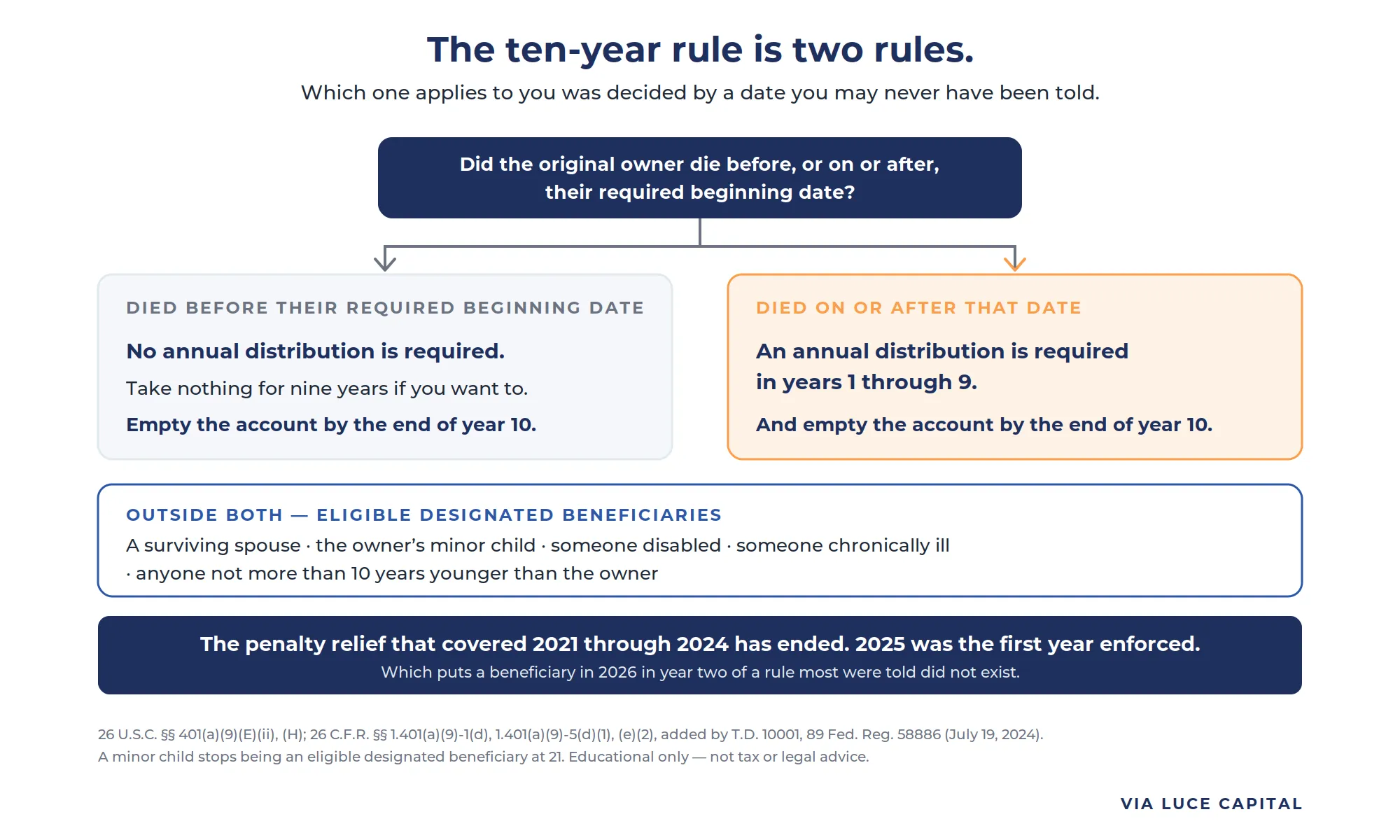
The ten-year rule is not one rule. It is two, and which one applies to a given beneficiary was determined by something they had no part in and may never have been told — the date the original owner died, measured against that owner’s required beginning date.
The fork
If the owner died before their required beginning date, the ten-year deadline is the whole obligation. Nothing has to come out in years one through nine. The account has to be empty by the end of the tenth year.
If the owner died on or after that date, a distribution is required in each of those in-between years as well. The final regulations are explicit: where the owner died after distributions had begun, the annual requirement continues, and the outer boundary is the calendar year containing the tenth anniversary of death. Both apply. Not one or the other.
The required beginning date itself is April 1 of the year after the later of the year the owner reached the applicable age or, for a workplace plan, the year they retired — and that retirement prong is not available to IRA owners or to five percent owners. The applicable age is 73 today and is scheduled to rise.
So the practical question for a beneficiary is narrow and answerable: had the person who left me this account started taking their own required distributions? If yes, there is an annual obligation. If no, there is not.
Why almost nobody noticed
Because for four years, missing one cost nothing.
The IRS issued a series of notices waiving the excise tax for exactly this category of missed distribution — covering 2021 and 2022, then 2023, then 2024. Each one bought a year. The final regulations then landed with an applicability date of January 1, 2025.
There was no gap and there has been no successor. 2025 was the first year the annual requirement was actually enforced, which places a beneficiary in 2026 squarely in year two of a rule a great many people were told did not exist.
Suppose someone inherited an IRA in 2022 from a parent who was 78 and taking distributions. Their ten-year deadline is the end of 2032. But they also owed a distribution in 2025, and owe one in 2026 — and 2025 is behind them.
(Illustrative. Not a real client. The amounts and the deadline depend on the specific account and dates.)
Who sits outside all of this
Eligible designated beneficiaries are not on the ten-year clock in the same way. There are five categories: a surviving spouse, a child of the owner who has not reached majority, someone disabled, someone chronically ill, and anyone not more than ten years younger than the owner.
The minor-child category has a trap in it. Majority is defined as the 21st birthday, and on reaching it the child stops being an eligible designated beneficiary and a ten-year clock starts — which is a deadline arriving at 31 for a reason nobody will remember by then.
What a missed one costs
An excise tax of 25 percent of the amount that should have come out and did not — reduced to 10 percent if corrected within the window the statute provides. It is assessed on the shortfall rather than the account, which keeps it survivable, and the reduced rate is a real reason to fix an old one rather than hope.
What to actually do
- Find the date of death and compare it to the required beginning date. This is the whole question, and it is usually answerable in an afternoon from the account paperwork.
- Do not assume the custodian is computing it. Custodians routinely calculate an owner’s own lifetime distributions. Beneficiary distributions inside a ten-year window are a different calculation, and it is worth confirming rather than assuming it is being run for you.
- If 2025 was missed, address 2025. The reduced rate applies to a correction made in the window, so the cost of dealing with it now is meaningfully lower than the cost of it surfacing later.
- Plan the whole ten years, not the current one. Even where annual distributions are not required, taking nothing for nine years produces a single large taxable event in the tenth. Spreading it may be the better answer, and that decision belongs with a CPA who can see the beneficiary’s other income.
- Check whether the account is a Roth. The lifetime distribution rule does not apply to a Roth IRA, so there is no required beginning date to have died after, and the annual requirement generally does not arise.
The pattern
The rule did not change in 2025. What changed is that it started being enforced — and four years of penalty relief had quietly taught everyone the wrong lesson about what the rule was.
A deadline nobody enforced for four years is still a deadline. It is just one you have had less practice noticing.
Inherited accounts are where planning most often goes unexamined, because they arrive at a moment when nobody is looking for a compliance calendar. The plan is the residue. The planning is the work.
Sources
- For a defined contribution plan, the five-year rule is applied by substituting ten years and applies whether or not distributions of the employee's interest have begun, except in the case of an eligible designated beneficiary — 26 U.S.C. § 401(a)(9)(H)
- The five categories of eligible designated beneficiary — a surviving spouse, a child of the employee who has not reached majority, a disabled individual, a chronically ill individual, and an individual not more than ten years younger than the employee — and the rule that a minor child ceases to be one on reaching majority — 26 U.S.C. § 401(a)(9)(E)(ii)–(iii)
- Where the employee dies after distribution has begun, distributions must continue to satisfy section 401(a)(9)(B)(i); and for a designated beneficiary who is not an eligible designated beneficiary the outer year is the calendar year containing the tenth anniversary of death — 26 C.F.R. § 1.401(a)(9)-5(d)(1), (e)(2), as adopted by T.D. 10001, 89 Fed. Reg. 58886 (July 19, 2024)
- The final regulations apply for purposes of determining required minimum distributions for calendar years beginning on or after January 1, 2025 — 26 C.F.R. § 1.401(a)(9)-1(d); age of majority defined as the 21st birthday at § 1.401(a)(9)-4(e)(3)
- Relief from the excise tax for certain missed distributions in 2021 and 2022, in 2023, and in 2024 respectively — I.R.S. Notice 2022-53; I.R.S. Notice 2023-54; I.R.S. Notice 2024-35
- A tax equal to 25 percent of the shortfall applies where the minimum required distribution exceeds the amount actually distributed, reduced to 10 percent if corrected during the correction window — 26 U.S.C. § 4974(a), (e)
- The required beginning date is April 1 of the calendar year following the later of the year the employee attains the applicable age or the year the employee retires, with the retirement prong unavailable to IRA owners and five percent owners; the applicable age is 73 and is scheduled to rise — 26 U.S.C. § 401(a)(9)(C)(i), (v)
- Section 401(a)(9)(A) does not apply to a Roth IRA — 26 U.S.C. § 408A(c)(4)