

The keys may be sitting on the counter before the family has agreed on the question. Is the house a home someone wants, an asset to sell, or a rental the family is prepared to operate?
An inherited Orange County home rarely arrives as one decision. It arrives as a stack of them: a property-tax filing, an estate-administration task, a cash-flow commitment, and a family conversation. Grief can be fresh. The house can be full of memories and deferred repairs. One sibling may see a future home while another sees an obligation.
The first goal is not to choose among keeping, selling, and renting in a weekend. It is to separate the decisions that have clocks from the decisions that deserve time.
First, separate the filing clock from the family decision
California’s Proposition 19 changed the parent-child property-tax exclusion for transfers on or after February 16, 2021. The old rule did not simply carry forward.
For a family home to be considered for the current exclusion, it generally must have been the transferor’s principal residence and must become or continue as an eligible transferee’s principal residence. The current Orange County BOE-19-P instructions say the transferee must file and be eligible for the homeowners’ or disabled veterans’ exemption within one year of the transfer date. For property inherited through a trust, will, or intestate succession, the form identifies the date of death as the change-in-ownership date.
That distinction matters. The clock may start before the family has distributed the property, finished probate, cleared the house, or agreed on a long-term plan.
The BOE-19-P claim itself is generally timely if filed within three years after the transfer or before the property is transferred to a third party, whichever comes first. The one-year principal-residence exemption requirement is the more immediate decision point. The form notes that prospective relief may be available after missed deadlines, but that is not the same as receiving the full treatment from the original transfer date.
Prop 19 also places a value limit on the exclusion. The current formula uses the home’s factored base-year value plus a biennially adjusted allowance; value above that limit is added to the taxable value. Because the allowance changes and the Assessor applies the rule to the property, use the current BOE materials rather than an old article or remembered threshold.
Prop 19 does not answer the keep-or-sell question
The exclusion is important, but it is one input. A lower assessed value does not make a house inexpensive to own, and reassessment does not automatically make selling the right answer.
Before comparing the paths, gather the same facts for all three:
- the current title, ownership percentages, and authority to act;
- the Assessor’s present taxable value and a current estimate under each occupancy scenario;
- any mortgage, lien, or required estate expense;
- an inspection or practical list of near-term repairs;
- current insurance availability, limits, and premium;
- expected maintenance, association dues, utilities, and property-management costs;
- a qualified value for estate, basis, buyout, and sale discussions; and
- each heir’s need for liquidity, willingness to share decisions, and preferred timeline.
This is where property tax and income tax need to stay separate. Prop 19 concerns California property-tax reassessment. The income-tax basis of inherited property is a different question, discussed in our overview of step-up in basis, and it belongs with the estate’s CPA and attorney.
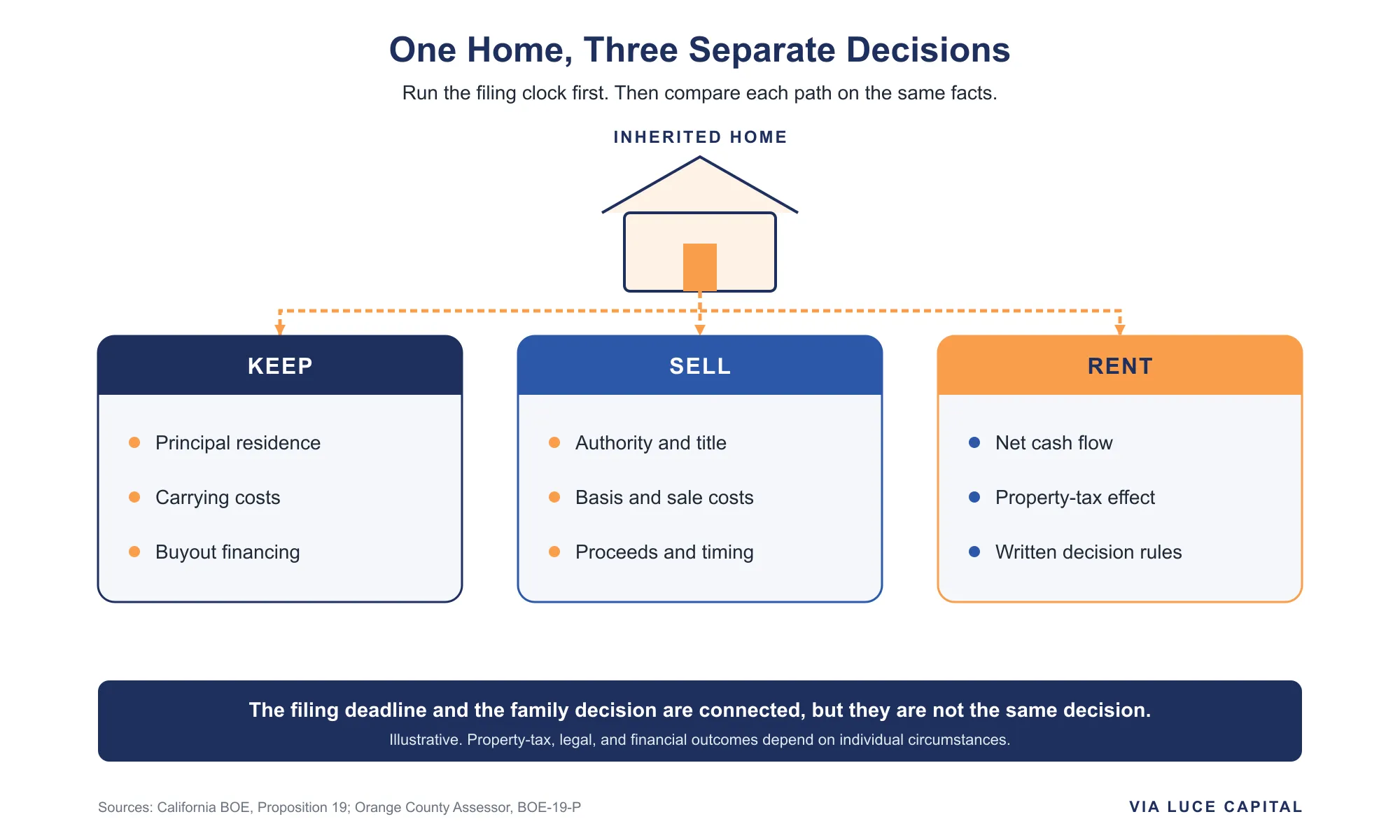
Keeping it: treat the house as a housing decision
If an heir genuinely wants to live in the home, start with that preference—but do not stop there. Ask whether the home fits that person’s life, location, cash flow, and willingness to take on the property as it is today.
The comparison should include more than the mortgage. Property tax, insurance, repairs, utilities, association costs, and the cash needed to buy out other heirs can turn a low-tax home into a large monthly commitment. If a buyout requires financing, the lender may view the transaction differently from an ordinary purchase, and the title plan has to align with the estate documents.
Keeping the home may also concentrate a substantial share of one person’s balance sheet in a single property. That is not automatically wrong. It simply means the family should name the tradeoff instead of letting sentimental value obscure it.
Selling it: treat speed and certainty as separate goals
A sale converts an indivisible property into cash the heirs can divide, which may make administration and family decisions simpler. But a rushed sale can create its own problems if the estate has not confirmed authority, basis records, required disclosures, repairs, or how sale expenses will be allocated.
Ask what must happen before the home can be listed, who has authority to sign, whether the estate or trust should sell, and how the proceeds will be held while tax and administration questions remain open. The highest offer is not the only variable; timing, contingencies, repair requests, and certainty of closing all matter to the estate’s cash-flow plan.
If an heir may want to buy the others out, establish the valuation and financing process before placing the property on the market. A vague family understanding becomes harder to unwind once an outside offer is on the table.
Renting it: treat the home as an operating business
The rental path is often framed as the middle ground: do not sell yet, collect rent, and decide later. In practice, it adds a new set of decisions.
Gross rent is not spendable cash flow. Vacancy, repairs, management, insurance, property tax, association rules, legal compliance, and capital projects all sit between the rent collected and the amount available to the owners. The family also needs a reserve for months when expenses arrive before rent does.
Then there is governance. Who chooses the tenant? Who approves repairs? Who keeps the books? How are cash calls handled if rent does not cover a major expense? Can one sibling force a sale, and how is a buyout priced? A co-owned rental can function well when those answers are written down. Without them, the property can turn every maintenance decision into a family vote.
Renting from the outset also generally does not satisfy Prop 19’s principal-residence condition for the family-home exclusion. That property-tax effect belongs in the rental forecast before anyone relies on a headline rent estimate.
Use one sequence for all three paths
A calm process usually runs in this order:
- Confirm the transfer date and filing status. Ask the Orange County Assessor which forms and exemptions apply to the actual ownership and occupancy facts.
- Confirm authority and title. The trustee, personal representative, beneficiaries, and current deed may not have interchangeable powers.
- Build a property fact sheet. Use current tax, insurance, debt, repair, value, and rental information—not family memory.
- Name each heir’s constraints. Liquidity needs, housing interest, risk tolerance, and decision horizon can differ without anyone being unreasonable.
- Compare the paths on the same time period. Include the cash needed now, likely ongoing costs, responsibilities, and what would cause the family to revisit the choice.
- Document the decision. If ownership continues, put decision rights, expense sharing, and an exit process in writing with qualified counsel.
The filing deadline and the family decision are connected, but they are not the same decision.
What to consider next
Start with a one-page inventory, not a conclusion. Write down the date of death, current ownership, occupancy plans, Assessor correspondence, mortgage, insurance, known repairs, estimated value, and each heir’s preferred outcome. Mark the items that are verified and the ones that are still assumptions.
Then place that page in front of the Orange County Assessor, the estate attorney, and the CPA. Their answers establish the tax and legal boundaries. A financial planning conversation can then compare how keeping, selling, or renting would affect liquidity and the rest of each household’s plan.
The house may eventually become a home, a sale, or a rental. The immediate work is making sure an unexamined deadline, an incomplete cash-flow estimate, or an unwritten family expectation does not make the choice by accident.
Sources
- Prop 19 parent-child and grandparent-grandchild exclusion rules, including principal-residence requirements and filing periods — California State Board of Equalization, Proposition 19
- Orange County family-transfer information and local filing direction — Orange County Assessor, Transfer Property Among Family
- For an inherited family home, date of death is the change-in-ownership date; the transferee principal-residence exemption must be filed within one year; BOE-19-P is generally timely within three years or before a transfer to a third party, whichever comes first — Orange County Assessor and California State Board of Equalization, BOE-19-P, Rev. 04 (07-25)