

For a decade, estate planning came down to one instinct: keep your assets under the estate-tax line. Then the line moved — to $15 million per person, permanently. For almost everyone, the tax you spent years planning around is simply gone. The planning isn’t.
When the 2025 law made that exemption permanent, it didn’t end estate planning. It changed what estate planning is for. The old game was shrinking your taxable estate to dodge a 40% tax. The new game, for the overwhelming majority of families who will never owe that tax, is income tax — and the most valuable move on the board is one you already own.
The break you already have
When you die, the assets your heirs inherit get their cost basis reset to fair market value as of your death. It’s called the step-up in basis, and it quietly erases every dollar of capital gain that built up during your lifetime.
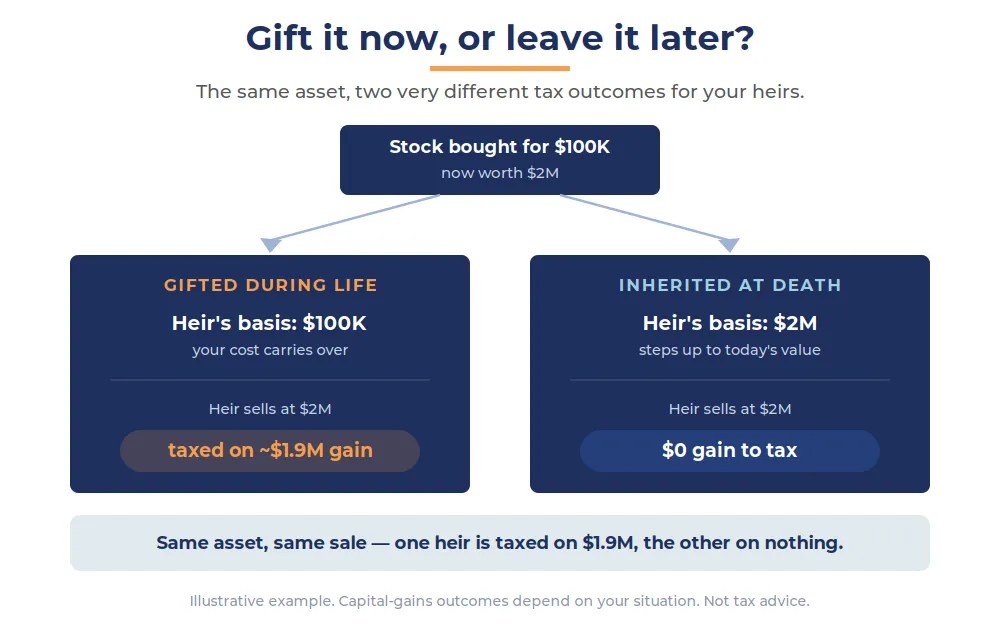
An example makes it concrete. Say you bought a stock decades ago for $100,000 and it’s worth $2 million today. If your heir inherits it, their basis becomes $2 million. They could sell the next day for $2 million and owe essentially nothing in capital gains tax. The $1.9 million of appreciation you rode for thirty years vanishes for tax purposes. For most families, that step-up is now the single most valuable tax feature in the entire estate.
The trap hiding in “just give it to the kids now”
Here’s where good intentions go wrong. A lot of people assume the smart move is to gift appreciated assets to their children during life. But a lifetime gift doesn’t get the step-up. The recipient takes your original cost basis — what’s called carryover basis.
Same stock: you gift it while it’s worth $2 million, but your $100,000 basis goes with it. If your child sells, they’re taxed on $1.9 million of gain. The identical asset, handed over two different ways, produces a wildly different tax bill — and the “generous” lifetime gift is the expensive one.
That doesn’t make gifting wrong. Cash carries no embedded gain, so gifting it is clean. Assets you expect to keep climbing can still make sense to move out of a taxable estate for the few families above the exemption. But for highly appreciated assets your heirs are likely to sell, inheriting usually beats gifting by a wide margin — and the old reflex to “give it away now” can quietly cost the next generation.
Your old estate plan may now work against you
If your estate plan was drafted before 2025, it was almost certainly built with a goal to fight a battle that’s over. Many plans from the last decade used trusts and large defensive gifts to pull assets out of the taxable estate ahead of the expected sunset. That sunset never came.
Worse, some of those very structures can now backfire. Certain trusts designed with a goal to keep assets out of your estate also keep them from getting the step-up — meaning a plan built with a goal to save estate tax you’ll never owe could deny your heirs the basis step-up that’s now worth far more. A plan that was sophisticated in 2020 may be actively counterproductive today. It deserves a fresh look with your attorney.
From estate tax to income tax
Notice how completely the orientation flips. For years the goal was to get assets out of the estate. For most families now, it’s often the reverse — keep appreciated assets in the estate so they earn the step-up, and spend your planning energy on income-tax efficiency instead.
That’s a genuinely different discipline, and it doesn’t live neatly in one professional’s office. It sits between your estate attorney, who controls the documents, and your CPA, who controls the basis and income-tax math. Getting it right means the two of them — and your overall plan — actually talking to each other. That coordination is the whole job.
What this means for you
If your estate is under roughly $15 million single or $30 million married, federal estate tax is likely a non-issue — so the energy belongs on basis and income-tax planning, not estate-tax avoidance. Be deliberate before gifting appreciated assets; the step-up may make inheriting the better deal. And if your documents predate 2025, have them reviewed before an outdated structure costs your heirs the break that now matters most.
Where this leaves you
The estate tax was the boogeyman behind a generation of planning. For almost every family, it’s gone. What’s left is quieter and, for most people, worth more: making sure the assets you leave arrive with their gains wiped clean — and that nothing in the plan you built years ago accidentally throws that away.
For most families, the most valuable estate-tax break isn’t a strategy you buy. It’s one you already have — unless you give it away.
The tax you feared is gone. The work now is making sure the plan you built with a goal to avoid it doesn’t cost your heirs the break that replaced it.
Sources
- Federal estate and gift tax basic exclusion amount of $15,000,000 for 2026 — IRC §2010(c)(3), as amended by the One Big Beautiful Bill Act, P.L. 119-21 §70106; IRS Revenue Procedure 2025-32
- Basis of property acquired from a decedent (step-up to date-of-death value) — IRC §1014
- Basis of property acquired by gift (carryover basis) — IRC §1015
- $19,000 annual gift tax exclusion for 2026 — IRS Revenue Procedure 2025-32, §4.42(1)