
The agreement was signed years ago. The policies were purchased. Everyone remembers the basic promise: if an owner dies, the business or the other owners buy the interest. Then someone asks a harder question: “If that happened now, would the documents, dollars, and valuation still describe the same transaction?”
That question does not mean the original planning failed. Businesses change. Ownership changes. Insurance policies change. Valuation formulas that once seemed practical may drift away from the company’s economics. Family and estate plans may change while the business agreement remains untouched.
A buy-sell agreement is the legal framework for a future transaction. It is not the funding, the valuation, or the final ownership result by itself. Those pieces need to be reviewed together.
A signed agreement is the start of the review
Begin by identifying who is expected to do what when a triggering event occurs.
- Is the company expected to redeem the departing or deceased owner’s interest?
- Are the remaining owners expected to purchase it directly?
- Does the agreement create a mandatory transaction, an option, or a sequence of rights?
- Who owns the insurance policies, and who receives the proceeds?
- Who receives the purchase price: the owner, the estate, a trust, or another party?
- What ownership remains after the transaction is complete?
Those questions sound basic. They often sit in different files maintained by different professionals. The attorney has the agreement. The insurance professional has the policy records. The CPA has the entity and owner information. The valuation professional may have an older report. The family estate plan may name people or trusts that the business records do not mention.
The first useful deliverable is not a new structure. It is one current diagram showing the parties, documents, money, and ownership before and after the event.
What Connelly decided - and what it did not
The Supreme Court’s 2024 decision in Connelly v. United States is a reason to revisit the coordination, not a reason to assume every agreement is defective.
The case involved a closely held corporation that owned life insurance on its owners and was obligated to redeem a deceased owner’s shares. For federal estate-tax valuation under the facts presented, the Court held that the corporation’s contractual redemption obligation did not reduce the value of the deceased owner’s shares. The insurance proceeds received by the company affected the company’s value, while the redemption did not reduce the remaining owner’s economic interest in the way the estate argued.
The Court also limited its holding. It did not say that a redemption obligation can never reduce corporate value. It noted that an obligation requiring liquidation of operating assets, for example, could affect future earning capacity. The decision also did not declare that every business should use a cross-purchase arrangement or another particular design.
The practical lesson is narrower: do not assume that the agreement’s purchase price, the insurance amount, the company’s balance sheet, and the federal estate-tax value automatically offset one another.
Trace the dollars and the ownership
Read the agreement beside the current policy records and ownership ledger. Follow the transaction step by step.
If the company receives insurance proceeds, what does the agreement require the company to do with them? If an owner receives proceeds, which shares may that owner purchase? If proceeds are less than the transaction obligation, where would the remaining cash come from? If proceeds exceed the amount used, where does the balance remain?
Then look past the payment. A company redemption and an owner purchase may leave very different ownership percentages, balance sheets, basis questions, and governance responsibilities. Those differences belong in the legal and tax review. They should not be inferred from an insurance illustration or a line in the agreement summary.
Policy ownership and beneficiary records need their own confirmation. A business may have changed entities, added owners, refinanced debt, or updated an estate plan since the policies were issued. A current carrier statement and ownership confirmation are more useful than a memory of what was arranged.
The same discipline applies outside the business. Our article on beneficiary designations explains why an account or policy form may operate on a track separate from a will or trust.
Test the valuation language against the current business
The agreement may use a fixed value, a formula, periodic appraisal, negotiated value, or a process that begins when the event occurs. Each approach asks a different practical question.
If the agreement names a fixed amount, when was it last updated? If it uses a formula, do the defined terms still match the company’s financial statements and current economics? If it calls for an appraisal, is the standard of value clear, and is there enough current information for the appraiser to do the work?
The IRS identifies multiple factors relevant to closely held business valuation, including net worth, earning power, history, industry conditions, goodwill, comparable interests, and supporting financial records. A single formula may not answer every valuation question for every purpose.
Internal Revenue Code section 2703 adds another legal layer. It generally directs estate- and gift-tax valuation to disregard certain purchase rights or sale restrictions unless the arrangement meets all of the statute’s requirements. Whether an agreement satisfies those requirements is a legal and tax conclusion, not something the business owner should decide from a summary article.
This is also where the succession review connects to operating value. What drives business value addresses the business characteristics a buyer may examine. A buy-sell review asks a related but different question: how will the agreement translate that business into a specific owner-level transaction?
Test the funding without assuming the result
Funding should be compared with a current transaction estimate, not the agreement’s original assumptions.
Ask the licensed insurance professional to confirm policy ownership, beneficiary designations, current death benefit, premiums, loans or withdrawals, contractual values and nonguaranteed assumptions, and the administrative steps expected after a death. Ask the attorney and CPA how those facts interact with the agreement and entity structure. Ask the valuation professional to explain the valuation date, standard, and information needed.
Insurance may be one source of liquidity. It is not the legal obligation and does not establish the business value. If there may be a gap between the expected proceeds and the expected purchase obligation, the owners need to understand the possible sources of cash, financing, or transaction delay without assuming that any one source will be available on acceptable terms.
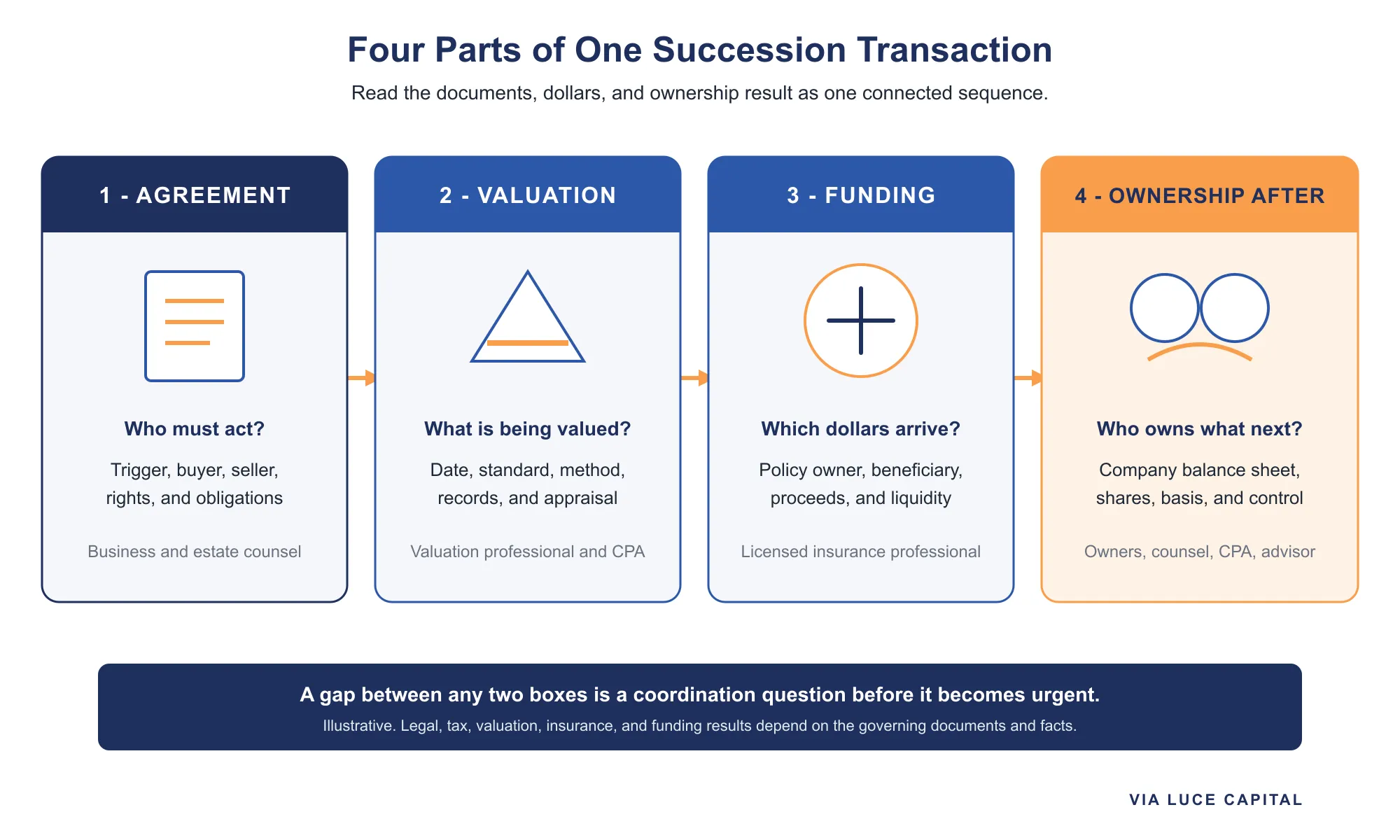
The agreement, the value, the funding, and the ownership result are four parts of one transaction. A gap between them is a coordination question before it becomes an emergency.
What to consider next
Create a one-page succession map with four columns: agreement, valuation, funding, and ownership afterward. Under each column, list the current document, date, responsible professional, and unresolved question.
Then convene one review using the same information set. Include the current agreement and amendments, entity and ownership records, recent financial statements, the latest valuation, policy statements and ownership confirmations, and the relevant estate-plan and beneficiary documents.
Ask the team to reconcile the sequence in writing:
- What event activates the agreement?
- Who has the right or obligation to purchase?
- How is the interest valued for the transaction, and what other valuation questions remain?
- Who receives the funding, and what obligation does it address?
- What does the company and family ownership look like afterward?
That review belongs inside the broader exit timeline described in The Exit Is Won Before the Sale. An owner’s death is not the only reason to test continuity. Disability, retirement, disagreement, and an outside offer may expose the same gaps.
The goal is not to choose a new structure from an article. It is to determine whether the structure already on paper still describes the business, the policies, and the ownership result the owners intend.
Sources
- The Supreme Court held in Connelly that the corporation's contractual obligation to redeem the deceased owner's shares did not reduce the value of those shares under the facts presented, while expressly declining to hold that a redemption obligation can never reduce corporate value — Supreme Court of the United States, Connelly v. United States, 602 U.S. 257 (2024)
- Internal Revenue Code section 2703 generally disregards certain below-market purchase rights and sale restrictions for estate- and gift-tax valuation unless the arrangement satisfies all three statutory exceptions — 26 U.S.C. § 2703, Certain rights and restrictions disregarded
- IRS estate-and-gift-tax examination guidance asks for governing instruments, ownership records, buy-sell agreements, appraisals, valuation methods, and supporting financial information when reviewing a closely held business interest — Internal Revenue Service, IRM 4.25.5.2.6, Closely Held Business Lead Sheet
- The IRS identifies net worth, earning power, business history, industry conditions, goodwill, comparable interests, and complete supporting financial information among the factors relevant to valuing closely held business interests — Internal Revenue Service, Publication 561 (December 2025), Determining the Value of Donated Property