
For most owners, the business is the single largest thing they own — and at the same time the least liquid, least diversified, and least planned-for. It’s the most important financial event of their life waiting to happen, and most treat it as a someday transaction: find a buyer, sign the papers, ride off. The data says that’s almost exactly backwards.
The most concentrated bet you’ll ever make
The Exit Planning Institute estimates that 70 to 80% of a typical owner’s net worth is locked inside their business. Sit with that. If a client walked in with 80% of their wealth in a single stock, you’d call it a dangerous concentration and start trimming. The owner’s balance sheet is that stock — except you can’t sell a slice on a Tuesday. It’s one illiquid asset, tied to one industry, one customer base, one key person: you.
Most businesses that go to market never sell
Here’s the number that should reorder priorities. Only 20 to 30% of businesses that go to market actually sell. Meanwhile, 51% of the U.S. business market is owned by Baby Boomers heading for the exits, three-quarters of owners want out within a decade, and half want out within five years. A wave of supply is coming, and most of it won’t find a buyer.
That failure usually isn’t the economy. It’s readiness. A business that can’t run without its owner, that has messy financials or a single dominant customer, isn’t a business a buyer can confidently take over — it’s a job that happens to have your name on it.
The exit is won before the sale
The value a buyer will pay isn’t decided at the closing table. It’s built in the years before it — by making the company less dependent on you, cleaning up the financials, diversifying the customer base, and building a team that stays. The old line is exactly right: work on the business, not just in it. By the time the letter of intent arrives, the value is already largely set. The owners who command strong offers started enhancing transferability long before they had a buyer in mind.
The number you want versus the number you need
Most owners fixate on a headline figure — the number they want to see on the check. The number that actually matters is different: whether the after-tax proceeds will fund the life they want for the rest of it. The gap between those two is where exits quietly fail. A sale is also a major taxable event, and how it’s structured can move the net proceeds substantially — which is precisely why that math belongs years ahead of a deal, worked through with your CPA and attorney, not discovered during due diligence.
The part almost no one plans: the life after
This is the most overlooked finding in the research, and the most human. About 76% of owners regret selling within a year — and a major reason is that 60% had no plan for what came next. The business wasn’t just income; it was identity, structure, purpose, and the place they were needed every morning. Sell that without a plan for the void it leaves, and the check doesn’t fix it.
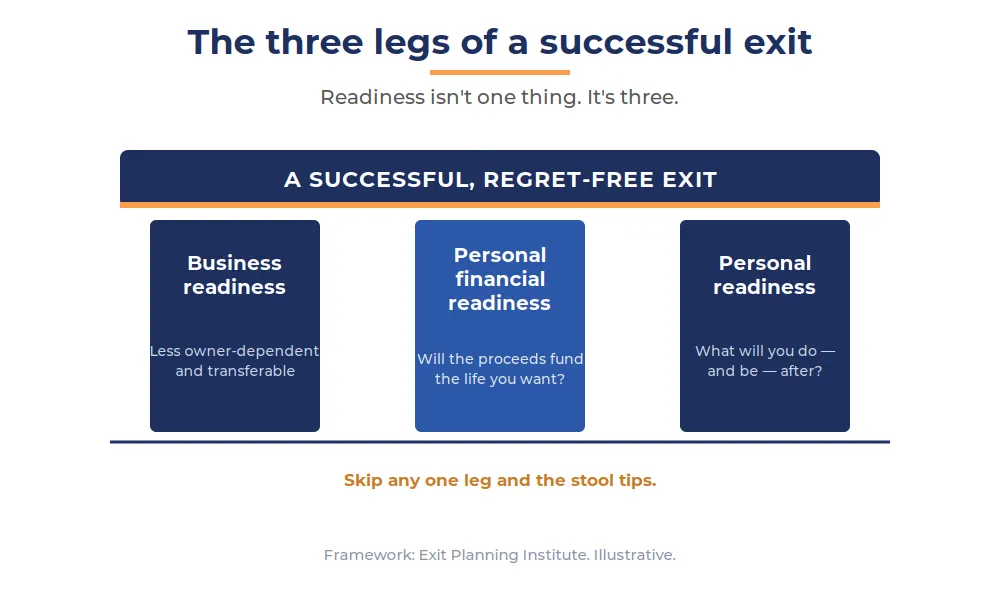
That’s why exit planning rests on three legs, not one: business readiness (is the company sellable?), financial readiness (do the proceeds fund your life?), and personal readiness (who are you, and what do you do, after?). Skip any leg and the stool tips.
Where a planning-led advisor fits
Only 5% of Boomer owners have a dedicated exit team — which is striking given that for most of them, this is the largest financial transaction of their lives. The M&A advisor sells the company. The attorney structures the deal. The CPA handles the tax. But the two legs that determine whether you’re actually better off — financial readiness and personal readiness — need a coordinator who knows your whole picture. That’s the work a planning-led advisor is made for, and it’s the reason the exit-planning credential exists. If your path is handing the business to family rather than selling, the case for starting early is even stronger: only 40% of family businesses survive to the second generation, and 13% to the third.
Where this leaves you
You spent decades building the most valuable asset you own. It deserves more than a someday. The owners who exit well — who sell at a strong number, keep enough of it, and are glad they did a year later — almost all have one thing in common: they started years before they had to, and they planned three readinesses instead of one transaction.
By the time you’re at the closing table, the value is already decided.
You built it over decades. The exit is worth planning like it.
Sources
- Approximately 76% of owners report regret within a year of selling — Exit Planning Institute, citing PwC / EPI owner-transition research — VERIFY EDITION BEFORE PUBLISH
- Share of U.S. businesses owned by Baby Boomers and family-transition success rates — VERIFY — attribute per ART about.pdf #5 pattern (asterisk + named source) or soften the claims
- 70–80% of a typical business owner's net worth concentrated in the business — Exit Planning Institute, State of Owner Readiness Report