

Every December, some version of this conversation happens: buy the equipment before year end and write the whole thing off. It is usually good advice. It is also a decision with a second half, and the second half arrives at a closing table three or four years later.
Full expensing is permanent now. The 100 percent first-year deduction applies to property acquired after January 19, 2025, and the schedule that would have phased it down to 20 percent in 2026 and to nothing after that was struck out of the Code.
For an owner running a capital-intensive business, that is straightforwardly useful. Cash stays in the business. The deduction is not a race against a sunset any more.
The part that gets less attention is what full expensing does to basis, and what basis does at a sale.
The deduction is a timing decision
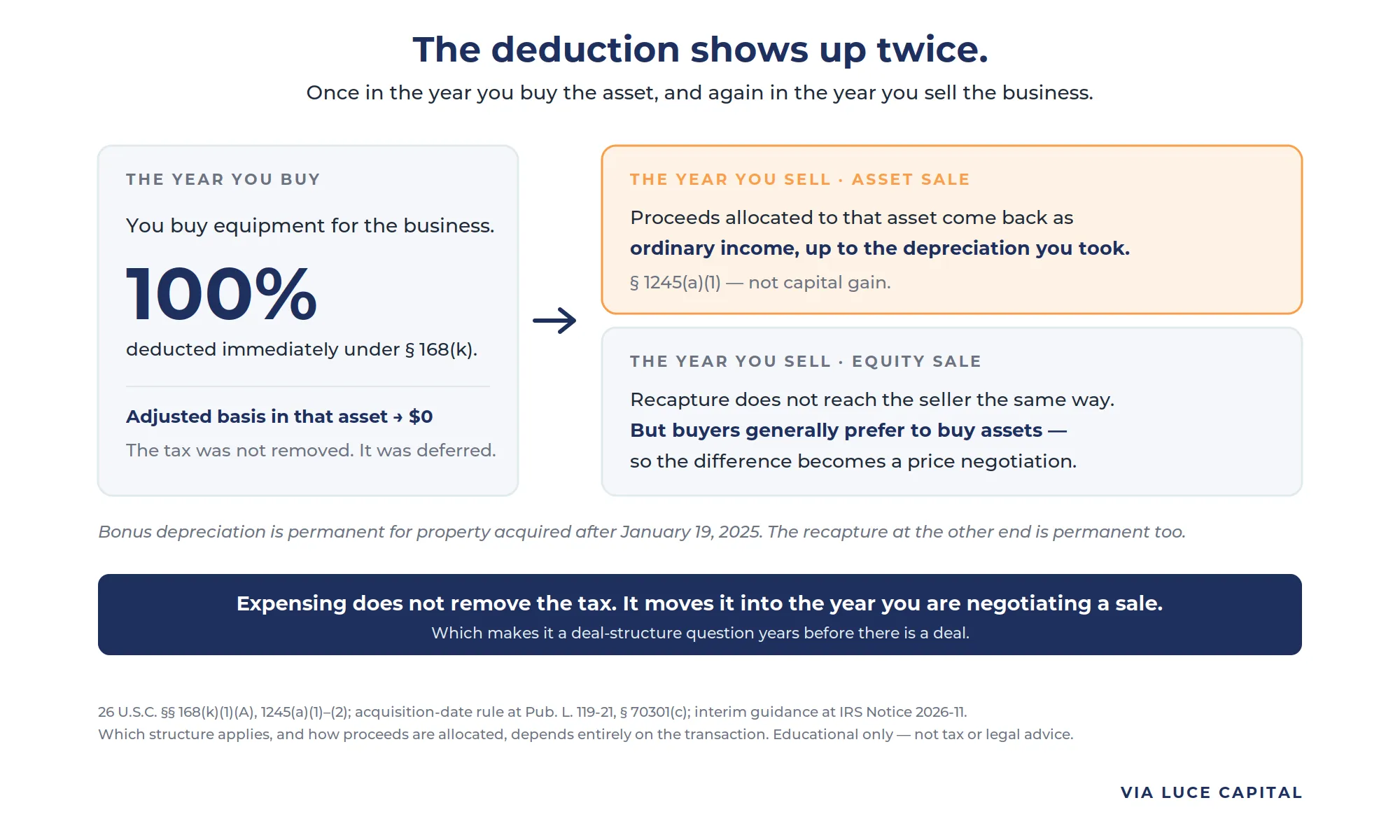
Write off the entire cost of an asset in year one and its adjusted basis goes to zero.
Basis is the amount you recover tax-free when you eventually sell something. Drive it to zero and every dollar of proceeds allocated to that asset is gain.
Worse — from a rate perspective — that gain is not capital gain. When section 1245 property is disposed of, gain is treated as ordinary income to the extent of the depreciation adjustments sitting in its basis. Fully expensed equipment has no basis left to shelter anything, so the proceeds allocated to it come back at ordinary rates.
The deduction was real. So is the recapture. What happened is that a liability moved from one year into another — and it happened to move into the year with the most going on.
Which makes it a structure question, not only a tax question
Consider an owner who bought $500,000 of equipment and expensed all of it. Four years later the business sells, and $300,000 of the purchase price is allocated to that equipment. Basis is zero, so the entire $300,000 is gain — and because of recapture, it is ordinary income rather than capital gain. The rate difference on that slice is the cost of the earlier deduction, arriving late.
(Illustrative. Not a real client. Allocation, structure, entity type, and state treatment all change the answer.)
Now the structural part. In an asset sale, the entity disposes of the assets and recapture is determined there. In an equity sale, the buyer acquires ownership interests, the assets are not disposed of in the same way, and the seller’s exposure looks different.
Buyers generally want assets. They get a stepped-up basis and a cleaner liability position, and they are usually willing to pay something for it. An owner carrying a large recapture exposure is therefore negotiating from a narrower position than one who is not — the asset structure the buyer prefers is the structure that costs the seller more.
None of that argues against expensing. It argues for knowing the number before someone else does.
What else moved
Three other changes are worth an owner’s attention, and one of them removes a clock.
Section 179 sits at $2,560,000 for 2026, phased down above $4,090,000 of qualifying property. It remains the more selective tool where bonus depreciation is the blunt one.
Domestic research expensing was restored for taxable years beginning after December 31, 2024. Foreign research still gets capitalized. There is an election to capitalize domestically over not less than sixty months, and smaller taxpayers had a retroactive option with its own deadline.
The qualified business income deduction no longer has a termination date, and it now carries a minimum deduction of $400 for taxpayers with at least $1,000 of qualified business income from an active business. The permanence matters beyond the arithmetic: an expiring deduction had been pulling some exit timelines forward. That particular reason to hurry is gone.
What an owner can usefully do
- Ask your CPA for the recapture number. Not the depreciation schedule — the exposure. What would be ordinary income today if the assets were sold at a reasonable allocation. It is a knowable figure and most owners have never seen it.
- Ask it again before you take a large deduction, if a sale is within a few years. Expensing that makes obvious sense at five years out is a closer call at eighteen months.
- Get the structure conversation started early. Asset versus equity is usually framed as a negotiation item. It is more useful as a planning input, because the years before a transaction are when the inputs can still change.
- Keep the CPA and transaction counsel in the same conversation. The deduction and the disposition are the same decision viewed from two ends, and they are usually handled by two different people who have never spoken.
The pattern
The tax move that looks obviously correct in isolation is frequently a timing decision wearing a discount’s clothing. Not wrong — just incomplete, because the second half arrives on a date nobody was thinking about when the first half was taken.
A deduction you take in December is a number someone else prices in a diligence room.
The value of planning years out is not that it finds a better answer to the December question. It is that it asks the December question and the exit question at the same time. The plan is the residue. The planning is the work.
Sources
- The additional first-year depreciation deduction is 100 percent of the adjusted basis of qualified property, with no expiration in the Code — 26 U.S.C. § 168(k)(1)(A)
- The 100 percent rate applies to property acquired after January 19, 2025; the former phase-down schedule at section 168(k)(6) and (k)(8) was struck — Pub. L. No. 119-21, § 70301(b)(1)(B), (c), 139 Stat. 72, 189 (2025)
- Interim guidance on the additional first-year depreciation deduction as amended, including the transition election and the prior phase-down percentages — I.R.S. Notice 2026-11 (announced by IR-2026-06, Jan. 14, 2026)
- On disposition of section 1245 property, the amount by which the lower of recomputed basis or the amount realized exceeds adjusted basis is treated as ordinary income; recomputed basis is adjusted basis plus adjustments reflected for depreciation or amortization — 26 U.S.C. § 1245(a)(1)–(2)
- 2026 section 179 expensing limitation of $2,560,000, reduced dollar-for-dollar above a $4,090,000 threshold — IRS Revenue Procedure 2025-32, § 4.24
- The qualified business income deduction no longer contains a termination provision, and a minimum deduction of $400 applies to taxpayers with at least $1,000 of aggregate qualified business income from active qualified trades or businesses — 26 U.S.C. § 199A(i); IRS Revenue Procedure 2025-32, §§ 2.12, 4.26
- Domestic research or experimental expenditures are deductible in the year paid or incurred, for amounts paid or incurred in taxable years beginning after December 31, 2024, with an election to capitalize over not less than 60 months; foreign research remains subject to capitalization — 26 U.S.C. § 174A(a)–(c); Pub. L. No. 119-21, § 70302, 139 Stat. 190; Rev. Proc. 2025-28