Two businesses can post the identical profit and sell for wildly different prices — sometimes double. The gap isn’t the earnings. It’s everything around the earnings, and most of it is buildable years before you ever decide to sell.
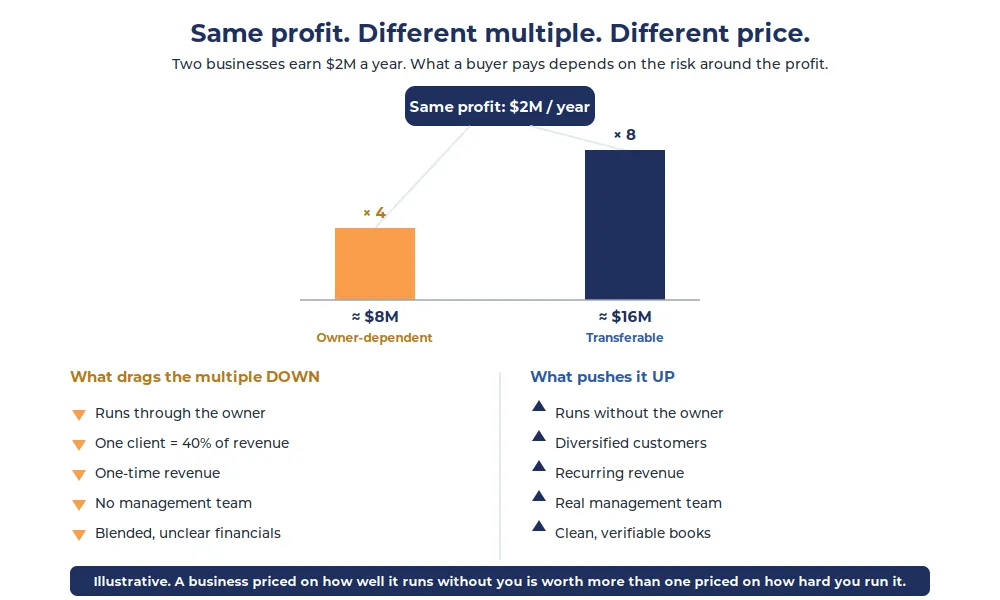
Two businesses sit side by side. Same industry, same $2 million in annual profit, same growth rate. One sells for four times earnings. The other sells for eight. The difference isn’t the profit — it’s everything around the profit.
Most owners think business value is arithmetic: take the earnings, apply a multiple, done. The earnings part is real. The multiple is where the actual money is made or lost, and it has almost nothing to do with how hard you work. It reflects a single question the buyer is really asking: how much risk am I taking on, and how much of this depends on the person selling it to me?
The wider the answer, the wider the gap between what you think your business is worth and what someone will actually pay for it.
Value is priced on risk, not effort
A buyer isn’t purchasing last year’s profit. They’re purchasing the likelihood of future profit — and paying more when that likelihood looks durable and less when it looks fragile. Everything that makes future earnings more certain and less dependent on any one person raises the multiple. Everything that makes them shaky pulls it down.
That reframe matters because owners tend to optimize for the wrong thing. Years of grinding to squeeze out more profit can build a business that’s more valuable to run and less valuable to sell — because the whole thing runs through the owner.
The levers that move the multiple
A handful of factors do most of the work in separating the four-times business from the eight-times one.
-
Owner dependence. This is the big one. If the business can’t run without you — you hold the key relationships, the operating knowledge, the decisions — a buyer isn’t buying a company, they’re buying a job that depends on you leaving. The more the business runs without you, the more it’s worth. Reducing owner dependence is the single highest-leverage thing most owners can do.
-
Customer concentration. If one client is 40% of revenue, the buyer sees a business that could lose nearly half its sales with one phone call. Diversified revenue across many customers is worth a premium because it’s durable.
-
Recurring vs. one-time revenue. Predictable, repeating revenue — contracts, subscriptions, retainers — is worth far more than the same dollar of revenue that has to be won again from scratch every year. Recurring revenue is the difference between owning a reservoir and owning a rainstorm.
-
A management team that isn’t you. A business with a capable team that can operate and grow it is transferable. A business that’s really just the owner and some staff is not. Buyers pay for the team almost as much as the numbers.
-
Clean, defensible financials. Books that clearly show what the business earns — separated from personal expenses, consistent, and verifiable — let a buyer trust the numbers. Messy financials introduce doubt, and doubt is discounted directly out of the price.
None of these are the profit line. All of them move the multiple applied to it.
Why this is a years-ahead project
Here’s the part that catches owners: none of this can be built quickly. You can’t reduce owner dependence in the ninety days before a sale — that’s years of delegating, documenting, and building a team. You can’t manufacture recurring revenue or diversify a concentrated customer base overnight. You can’t clean up five years of blended financials the week the buyer’s accountant shows up.
The owners who sell for the high multiple started working on these drivers years before they had any intention of selling — which, not coincidentally, also made the business better to own in the meantime. The ones who wait until they’ve decided to exit discover the value gap when it’s too late to close it.
This is the core of exit planning, and it’s why “exit planning” is a slightly misleading name — the work has almost nothing to do with the exit and almost everything to do with building a business that doesn’t need you. The transaction is the last step, and by the time you’re at it, the value is already set.
What it means for you
If selling your business is anywhere on your horizon — five years out, ten, or “someday” — the question worth asking now isn’t “what’s my business worth?” It’s “what’s driving the number down, and which of those can I still change?”
The profit is what you’ve built. The multiple is what you can still build. And the distance between the two is usually a lot bigger than owners expect — in both directions.
A business priced on how well it runs without you is worth more than one priced on how hard you run it.
The most valuable thing you can do for your eventual sale price isn’t found in a valuation report. It’s in making yourself, gradually and deliberately, less essential to the thing you built.
Key takeaways
- Two businesses with identical profit can sell for very different prices; the difference is the multiple, which reflects risk and transferability, not effort.
- The biggest driver is owner dependence — a business that can’t run without the owner is worth far less to a buyer.
- Customer concentration, recurring versus one-time revenue, a capable management team, and clean financials all move the multiple up or down.
- These drivers take years to build, so the value is largely set long before the transaction — which is what exit planning actually addresses.