


The most common estate planning failure isn’t a drafting or tax error. It’s a coordination failure — documents that exist but that the people involved don’t know enough about to operate during a crisis. The fix is upstream of the documents.
The estate plan that no one understands except the attorney who drafted it isn’t functionally a plan. It’s a document.
Most estate plans get signed. Few get talked about. The gap between those two things is where the most common — and most painful — estate planning failures happen. Not a drafting mistake. Not a tax oversight. A coordination mistake. The kind that surfaces, predictably, at the worst possible moment: incapacity, death, or sudden family stress, when nobody is in a position to ask the people who designed the plan what it was supposed to do.
A signed estate plan is necessary. It’s not sufficient.
The failure mode no one plans for
The pattern is consistent. Documents exist. Sometimes excellent documents — drafted by capable estate attorneys, integrated with tax planning, funded through appropriate accounts. And then something happens. A parent’s cognitive decline. A sudden hospitalization. A death. And the documents start to matter operationally, in real time, under stress.
That’s when the conversations that didn’t happen show up as problems.
The successor trustee turns out not to know they were named. The adult children don’t know where the documents live or which attorney drafted them. The agent under the durable power of attorney has never seen the document and isn’t sure of their authority. The healthcare directive sits in a safe-deposit box at a bank that can’t be accessed on the weekend. Two siblings discover, days into the funeral arrangements, that one of them is the executor — to the surprise of both.
None of those are drafting errors. The documents say what they should say. The plan, on paper, is sound. What failed wasn’t the plan. What failed was the coordination around it.
What documents can’t do
Documents articulate what. They specify distributions, authorities, conditions, sequences. They don’t articulate why. They don’t ensure that the right people know they exist. They don’t coordinate with surviving family during stress. They don’t bridge the cultural reluctance that keeps families from discussing money, mortality, and authority while everyone is still healthy and able.
A document also becomes operational at the worst time to learn about it. The day you need the durable power of attorney is the day you can’t explain it. The week after a death is the week the executor learns the role they didn’t know they had. The estate plan rolls into action precisely when the people it depends on are least prepared.
The fix is upstream. It’s a conversation — actually, a few of them — that happens while everyone is healthy and able to engage. Not a single dramatic family meeting. A sequence of focused, practical exchanges that make the document operational long before it has to be.
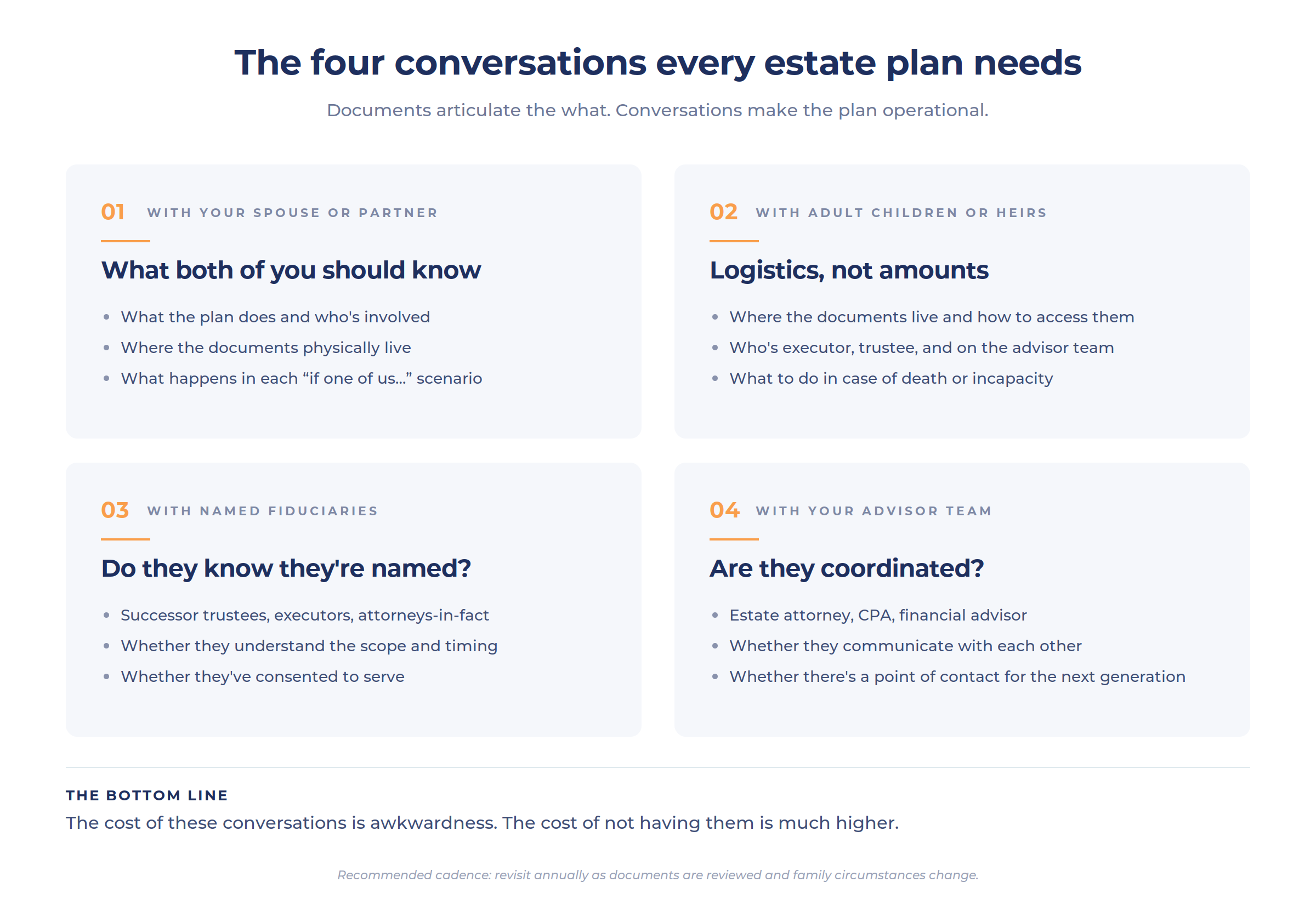
The four conversations every estate plan needs
The spouse or partner conversation. Both of you should know what the plan does, where the documents live, who the named parties are, and what happens in each of the foreseeable scenarios. “If something happens to you first.” “If something happens to me first.” “If we both become incapacitated.” It’s an uncomfortable conversation. It also tends to be a short one. The cost of not having it is high; the cost of having it is awkwardness for an afternoon.
The adult children or named heir conversation. This is the one most often skipped. Not because parents don’t want to communicate, but because they don’t want to disclose specific dollar amounts (often for legitimate reasons) and they conflate the dollar conversation with the logistics conversation. They’re separate. The dollar conversation is optional. The logistics conversation is essential. Adult children should know where the documents are, who’s the executor and trustee, what advisors are involved (CPA, attorney, financial advisor), and what to do if a parent becomes incapacitated or dies. Not the amounts. The mechanics. A surprising number of estate disputes trace back to children who didn’t know who held authority or where to find the documents — surprises that could have been prevented with a fifteen-minute conversation.
The named fiduciary conversation. Trustees, executors, agents under powers of attorney. Do they know they’ve been named? Have they consented to the role? Do they understand the scope of the authority and the timing? Do they know where the documents are? Are they willing? Successor trustees in particular often discover their role only when activated — meaning they’re learning the responsibility under family crisis, not from a place of preparation. This is solvable. A direct conversation, in advance, with everyone named in the documents — about the role, the expectations, and the location of the documents — eliminates almost all of this category of failure.
The advisor team conversation. Estate planning is rarely the work of a single professional. It involves the estate attorney who drafted the documents, the CPA who handles tax planning, the financial advisor who manages the asset side, and sometimes others — corporate counsel for business owners, insurance professionals, charitable advisors, family-business consultants. Most families have these advisors but never introduce them to each other. The result is a plan that works in each lane but breaks at the integration points. Coordinating the team — and identifying a point of contact for the next generation — is one of the highest-leverage moves a family can make. It costs little; it solves a category of failure that’s expensive and emotional to clean up after the fact.
Why this conversation gets postponed
The reasons are predictable. The conversation surfaces mortality. It surfaces family dynamics — adult children’s relationships with each other, parents’ assessments of their children’s readiness, latent assumptions about who’s “responsible” and who isn’t. It surfaces money, which families navigate awkwardly even in the best circumstances. There’s no clean “right time” to bring it up. Parents worry about influencing their children’s life decisions; children worry about appearing acquisitive. Most cultural and family norms tilt against discussion of money and death.
These are real reasons. They’re also bad reasons to keep postponing the conversation indefinitely. The alternative — leaving the conversations to happen by accident, during stress, with key facts surfaced after they’re needed — is worse for everyone involved.
How to actually have the conversation
The conversation tends to go better when it’s framed as logistics rather than bequests. The question “if something happens to me, here’s what should happen and how, and who knows about it” is operational. The question “here’s what you’re inheriting” is loaded. The first version is much easier to start.
A few practical patterns:
• Use the documents as the agenda, not the destination. Walk through what the documents say, in plain language, in the context of “here’s what would happen if X.”
• Lead with role, not amount. “You’d be the executor” carries information without disclosing dollars.
• Make it recurring, not a single event. A 30-minute conversation once a year, as documents are updated, normalizes the topic and avoids the “big talk” pressure.
• Consider including the advisor team. A family meeting with the attorney, CPA, and financial advisor present can carry weight that a parent’s solo description can’t.
• Document the operational details. Where the documents physically live. Who has copies. Who the advisors are and how to reach them. A one-page summary that everyone in the planning circle has access to.
The cost of not having it
The cost of the conversation is awkwardness for an afternoon. The cost of not having it shows up at predictable moments: a surviving spouse who doesn’t know where the trust documents are, a successor trustee learning their role under emergency conditions, adult children discovering at the funeral that the estate plan distributes assets differently than they assumed — and litigating their way through grief — an incapacitated parent whose medical preferences are unknown to the people deciding their care.
None of those outcomes is caused by bad estate planning. They’re caused by good estate planning that wasn’t accompanied by the conversation that makes it usable.
The pattern
In an earlier post in this series on the OBBBA estate exemption, the closing observation was that documents do half the work of estate planning and coordination does the rest. This is the rest.
The plan isn’t done when the documents are signed. The plan is what happens when the people involved understand the documents, know their roles, and can coordinate under stress. That part isn’t on paper. It’s in the conversations that produce the shared understanding — or in the absence of those conversations.
The plan is the residue. The planning is the work. The conversations are the planning.
Key takeaways
• The most common estate planning failure isn’t a drafting or tax error — it’s a coordination failure that surfaces at the worst moment: incapacity, death, or family stress.
• Documents articulate what. They don’t articulate why, don’t ensure the right people know they exist, and don’t coordinate during stress.
• Four conversations make estate plans operationally functional: with your spouse or partner, with your adult children or heirs, with your named fiduciaries, and with your advisor team.
• The “adult children” conversation can address logistics (who’s executor, where documents are, who the advisors are) without disclosing dollar amounts. The two are separable.
• Named fiduciaries — successor trustees, executors, agents under powers of attorney — often discover their role only when it’s activated. A direct conversation in advance eliminates almost all of this category of failure.
• The conversation gets postponed for predictable reasons (mortality, family dynamics, cultural norms around money). The cost of postponing it is much higher than the cost of having it.
Common questions about the estate planning conversation
What is the most common estate planning mistake?
The most common estate planning failure isn’t a drafting or tax error — it’s a coordination failure. Documents exist, but the people involved (spouse, adult children, named fiduciaries) don’t know enough about the plan to operate it during a crisis. Successor trustees discover their role at the worst possible moment. Healthcare directives sit in inaccessible locations. Family conflict surfaces because intent was never discussed. The mistake isn’t in the documents — it’s in the absence of the conversations around them.
Should adult children know the details of their parents' estate plan?
The “details” can be separated into two categories. Dollar amounts and bequest specifics are optional — many families have legitimate reasons to keep those private. Logistics, by contrast, are essential: adult children should know where the documents physically live, who the named executor and trustees are, what advisors are involved, and what to do if a parent becomes incapacitated or dies. The logistics conversation makes the estate plan operational without requiring disclosure of amounts.
How do you have the estate planning conversation with your family?
A few patterns help. Frame it as logistics rather than bequests — “here’s what should happen if something happens to me” is much easier to start than “here’s what you’re inheriting.” Use the documents as the agenda, not the destination. Lead with role rather than amount. Make it recurring (an annual 30-minute check-in) rather than a single dramatic event. Consider including the advisor team in a family meeting. Document the operational details — where documents are, who has copies, advisor contacts — in a single summary everyone in the planning circle can access.
What is a successor trustee and why do they need to know they're named?
A successor trustee is someone named in a trust document who takes over administration if the original trustee (usually the grantor) becomes incapacitated, dies, or otherwise can’t serve. Successor trustees often discover their role only when it’s activated — meaning they’re learning the responsibility under crisis conditions. A direct conversation in advance, where the successor trustee learns about the role, the documents, and the expectations, eliminates almost all of the failures in this category. The same applies to executors and agents under powers of attorney.
Who should be involved in estate planning coordination?
At minimum: the estate attorney who drafts the documents, the CPA who handles tax planning, and the financial advisor who manages the asset side. For business owners, corporate counsel often joins the group. Some families also include insurance professionals, charitable advisors, or family-business consultants. Most families have these advisors individually but never introduce them to each other. Coordinating the team — and identifying a point of contact for the next generation — is one of the highest-leverage moves a family can make.
When should families update their estate plan and revisit the conversation?
The plan should be reviewed any time there’s a material change in family or financial circumstances — births, deaths, marriages, divorces, sale of a business, significant change in net worth, change in state of residence, or major changes in tax law. (OBBBA, passed in July 2025, was a major tax-law change that may warrant a fresh review for many families.) The family conversation should be more frequent — ideally annually, even if no changes have been made — so the operational details stay current and the topic stays normalized rather than dramatic.
This article is for informational and educational purposes only and is not intended as legal, tax, or estate planning advice. Estate planning decisions involve complex personal, family, and legal considerations that should be made in coordination with qualified professionals. Consult your estate attorney, CPA, and tax advisor about how to structure your plan and the conversations around it.
Securities and advisory services are offered through LPL Financial (LPL), a registered investment advisor and broker-dealer (member FINRA/SIPC). Insurance products are offered through LPL or its licensed affiliates. Via Luce Capital is not registered as a broker-dealer or investment advisor. Registered representatives of LPL offer products and services using Via Luce Capital, and may also be employees of Via Luce Capital. These products and services are being offered through LPL or its affiliates, which are separate entities from, and not affiliates of Via Luce Capital.