


A plan is a deliverable. Planning is a discipline. Most clients are sold the first when they need the second.
A plan is a noun. Planning is a verb. The distinction sounds semantic. It isn't.
A financial plan is a document — a snapshot of decisions made at a moment in time, given a set of assumptions about income, expenses, taxes, market returns, family circumstances, and goals. It looks impressive on a coffee table. It gets emailed back and forth. It has page numbers.
A planning process is the ongoing discipline that produces those decisions through changing conditions, year after year. It doesn't have page numbers. It has rhythms — seasons of work that look different at different times of the year. The plan is what's left behind by the process. The process is the actual product.
Most clients are sold the noun and need the verb. The two terms get used interchangeably in the wealth management business, which is part of how the mismatch persists.
Why the industry sells plans
The financial industry sells what's easy to sell. Plans are easy to sell because they have a SKU.
A plan can be priced. It can be marketed. It can be delivered as a clearly defined output — typically a binder, a PDF, a software dashboard. It can be checked off a list ("we have a financial plan"). It produces a billable artifact at a predictable point in time. The economics work.
Planning doesn't have those edges. There's no single deliverable, no clear "done" moment, no obvious SKU. The work is iterative, mostly relational, and only really visible in aggregate across multiple years. It's harder to package and harder to sell. The economics are softer.
So the industry defaults toward producing plans. Many firms do real planning around their plans, but the structure pushes the other way. Marketing emphasizes the deliverable. Onboarding emphasizes the deliverable. Anniversary conversations emphasize the deliverable. Even sophisticated clients are trained to ask "do you have a financial plan?" — a question that can be answered with a yes or no — instead of "is someone actively planning with me?" — a question that requires actually examining the relationship.
This isn't a critique of any individual advisor. It's a structural observation about how the market is organized. The advisors doing the best work are often working against the gravity of their own industry to do it.
What planning actually looks like
The reason planning is harder to sell is that planning is harder. It runs continuously, in cycles, with different focuses at different times of the year. Done well, it produces decisions before circumstances force them — but the work that produces those decisions is mostly invisible from the outside.
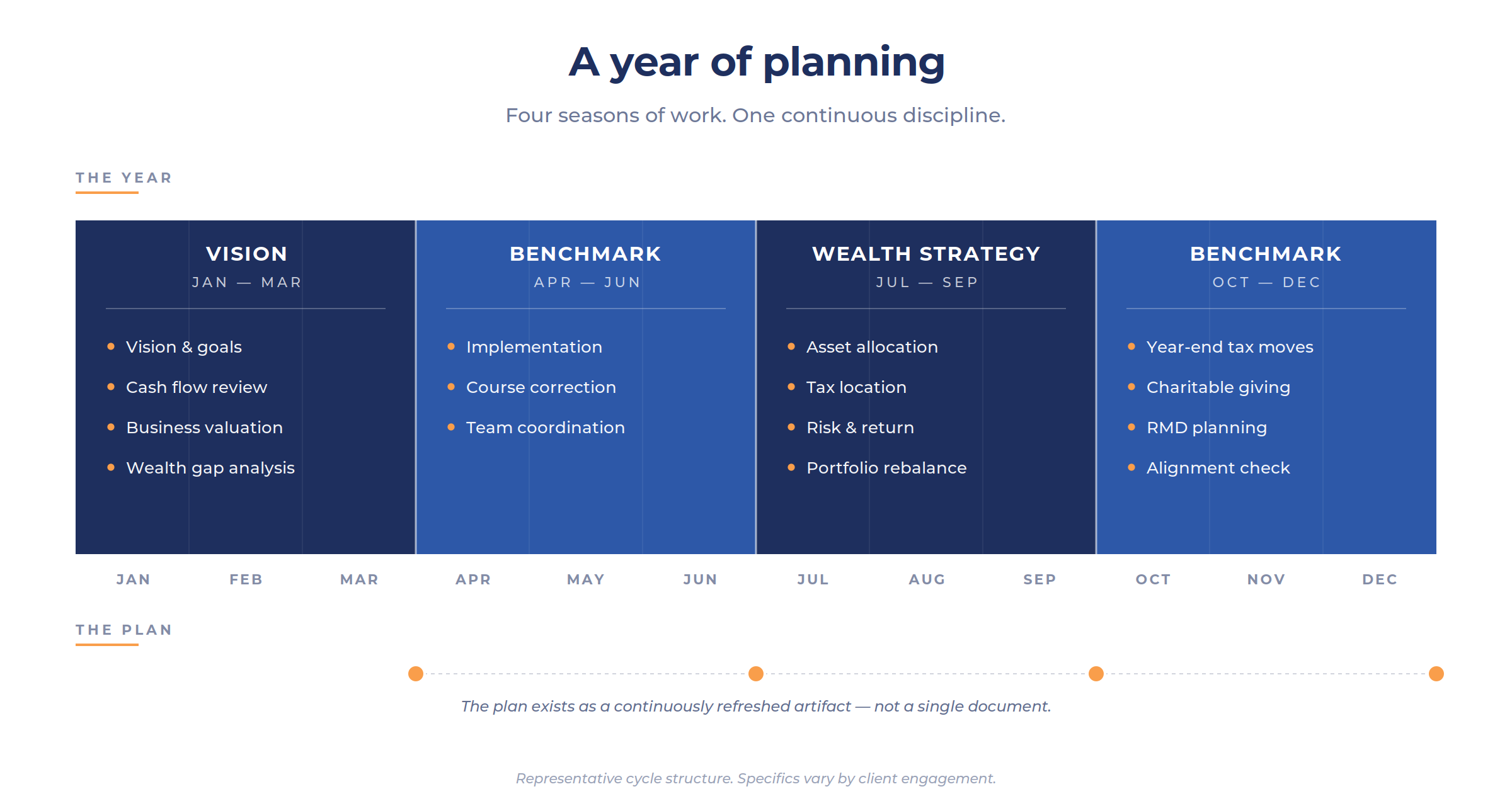
A real planning year breaks roughly into four seasons.
Early year is for vision and strategic positioning. Before the year's tactical decisions get made, the work is structural: where is this family or business owner trying to go over the next year, three years, ten years? What does the balance sheet actually look like — cash flow, net worth, business value, real estate, concentration risk? Where are the gaps between current trajectory and stated goals? This is the season when wealth-gap analysis actually matters — when there's still time to act on what's found.
Spring is for implementation benchmarking. The strategic moves identified earlier need to actually happen — trust funding, account retitling, beneficiary updates, insurance reviews, business-side coordination. Spring is when the team checks whether the decisions made in the vision phase have been executed, where they're stalling, and what needs joint attention from the CPA, the attorney, or other specialists. This is unglamorous work and almost never makes it into a marketing brochure. It's also where most plans quietly fail.
Mid-year is for deeper wealth strategy. With execution underway, the work shifts to the analytical layer: asset allocation review, tax-location optimization, rate-of-return analysis, portfolio rebalancing, savings adjustments, market outlook, and — for business owners — value-gap analysis and maintain/grow/exit decisions. This is the season when the portfolio gets stress-tested against current reality, not last January's assumptions.
Late year is for benchmarking and year-end alignment. Tax-driven decisions cluster here: charitable giving strategy, harvesting losses, Roth conversion sizing, RMD planning, deferred comp elections. The year-end pass is where the planning year closes its loop, captures what changed, and sets up the vision phase for the next cycle.
Across all four seasons, the plan exists as a continuously updated artifact — not a single document delivered in January, but a living set of decisions, projections, and commitments that gets refreshed as the work moves through its cycle. Decisions made in mid-year strategy update projections that the next benchmarking pass tests against reality, which surfaces issues that the next vision pass addresses structurally. The plan isn't a static binder. It's the residue of a year of attention.
That continuous attention is what most clients are actually paying for, even when what they think they bought is the binder.
A plan is a noun. Planning is a verb. The distinction sounds semantic. It isn't.
How to tell which one you have
If the distinction between a plan and planning matters, the practical question is: how do you tell which one you have? A few diagnostic questions cut through the marketing surface.
When did your circumstances last change materially — and what happened? A liquidity event, a job change, a family change, a meaningful market move, a tax-law change. A planning relationship surfaces the implications proactively. A plan-delivery relationship waits for the next scheduled review.
Who is modeling cross-domain consequences before decisions get made? When a Roth conversion is on the table, who is checking the IRMAA impact, the state-tax implications, the effect on the surviving spouse's tax bracket, the portfolio rebalance timing? When a property sale is on the table, who is modeling the bracket effect against charitable strategies, the impact on Medicare premiums, the coordination with estate plans? If no one is doing this work in advance, the seams fail in expensive ways.
How often does the relationship reach out unprompted? Real planning is anticipatory. If the only contact is scheduled annual reviews — or if the only outbound communication is generic market commentary — the engagement is being managed as a deliverable, not a discipline.
What does the engagement look like in the slow months? The slow months are when planning actually happens. If nothing is happening in those months, nothing is being planned. The slow months are when execution gets benchmarked, tax projections get re-run, and assumptions get re-tested before they ossify into a stale plan.
The answers to these four questions are usually more informative than reading the plan document itself. The document can be excellent in a relationship that isn't actually doing planning. The document can be ordinary in a relationship that's doing exceptional planning. The document and the discipline are different things.
The right question
The financial plan isn't the wrong thing. It's the wrong thing to anchor on.
Plans matter. Plans should be done well, refreshed often, and built to stress-test against actual conditions. But the plan is the artifact of the work, not the work itself. The work is planning — the ongoing discipline of integrating tax, investment, estate, retirement, business, and risk decisions across changing conditions. The discipline is what holds the seams together. The artifact is what proves it's happening.
The question worth asking isn't "do I have a financial plan?"
The question worth asking is "is someone actively planning with me — in February, in May, in July, in October, and again next year?"
That's the question the work either answers or doesn't.
Key takeaways
• A financial plan is a noun — a document, a snapshot, a deliverable. Planning is a verb — the ongoing discipline that produces decisions through changing conditions.
• The industry sells plans because plans are easy to sell: they have a SKU, a deliverable, a billable artifact. Planning is harder to package and easier to neglect.
• Real planning runs in seasons across the year — vision and strategic positioning, spring implementation, mid-year wealth strategy, year-end alignment — with the plan emerging as a continuously refreshed artifact along the way.
• The diagnostic isn't "do I have a plan?" but "is someone actively planning with me?" — and the answer shows up in how the relationship handles material changes, models cross-domain consequences, and operates in the slow months.
• The plan is the residue of the discipline. The discipline is the actual work.
Securities and advisory services are offered through LPL Financial (LPL), a registered investment advisor and broker-dealer (member FINRA/SIPC).