For years, the Roth conversion pitch came with a countdown: convert before the tax cuts expire at the end of 2025. Then the expiration got cancelled. The clock everyone was racing simply stopped.
In 2025, the One Big Beautiful Bill Act made the current federal tax brackets permanent. The sunset that drove a decade of “convert now, before rates jump” urgency isn’t coming. For a lot of people, that lands as a reason to stop thinking about Roth conversions. It’s closer to the opposite — because the deadline was never really the point.
The deadline that disappeared
The old argument was simple and time-bound. The 2017 tax law lowered the brackets temporarily and set them to snap back at the end of 2025. A Roth conversion means moving traditional IRA or 401(k) money into a Roth — paying income tax on it now in exchange for tax-free growth and withdrawals later. So the pitch wrote itself: lock in today’s lower rates before they revert. The calendar was the whole story.
Then the law changed. The brackets were made permanent. There’s no scheduled jump left to race. If beating the sunset was your only reason to convert, that reason is gone.
The window was never on the tax calendar
Here’s what the countdown obscured: the most valuable time to convert usually has nothing to do with federal rate changes. It has to do with your own income.
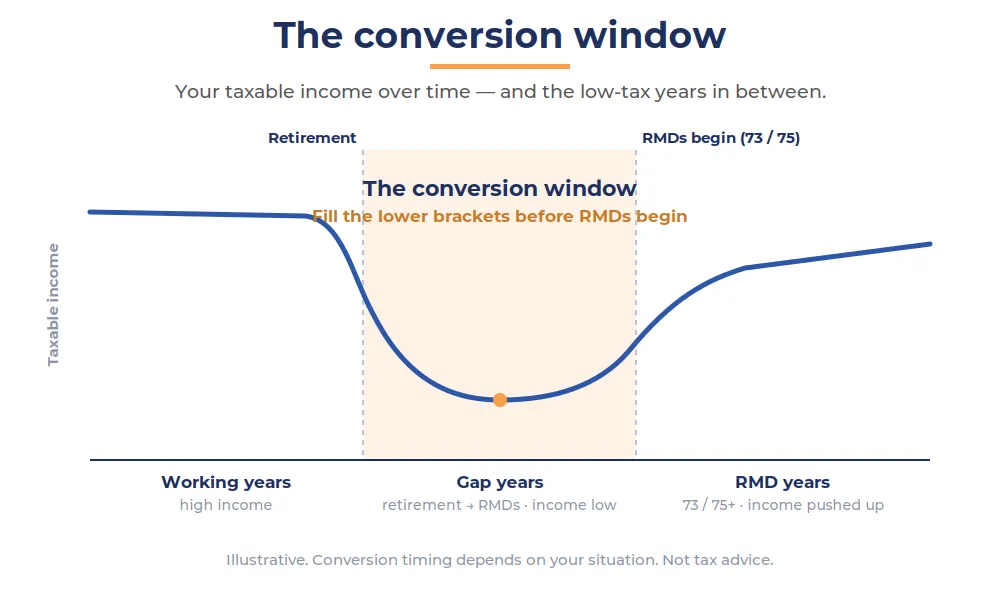
For most people there’s a stretch — roughly from when work income stops to when required withdrawals begin — where taxable income falls to the lowest point of their adult life. Retired, not yet claiming Social Security, not yet forced to take distributions. That low-income gap is the real conversion window, and it’s defined by your life, not by Congress’s calendar. Convert during it and you’re paying tax at unusually low rates by your own standards — whatever the statutory brackets happen to be.
What actually drives the timing now
With the rate deadline off the table, three durable forces decide when a conversion earns its keep.
Your own bracket is going up. Required minimum distributions begin at 73 — 75 for younger savers. A large traditional IRA left untouched eventually forces out sizable taxable withdrawals every year, often pushing a retiree into a higher bracket and keeping them there for life. Converting earlier shrinks that future balance and flattens your lifetime tax rate, shifting dollars out of the high-RMD years and into the low-income ones.
Filling the bracket, not blowing past it. The craft of conversion is converting just enough to reach the top of your current bracket without spilling into the next one. Done by rule, year after year, it’s a deliberate way to use low-rate room you’d otherwise leave on the table.
The Medicare trip-wire. Conversions raise the income figure Medicare uses to set your premiums, and those surcharges jump at hard thresholds. A conversion sized without watching them can trip a premium increase that quietly offsets the benefit. Manageable — but only if it’s planned.
The part that doesn’t show up on this year’s return
Two things stretch beyond the current tax year. First, legacy: a Roth passes to your heirs income-tax-free, and you’re never forced to take distributions from it yourself — which makes it one of the cleaner assets to leave behind. Second, for Californians, the state comes to the table too. California taxes a conversion as ordinary income in the year you do it, on top of the federal bill, so the upfront cost here is higher than the federal math alone suggests. Neither changes the logic — both change the sizing.
It’s a decision you size, not a button you press
A conversion isn’t a one-time move you make and forget. It’s a multi-year sequence: convert a measured amount in each low-income year, watch the bracket and the Medicare thresholds, and adjust as your income and the balance change. And it’s unforgiving in one specific way — a conversion can’t be undone. Once you convert, the tax is owed, which is exactly why the amount is a decision to size carefully, in coordination with your CPA, rather than a number to guess.
That’s the same discipline that governs the rest of a good plan: deliberate, maintained year over year, and integrated rather than improvised.
Where this leaves you
The headline event — the expiring tax cuts — turned out to be a non-event. But the opportunity it was attached to didn’t go anywhere. It just went back to where it always lived: in the quiet, low-income years of early retirement, where a well-sized conversion can reshape decades of future tax bills.
The rate deadline was never the real reason to convert. Your own future bracket is.
The deadline was external. The window is personal — and for many people, it’s open right now.