
A couple can agree on when to retire and still face two different Social Security decisions. One spouse may leave work first. One benefit may be substantially larger. A pension or part-time job may cover some expenses while the household waits to claim.
The useful question is how each filing date changes the household’s cash flow, including a future period when one spouse may be living alone. A single break-even age does not answer all of that.
Start by separating what is known from what needs confirmation. Dates of birth, earnings records, expected work income, and current expenses are inputs. Future health, longevity, spending, and legislation are uncertainties. A good comparison makes both visible rather than hiding them behind one preferred age.
Put four dates on the page
Write down each spouse’s intended work-stop date and proposed benefit-start date. They are separate choices. Under current SSA rules, retirement benefits generally can begin at age 62, full retirement age depends on birth date, and delayed retirement credits stop at age 70.
Waiting beyond full retirement age increases the worker’s retirement benefit through delayed credits. That does not mean everyone should wait. A household still needs to pay its bills in the meantime, and the value of a later benefit depends partly on how long it is received.
Use months as well as years. Identify the last regular paycheck, any final bonus, and the first expected benefit deposit. Ask SSA to confirm payment timing before treating an entitlement month as cash already available in the checking account.
Check the estimates before comparing them
Each spouse should obtain a current estimate from their own Social Security account. Review the earnings record and the assumed future earnings. SSA allows users to adjust expected future income; an estimate based on continued work may not match a plan to stop sooner.
Keep the estimates on a consistent basis. Do not compare a figure expressed in today’s dollars with another that includes assumed future inflation. Label whether each amount is before or after deductions, and confirm what will actually be available to spend.
Bring questions about an incomplete earnings record, prior marriage, disability, or employment outside Social Security to SSA. Those circumstances may change eligibility or the available choices. A general planning article cannot determine the correct benefit for a particular couple.
Price the waiting period
For every proposed filing combination, show the household spending that falls between the last paycheck and the later benefit date. Identify the expected income during that interval and the remaining amount that savings would need to supply.
The retirement income organizer helps structure one monthly snapshot at a time. Use separate entries for a period with no Social Security, a period with one benefit, and a period with both. It does not calculate Social Security or decide which date is best.
Then review the funding source. Using cash, selling investments, and taking retirement-account withdrawals have different consequences. Taxes, market conditions, and other near-term obligations belong in that review. Delaying a benefit may be feasible on paper while leaving too little flexibility for an unexpected expense.
Understand what a spousal benefit does
A benefit based on a spouse’s record is not an extra full payment added to a person’s own full retirement benefit. SSA coordinates the benefits. Eligibility, filing age, and the worker’s filing status matter; early claiming may reduce a spousal benefit.
Also be cautious with advice about collecting only a spousal benefit while allowing your own retirement benefit to grow. For people subject to current deemed-filing rules, filing for one generally means filing for both when eligible. Special circumstances require review, and survivor benefits have different rules.
Ask SSA to confirm the applicable benefit amounts for the proposed month. Two individual retirement estimates alone may not describe what the household would receive under the spousal rules.
Include the surviving spouse’s budget
Run a separate view for each spouse surviving the other. Housing and many fixed bills may continue even though Social Security income changes. Do not assume the household keeps both benefit payments.
SSA does not add a full survivor payment to a full retirement payment. The available amount depends on the relevant records and claiming circumstances. Request a survivor estimate rather than assuming it equals a particular bank deposit from the couple’s current budget.
Survivor benefits are also an exception to deemed filing. In some circumstances, a person may take one type of benefit and switch to another later. This is a separate analysis, with different rules from a living spouse’s benefit.
The aim is to understand the remaining household’s obligations and income. For more on the practical transition, see what changes first in a surviving spouse’s cash flow.
Compare a timeline, not a universal sequence
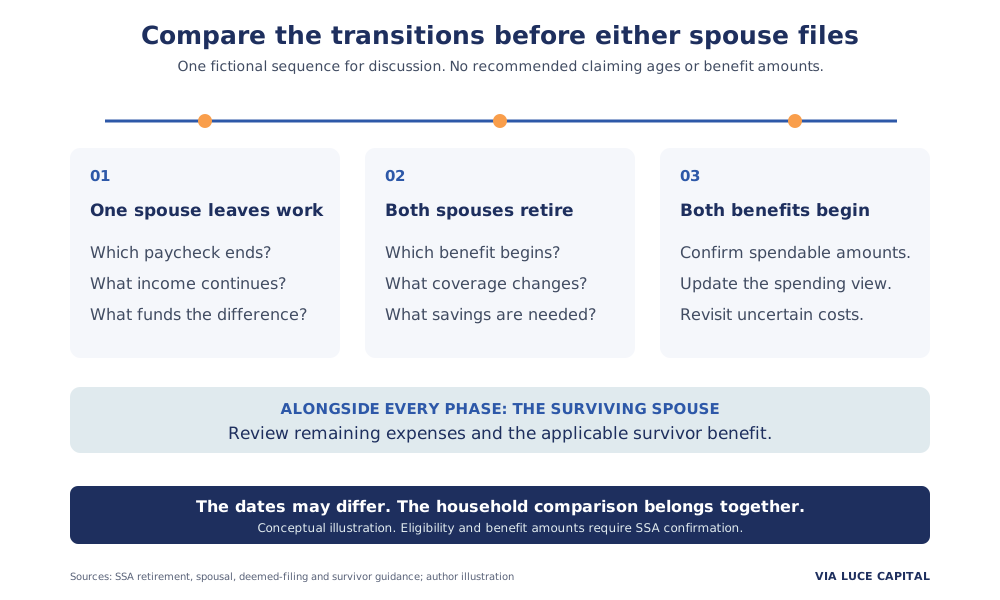
Hypothetical illustration: One spouse stops working while the other continues. Later, the second spouse retires and the first begins benefits. The second spouse considers waiting longer to claim. This is a fictional comparison, not a recommended order.
At each transition, write down which paychecks end, which benefits begin, what health coverage changes, and what savings must provide. Then compare a different sequence: earlier benefits, a later retirement date, or a smaller spending commitment. The comparison is useful even before a precise recommendation is possible.
Health, family longevity, comfort using savings, and commitments to other family members may affect the decision. A larger future monthly benefit is only one part of the household picture. Record why the chosen sequence fits the circumstances and what developments would prompt another review before filing.
Keep work, Medicare, and taxes in the conversation
If either spouse plans to work while receiving benefits before full retirement age, review SSA’s earnings rules. Wages or self-employment earnings may affect payments. Check the current rules rather than applying an old earnings-limit figure.
Medicare enrollment is a separate decision. Delaying Social Security does not by itself justify delaying Medicare. Review eligibility, enrollment timing, and coverage based on current employment before a job ends. Ask a tax professional to review the household tax picture alongside the proposed benefit dates.
Six questions to resolve before filing
- Do both estimates reflect the work income each spouse actually expects?
- Which monthly expenses must be funded before each benefit begins?
- Have SSA’s spousal and deemed-filing rules been applied correctly?
- What income would remain if either spouse dies first?
- Are work earnings, Medicare enrollment, and taxes accounted for separately?
- What makes the selected dates suitable for this household’s circumstances?
Keep the estimates and written assumptions together. Pair the timeline with a monthly spending picture. The filing decision becomes easier to assess when both spouses can see the dates, tradeoffs, and unanswered questions on the same page.
Sources
- Retirement benefits generally begin no earlier than age 62; full retirement age depends on birth date, and stopping work is distinct from claiming. — SSA, Your Retirement Age and When You Stop Working; reviewed September 19, 2026.
- Retirement benefits earn delayed credits after full retirement age, with no additional delayed credits after age 70. — SSA, Delayed Retirement Credits; reviewed September 19, 2026.
- Personalized benefit estimates allow changes to expected future earnings. — SSA, Get a benefits estimate; reviewed September 19, 2026.
- Spousal eligibility and benefit amounts depend on the worker’s filing and the spouse’s circumstances; early claiming may reduce the spousal benefit. — SSA, Benefits for Spouses; reviewed September 19, 2026.
- Deemed filing generally applies to retirement and spousal benefits for people subject to current rules, but does not apply to survivor benefits. — SSA, Filing Rules for Retirement and Spouses Benefits; reviewed September 19, 2026.
- Survivor and retirement payments are not added together; claiming age and circumstances affect the survivor amount and switching may be possible. — SSA, What you could get from Survivor benefits; reviewed September 19, 2026.
- Work earnings may affect benefit payments before full retirement age. — SSA, Receiving Benefits While Working; reviewed September 19, 2026.
- Delaying Social Security does not resolve Medicare enrollment requirements; review coverage based on current employment and enrollment separately. — Medicare, Working past 65; reviewed September 19, 2026.
- The household timeline is an invented conceptual illustration without benefit amounts, assumed returns, or an optimized filing recommendation. — Via Luce Capital, author-created hypothetical illustration, September 19, 2026.