

Retirement changes the source of the paycheck. It does not make the household bills arrive in a convenient pattern.
The mortgage may be monthly, property taxes less frequent, and a roof replacement unpredictable. One spouse may still work while the other retires. Social Security and a pension may begin later. A useful spending plan makes those differences visible before the household decides how much to withdraw.
For a family in Newport Beach, Costa Mesa, or elsewhere in Orange County, keeping a home, helping adult children, and traveling to see family may all belong in that conversation. None has a universal price tag. Your records are a better starting point than someone else’s retirement budget.
Start with what the household actually uses
Review a full cycle of checking and credit-card activity. Separate purchases from transfers between your own accounts. A credit-card payment is not another expense if you already counted the underlying purchases. Likewise, moving money into savings is not consumption, although a continuing savings goal still needs funding.
Group spending into housing, everyday living and healthcare, flexible spending and irregular bills, and additional taxes. Keep a short note under each total explaining what it includes. A number without its assumptions becomes difficult to update when circumstances change.
Then mark what ends, continues, or begins at retirement. Commuting may decline. Travel may rise. Payroll deductions may disappear while replacement health insurance becomes a household bill. Ask both spouses to review the list; each may know about commitments the other rarely pays directly.
Give irregular bills two places to live
A monthly equivalent helps compare spending with monthly income. A payment calendar shows when cash must actually be available. Both views matter.
For recurring annual costs, divide the expected total across the year in your planning worksheet. Separately record the due date. A property-tax payment belongs in the monthly equivalent and the calendar, but it should not be added twice to the annual spending total.
Keep major one-time projects on a separate list. A home renovation is different from ordinary maintenance. Label each item with an estimated amount, likely timing, and whether it is committed or optional. Avoid making the everyday budget appear affordable by quietly leaving those projects out.
Compare spendable income with spending
Use a consistent convention. In the retirement income organizer, income means money available to spend after deductions. SSA notes that Medicare premiums and tax withholding may reduce the amount deposited from a Social Security benefit.
If a premium is already withheld from the income you enter, do not also list it as a household expense. If federal or state taxes have already been withheld, the additional-tax line should capture only the further amount you expect to fund. The organizer does not calculate that amount.
A tax professional can help estimate the remaining liability. IRS guidance distinguishes withholding from the ultimate tax obligation; the fact that money was withheld does not establish that enough was paid. When a funding plan changes, its tax estimate may need to change too.
A fictional household, entered one line at a time
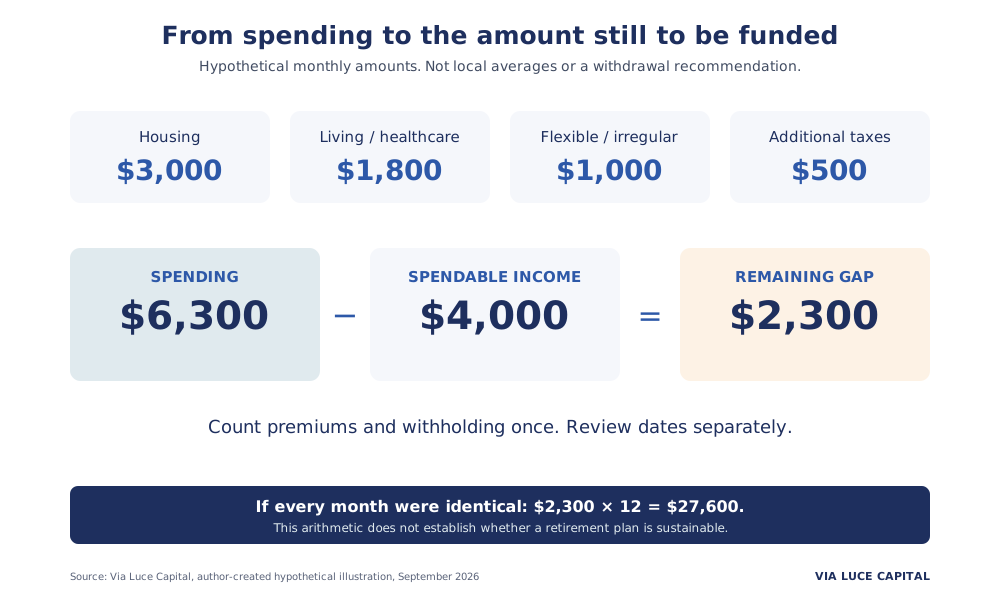
Hypothetical illustration: Assume a household enters $3,000 for housing, $1,800 for everyday living and healthcare, $1,000 for flexible spending and irregular bills, and $500 for additional taxes. Total monthly spending is $6,300. Assume its spendable Social Security and pension income totals $4,000, with no other income entered.
That leaves $2,300 each month still to be funded. If every month were identical, the arithmetic would be $27,600 for the year. These invented figures match the organizer’s example. They are not local cost estimates, benefit projections, or a recommended spending level.
The result identifies a question: where will that remaining cash come from? It does not establish a sustainable withdrawal amount, an appropriate investment allocation, or the number of years savings might support spending. Additional withdrawals may themselves create taxes that require another pass through the worksheet.
Build a second view when a date changes the picture
One average month may conceal the most demanding part of the transition. Make separate snapshots for the period before a benefit starts, the period afterward, and any later change in health coverage or work income.
Extend the fictional example: suppose replacement health coverage adds $600 to monthly spending, while another benefit adds $1,200 of spendable monthly income. Spending becomes $6,900 and income becomes $5,200. That leaves $1,700 still to be funded. These are independent assumptions, not actual premium or benefit estimates. They show why dates and amounts belong together.
Also ask what happens if the expected income begins later. Medicare enrollment and coverage after employment ends require their own review. A spending worksheet does not determine eligibility, enrollment deadlines, or insurance suitability.
Separate the monthly gap from the longer-term plan
Once the current picture is clear, test the assumptions around it. Which expenses are flexible? What happens after a large repair? How might spending change if one spouse needs care or dies? Which costs may rise over time?
The organizer is deliberately a starting point. It does not model inflation, investment returns, longevity, benefit changes, or future tax law. A positive monthly balance is not proof that retirement is fully funded, and a gap is not proof that retirement is impossible.
The next decision is how to fund the gap and handle exceptions. Our article on which account should fund the first five years of retirement addresses that separate question. For a couple whose benefit dates are still open, Social Security timing belongs in the same conversation.
Six things to carry into the planning conversation
- Start with spending records and remove duplicate transfers and payments.
- Distinguish recurring costs, irregular bills, and major one-time projects.
- Use net income consistently and count deductions only once.
- Attach a start date or end date to every changing income source or expense.
- Treat the monthly gap as an input to planning, not a withdrawal recommendation.
- Keep a list of uncertain amounts and who will confirm each one.
Bring your notes, current benefit estimates, insurance information, and the payment calendar. Use the retirement income organizer to create a first snapshot without providing an email address, then print it for discussion. The value is a clearer set of questions tied to your household’s actual obligations.
Sources
- Social Security deposits may differ from gross benefits because of Medicare premiums and tax withholding. — Social Security Administration, Plan for Retirement; reviewed September 19, 2026.
- Federal withholding and estimated payments may apply to pension and retirement-plan payments; withholding is distinct from final tax liability. — Internal Revenue Service, Publication 575, Withholding Tax and Estimated Tax; reviewed September 19, 2026.
- Health coverage and Medicare enrollment need review when employment ends; continuation coverage is not the same as coverage based on current employment. — Medicare, Working past 65; reviewed September 19, 2026.
- All example amounts are invented assumptions: $3,000 + $1,800 + $1,000 + $500 = $6,300; $6,300 - $4,000 = $2,300; $2,300 x 12 = $27,600. In the second snapshot, $600 adds to spending and $1,200 adds to income: $6,900 - $5,200 = $1,700. — Via Luce Capital, author-created hypothetical illustration, September 19, 2026. These are not estimates of local costs or benefit entitlements.