

Two things are widely believed about the deduction for people over 65. The first is that it helps with Medicare surcharges and health insurance subsidies. The second is that it made Social Security tax-free. Neither is true, and the reason for both is the same single structural fact.
Start with what the deduction is. For each qualifying individual who reaches 65 before the end of the year, $6,000 — $12,000 on a joint return where both spouses qualify. It is available whether you itemize or not. It phases out at 6 percent of modified adjusted gross income above $75,000 single and $150,000 joint. And it is temporary: available for taxable years beginning before January 1, 2029.
For a household in the middle of the range, that is a real number. It is worth understanding precisely what it does with it.
Where it sits in the return
Adjusted gross income is not a concept a taxpayer gets to influence freely. It is gross income less a specific enumerated list of deductions written into the statute.
The senior deduction is not on that list. It lives in section 151, and section 151 does not appear in the definition of adjusted gross income. Structurally, it comes off after adjusted gross income has already been determined — alongside the standard deduction rather than above it.
Which means your adjusted gross income is exactly the same with the deduction as without it.
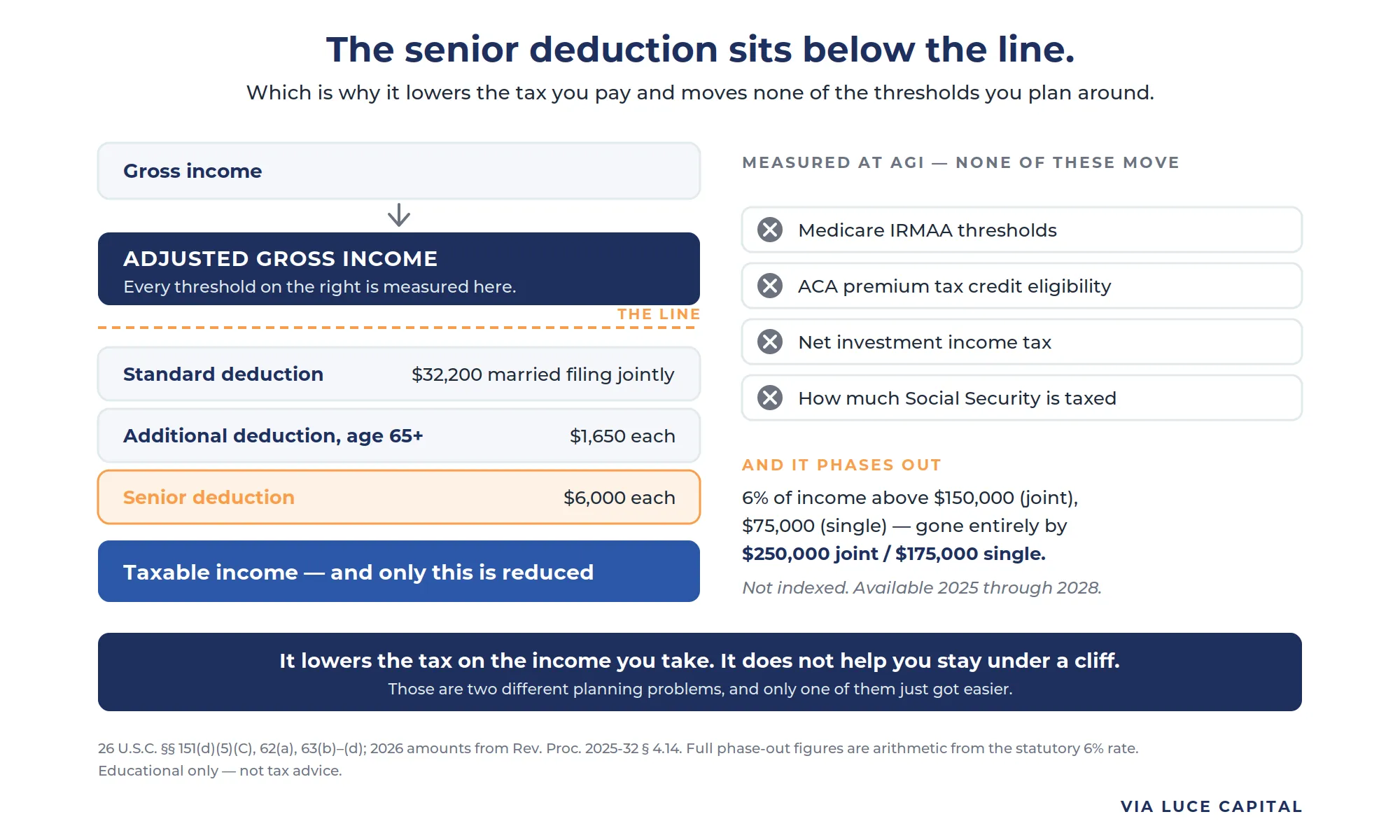
That single fact answers four questions at once
Nearly every threshold a retiree plans around is measured against a modified adjusted gross income figure, and every one of those figures starts from adjusted gross income.
- Medicare IRMAA is adjusted gross income plus tax-exempt interest.
- ACA premium tax credit eligibility adds tax-exempt interest, untaxed Social Security, and excluded foreign income.
- The net investment income tax uses its own modified figure, also built on adjusted gross income.
- How much of a Social Security benefit is taxable is determined from a figure that likewise begins with adjusted gross income.
A deduction that does not reduce adjusted gross income cannot move any of them. Not one.
So a household hoping the new deduction buys some headroom under an IRMAA bracket, or keeps a premium tax credit intact, is going to be disappointed — and it is better to be disappointed in August than in April.
No, Social Security did not become tax-free
This is worth stating plainly because it is repeated constantly.
The thresholds that determine how much of a Social Security benefit is included in income were not amended. They are still $25,000 and $34,000 for a single filer, $32,000 and $44,000 on a joint return — figures set in 1983 and 1993 that have never been indexed. That lack of indexing is precisely why an ever-larger share of retirees crosses them.
What the law did was create a separate deduction that reduces taxable income for some people over 65. For many households the practical result is a lower tax bill, which is easy to mistake for the benefit being taxed differently. It is not. The same amount of Social Security is included in income; the income is simply taxed against a larger deduction.
The stack, and where it disappears
For 2026, a married couple both over 65 and both qualifying can subtract the standard deduction of $32,200, plus the additional age-65 amount of $1,650 each, plus the senior deduction of $6,000 each — $47,500 in total before a dollar of tax is computed.
(Illustrative. Not a real client. The amounts depend on filing status, age, and income.)
Then it starts going away. The phase-out runs at 6 percent of modified adjusted gross income above $150,000 joint, so a $12,000 combined deduction is fully gone by roughly $250,000 of joint income — and $175,000 for a single filer. Those endpoints are arithmetic from the statutory rate rather than figures the statute prints.
Two features of that zone are worth noticing. The phase-out adds roughly 6 percent to the effective marginal rate on every dollar inside it. And it can overlap the range in which additional Social Security benefits are becoming taxable, so two separate ramps can be operating on the same dollar.
What this actually changes in planning
- It does not create cliff headroom. If the plan depends on landing under an IRMAA threshold or a premium tax credit limit, this deduction is not a tool for that. Adjusted gross income is where those are fought.
- It does lower the cost of income you decide to take. A Roth conversion in one of these years is taxed against a larger deduction, so the same conversion costs less in tax than it otherwise would. That is a genuine effect, and it works in the opposite direction from the cliff problem.
- It has a clock on it. Available through taxable years beginning before 2029. A four-year window is short enough to plan around deliberately rather than assume will still be there.
- It shrinks in real terms every year. Not indexed, while the standard deduction and brackets are. The same nominal $6,000 is worth less each year, and the fixed phase-out thresholds catch more households as other figures rise.
The pattern
A tax provision is easy to describe and hard to place. Most of the confusion here is not about what the deduction is worth — it is about where in the return it happens, which turns out to determine everything else.
The question was never how big the deduction is. It was which number it comes off.
Above the line and below the line are four words apart and a planning cycle apart. The plan is the residue. The planning is the work.
Sources
- A deduction of $6,000 for each qualified individual who has attained age 65 before the close of the taxable year, reduced by 6 percent of modified adjusted gross income above $75,000 ($150,000 on a joint return), for taxable years beginning before January 1, 2029 — 26 U.S.C. § 151(d)(5)(C), as added by Pub. L. No. 119-21, § 70103(a), 139 Stat. 72, 159 (2025)
- Adjusted gross income is gross income less an enumerated list of deductions, which does not include the deduction for personal exemptions provided in section 151 — 26 U.S.C. § 62(a)
- Taxable income for a taxpayer who does not itemize is adjusted gross income minus the standard deduction and the deduction for personal exemptions provided in section 151, and amounts referred to in subsection (b) are excluded from the definition of itemized deductions — 26 U.S.C. § 63(b), (d)
- 2026 standard deduction of $32,200 for married filing jointly and $16,100 for single filers, and an additional standard deduction of $1,650 for taxpayers who are aged 65 or older or blind, or $2,050 if unmarried and not a surviving spouse — IRS Revenue Procedure 2025-32, § 4.14(1), (3)
- The base amounts and adjusted base amounts used to determine how much of a Social Security benefit is included in gross income — $25,000 and $34,000 for single filers, $32,000 and $44,000 on a joint return — 26 U.S.C. § 86(c)(1)–(2)
- Modified adjusted gross income for the senior deduction is adjusted gross income increased only by amounts excluded under sections 911, 931 and 933 — 26 U.S.C. § 151(d)(5)(C)(iii)(II)