

An IRMAA notice connects a Medicare premium year with income from an earlier tax year. Start by checking that connection, then determine whether the notice reflects correct information or a change Social Security should review.
A household retires, earnings fall, and a Medicare premium notice arrives using income from the working years. The charge may be correct under the normal process, yet the change in circumstances may warrant a closer look.
IRMAA is the income-related monthly adjustment amount for Medicare Part B and Part D. It is separate from choosing a health plan and separate from the income tax due on a return. Understanding those differences helps identify the right question to take to Social Security.
For a Southern California retiree, the practical starting point is a small set of records: the notice, the return cited in it, evidence of any relevant life event, and an estimate of current income. Do that review before treating the premium as either an error or an unavoidable permanent cost.
Read the dates before the dollar amounts
SSA generally uses tax information from two years before the premium year. For 2026, the usual reference is the 2024 federal return filed in 2025. Sometimes SSA receives older information, and its guidance explains how to provide more recent available tax information. 1
For IRMAA, modified adjusted gross income generally means adjusted gross income plus tax-exempt interest. It is not the account balance, the household’s spending, or the amount deposited from Social Security. Check the income measure used in the notice against the relevant return. 1
Write the premium year and tax year next to one another. That simple step keeps an investment or tax decision in one year from being confused with the year a resulting premium adjustment may appear.
Review each spouse’s notice separately. The household’s tax filing may supply the income information, but the adjustment applies to each enrolled person and the applicable coverage. A joint filing does not turn two individual premium obligations into one household charge. 1
Use the correct premium table
CMS publishes the premium amounts and income bands for each year. For 2026, the standard full Part B monthly premium is $202.90. The first IRMAA band begins above $109,000 for individual filers and above $218,000 for married couples filing jointly. Separate rules apply to certain married people filing separately. 2
In that first band, the 2026 monthly Part B adjustment is $81.20, making the total Part B premium $284.10. The Part D adjustment is $14.50 in addition to the person’s plan premium. These are published 2026 figures, not estimates for a later year. 2
Illustrative arithmetic, not a real client: one person with both adjustments for all twelve months would pay $95.70 more each month, or $1,148.40 for the year. Two spouses both in that band, both enrolled in the applicable coverage all year, would pay $2,296.80 in combined additional charges. Actual coverage and circumstances may differ. 2[3]
Keep the base premium, the adjustment, and the Part D plan premium separate in your records. Otherwise, an attempt to compare notices may accidentally mix a health plan’s price with a federal income-related charge.
Match the response to the reason
If the tax information is wrong, older than the available return, or affected by an amended return, contact SSA about the appropriate update and documentation. That is a different question from asking SSA to consider a qualifying life-changing event. 1
If income declined because of an event recognized by SSA, a request for a new determination may be appropriate. SSA lists events such as marriage, divorce, death of a spouse, work stoppage, and work reduction, along with certain losses of income-producing property, pension changes, and employer settlements. Eligibility depends on the circumstances. 4
Form SSA-44 is the life-changing-event form. It asks for information about the event and the lower income, with supporting evidence. SSA’s online guidance explains how to request a reduction and which records to provide. The agency decides whether the request changes the adjustment. 45
If you disagree with a determination, review the appeal instructions and deadline on your notice promptly. Do not assume that preparing a form extends that deadline or suspends the amount due. Ask SSA how to handle payments while the matter is reviewed.
Explain what changed and document it
A useful submission connects the event, its date, and the income change. A retirement letter may help establish a work stoppage. Tax records and the income information requested by SSA help explain the financial effect. Use the form’s instructions and ask SSA about acceptable evidence for your situation. 5
Separate recurring income from transactions that occurred once. A large taxable sale or Roth conversion may explain a high-income year, but a voluntary transaction by itself is not one of the listed life-changing events on SSA-44. Its disappearance the next year does not automatically establish eligibility for a reduction. 5
If retirement and a one-time transaction occurred near one another, show the facts clearly rather than describing all of the decline as lost wages. Ask the tax professional to help estimate the applicable income. Give SSA the information it requests, including taxable income that continues after employment ends.
Keep copies of the notice, submitted material, confirmation of receipt, and any response. Record who will follow up. A spouse who rarely handles tax documents should know where the records are stored and what remains unresolved.
Coordinate future income without chasing one threshold
The notice also creates a planning question for future years. IRA withdrawals, capital gains, and taxable Roth conversions may affect the income used for IRMAA. Compare those choices with household cash needs, investment considerations, and the broader tax plan. 16
Staying below an income band is not automatically the best overall decision. A necessary withdrawal, a planned sale, or a conversion may still make sense after the premium effect is included. Deferring income can move a problem to another year. The useful comparison considers the full cost and the reason for the transaction.
Keep future thresholds separate from current facts. A transaction during 2026 would generally enter the normal two-year lookback for 2028 premiums, but the applicable 2028 amounts must be checked when published. The 2026 table does not establish a future year’s boundary. 1
Before year-end decisions, bring the income estimate, planned transactions, and health-coverage details together. A tax professional can help estimate taxable income; a financial professional can help connect proposed transactions with cash needs. SSA remains the authority for an IRMAA determination.
The pattern
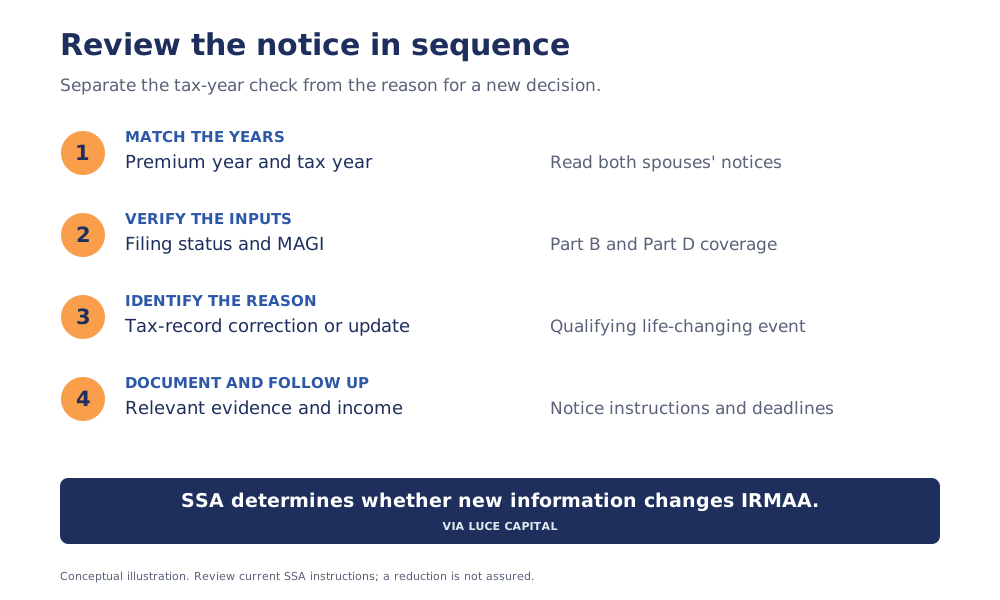
An IRMAA review has a sequence: identify the years, check the income and coverage, determine the reason for any discrepancy or change, and use the appropriate SSA process. Separately, incorporate potential future adjustments into the household plan.
That sequence gives you a more useful next step than focusing only on the size of the bill. It also keeps a request for review grounded in records. A well-documented request supports the agency’s evaluation, but it does not promise a reduction.
Start with the tax year on the notice, then document what has changed.
The plan is the residue. The planning is the work.
Sources
- 2026 usually uses 2024 information; MAGI is AGI plus tax-exempt interest; each person's coverage matters. — [1] SSA, Medicare Premiums; reviewed September 26, 2026.
- 2026 Part B $202.90; first bands above $109,000 individual and $218,000 joint; B adjustment $81.20, B total $284.10, D adjustment $14.50 plus plan premium. Special married-filing-separately rules apply. — [2] CMS, 2026 Medicare Premiums and Deductibles; reviewed September 26, 2026.
- Author calculation: $81.20 + $14.50 = $95.70; $95.70 x 12 = $1,148.40; x 2 = $2,296.80. Both coverages and same first band all twelve months. No actual client. — [3] Via Luce Capital, Hypothetical Arithmetic; reviewed September 26, 2026.
- Life-changing-event requests, amended returns and evidence. — [4] SSA, Request to Lower IRMAA; reviewed September 26, 2026.
- Listed events and required evidence; voluntary conversion alone is not a listed event. — [5] SSA Form SSA-44, December 2025 Edition; reviewed September 26, 2026.
- Taxable Roth conversion income enters the tax return. — [6] IRS Publication 590-A, Conversions; reviewed September 26, 2026.