
Early retirement can create time to consider Roth conversions. First identify the money that pays the bills while you wait, the money that pays the conversion tax, and the rules that govern access to each account.
The attractive part of a Roth conversion discussion is easy to see: moving money from a traditional IRA into a Roth IRA may fit a longer-term tax plan. The immediate question is more practical. How does the household pay for life between leaving work and the dates when other income becomes available?
For an Orange County household retiring early, that gap may include housing, family commitments, and health coverage after employer benefits end. A conversion moves money between retirement accounts. It does not create a separate paycheck to cover those expenses.
Start by drawing the cash-flow calendar. Only then compare whether a conversion belongs in a particular year and, if so, how it would be funded. A strategy that appears attractive on a tax worksheet still has to work in the household bank account.
Give spending and conversion taxes separate funding
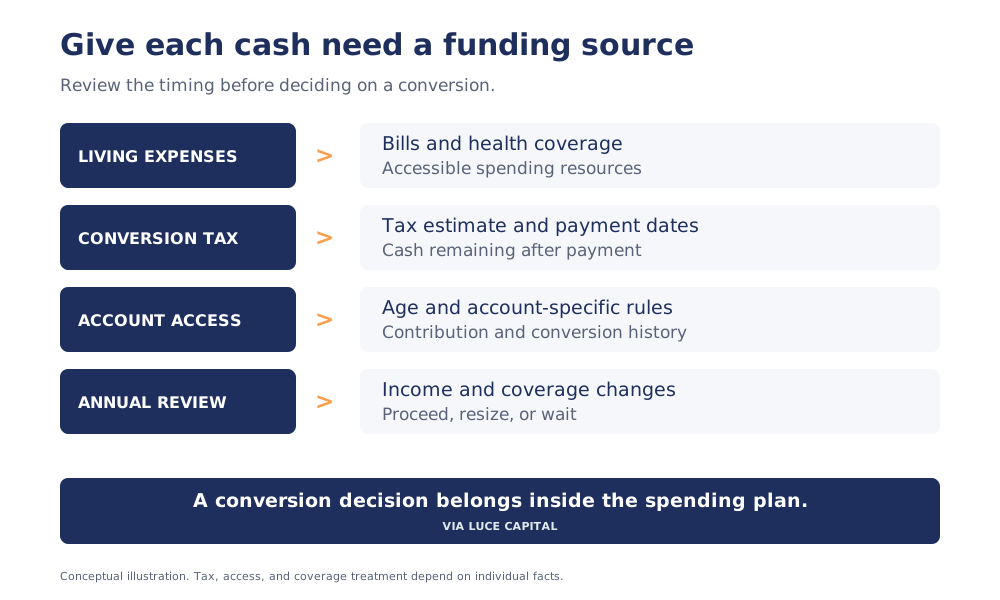
List the spending expected during each stage of early retirement. Include ordinary bills, irregular expenses, health coverage, and tax payments. Next identify the accounts available to meet them and any restrictions on access. Keep emergency reserves visible rather than treating every dollar as available for a tax decision.
A Roth conversion generally creates taxable income to the extent the converted amount has not already been taxed. Existing after-tax IRA basis requires its own calculation; do not assume a chosen account can be considered in isolation. Confirm the calculation with your tax professional. 1
Separate the conversion amount from the cash needed to pay the resulting tax. If taxes are paid from non-retirement cash, that cash is no longer available for living expenses. If money is withheld from an IRA distribution, that portion does not reach the Roth and may raise an early-distribution issue. 12
Ask the CPA to compare the whole return and payment schedule. A conversion estimate should reflect other income, deductions, state taxes where applicable, and the source of the tax payment. It should also show what remains available to spend afterward.
Map account access before moving money
Account type matters. Taxable savings, an employer plan, and different components of a Roth IRA can have different withdrawal consequences. Build the spending plan from documented access rules rather than from the total value on a consolidated statement.
The IRS generally imposes an additional 10% tax on taxable early distributions before age 59 1/2 unless an exception applies. Exceptions differ by account type. For example, qualifying employer-plan distributions following separation from service during or after the year a worker reaches age 55 may qualify for an exception that does not apply to IRA withdrawals. Plan terms also matter. 23
That distinction deserves attention before a rollover. A move to an IRA may change which early-access exception is available. Compare the existing plan’s costs, features, investment choices, and distribution options with the proposed account; this article does not recommend either keeping or moving a plan.
Do not make a withdrawal first and investigate the exception later. Ask the plan administrator or custodian how the transaction would be handled, then have the tax professional confirm the intended treatment and documentation.
Keep the Roth clocks distinct
A qualified Roth IRA distribution generally requires satisfaction of the account’s five-tax-year requirement and a qualifying condition, such as reaching age 59 1/2. A separate five-tax-year rule can apply to taxable converted amounts withdrawn before age 59 1/2, unless an exception applies. Each conversion has its own clock for that purpose. 4
Roth IRA ordering rules generally treat regular contributions as coming out first, followed by conversions and rollovers, then earnings. That ordering does not make every withdrawal tax-free or free of additional tax. Account history and records matter. 4
These distinctions are why a conversion ladder needs a funding plan for the waiting period. The term describes a sequence of conversions; it does not establish that a particular household can access the desired amount on the desired date.
Collect records of contributions, conversions, and prior withdrawals before relying on Roth funds. Ask for a year-by-year access review. If the household cannot document the amounts or dates, resolve that uncertainty before treating them as available spending money.
Include the health coverage consequences
Taxable retirement income can affect Marketplace income calculations. HealthCare.gov instructs applicants to include most taxable IRA and retirement-plan withdrawals and to estimate income for the coverage year. Qualified Roth distributions are treated differently. Report the applicable income and update the coverage application when circumstances change. 5
For California households, review the relevant Covered California rules and available coverage with an appropriate professional. Do not assume an attractive federal tax bracket produces the lowest overall household cost. Income-related health-insurance effects belong in the comparison, along with federal and state taxes.
For a person enrolled in Medicare, income-related premium adjustments introduce another timing issue. SSA generally uses tax information from two years earlier to determine IRMAA. A taxable conversion can affect the income used in that calculation. The thresholds for the applicable premium year must be checked when published. 6
These effects do not automatically rule out a conversion. They change the cost being evaluated. Ask for the comparison with and without the proposed transaction, and make clear which health-coverage and tax assumptions are confirmed and which still need updating.
Review a sequence without committing to it
Consider an illustrative household, not a real client, that plans to leave work before Medicare eligibility. It has some taxable savings, a traditional IRA, and an existing Roth IRA. The first task is to fund spending and insurance while identifying which Roth amounts are accessible under the applicable rules.
The next task is to estimate a possible conversion and its tax payment. If the conversion would use cash needed for a roof repair or health coverage, the household has a real tradeoff to discuss. A smaller conversion, a later conversion, or no conversion may be appropriate depending on the full situation.
Compare the plan again when income becomes clearer. Severance, consulting income, capital gains, or a spouse’s earnings may change the year’s picture. A multi-year idea should allow decisions to be revisited before each transaction; it should not become an automatic instruction that ignores new facts.
Current federal law does not permit a Roth conversion made after 2017 to be reversed through recharacterization. Confirm the amount and implementation before proceeding, and retain the records needed for future withdrawal and tax reporting. 7
The pattern
Early-retirement planning connects two timelines: money needed for living and money being repositioned for future use. Both depend on account rules, taxes, and health coverage. A conversion should be considered within that larger picture, with enough accessible cash to carry out the household’s commitments.
Bring the account history, spending calendar, coverage information, and income estimate to a joint review with your financial and tax professionals. The useful result is a decision you can explain and implement, including a clear reason to proceed, change the amount, or wait.
Map the paycheck gap before deciding how much belongs in a Roth conversion.
The plan is the residue. The planning is the work.
Sources
- Conversions generally include pretax amounts in income; IRA basis requires calculation. — [1] IRS Publication 590-A, Conversions; reviewed September 26, 2026.
- Taxable early distributions before age 59 1/2 generally incur 10% additional tax unless an exception applies. — [2] IRS, IRA Distributions FAQs; reviewed September 26, 2026.
- Qualifying separation in or after the calendar year of age 55 can except employer-plan distributions from 10% additional tax; not the IRA rule. — [3] IRS, 401(k) General Distribution Rules; reviewed September 26, 2026.
- Qualified-distribution five-tax-year requirement; age 59 1/2; conversion five-tax-year periods and ordering rules. — [4] IRS Publication 590-B, Roth IRA Distributions; reviewed September 26, 2026.
- Marketplace income includes taxable retirement withdrawals; coverage-year estimates need updating. — [5] HealthCare.gov, What Is Included as Income; reviewed September 26, 2026.
- IRMAA generally uses tax information from two years before the premium year. — [6] SSA, Medicare Premiums; reviewed September 26, 2026.
- Conversions after 2017 cannot be reversed through recharacterization. — [7] IRS, Topic 309 Roth IRA Contributions; reviewed September 26, 2026.