
Retirement affordability depends on the household you intend to support, the timing of its income, and the changes you could make if the assumptions disappoint. An account balance is the starting point for that conversation.
Two Orange County households can have similar savings and very different retirement choices. One has a paid-off home and modest fixed commitments. Another expects to support relatives, replace employer health coverage, and keep a mortgage. The same balance has different work to do.
A retirement calculator can help organize the question, but its answer depends on what you enter. Spending, taxes, investment assumptions, retirement dates, and the length of the planning period all influence the result. A favorable result deserves a close look at those assumptions before it becomes a resignation date.
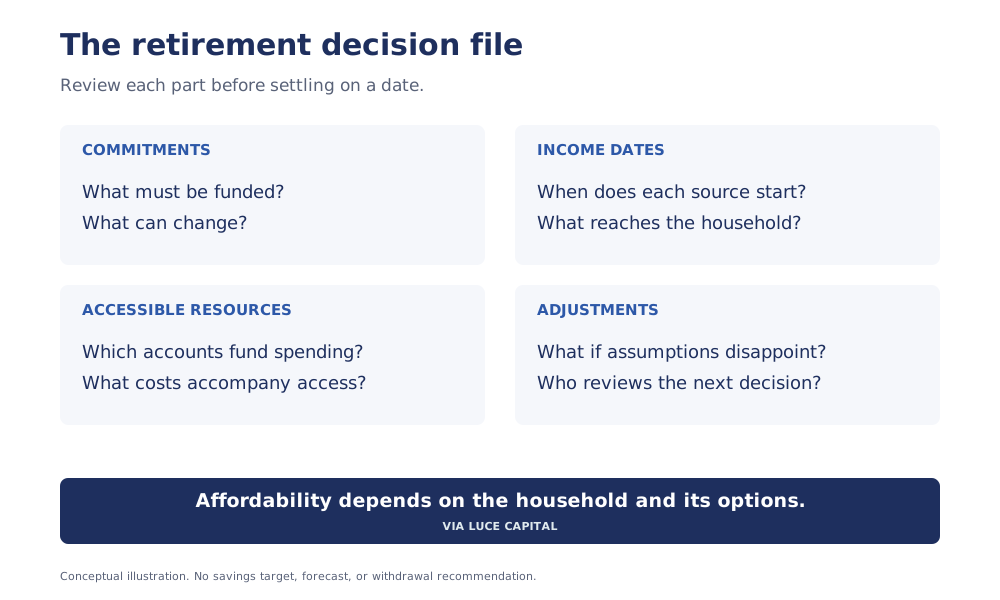
The practical task is to build a retirement decision file: what the household needs, what resources are available, where the plan is vulnerable, and which adjustments would be acceptable. That file should be specific enough for both spouses to discuss.
Begin with commitments and choices
Review actual spending before estimating retirement spending. Separate expenses expected to continue from costs that end with work and costs that begin afterward. Put annual bills and occasional large purchases on the list, including home maintenance, replacement vehicles, travel, and family support.
For a homeowner in Southern California, a paid-off mortgage still leaves property taxes, insurance, utilities, repairs, and possibly association charges. Obtain estimates from your records and providers. A regional average cannot establish what your home or household will cost.
Mark which expenses are difficult to change and which are flexible. Discuss the difference together. One person’s optional travel may be another person’s reason for retiring. A budget is more useful when it reflects those preferences instead of treating every expense as equally adjustable.
Keep a dated note for large future commitments. Helping a child, renovating a home, or providing care may require a separate decision. If you have not agreed on the amount or timing, identify it as an open question rather than quietly leaving it out.
Put the income on a calendar
Retirement rarely starts every income source at once. One spouse may stop work first, a pension may begin later, and Social Security may have its own start date. Compare spending and spendable income for each distinct period.
Stopping work and claiming Social Security are separate decisions. SSA explains that the work history and claiming date affect benefits. Review estimates using the earnings assumptions appropriate to your proposed retirement date; a statement based on continued earnings may not describe your intended path. 1
Use a consistent tax convention. If income is entered after withholding or premium deductions, avoid counting those same amounts again as expenses. If you use gross income, show the associated taxes and deductions separately. A CPA can help estimate the tax cost of drawing from different accounts.
Also consider income that depends on another person or asset. Rental income may involve vacancies and repairs. Consulting income may end sooner than expected. A possible business sale is not cash available today. Label those assumptions so they receive their own review.
Distinguish net worth from spending resources
A home, a business interest, a retirement account, and a bank account do not fund spending in the same way. List the resources separately, including how accessible they are and what taxes or transaction costs could accompany their use.
Home equity may be part of a retirement plan if there is an actual housing decision attached to it. If you intend to stay, that equity is not already in the checking account. Selling, downsizing, or borrowing each brings costs, timing, and consequences that need separate analysis.
Retirement-account withdrawals also deserve care. Federal tax treatment depends on the account and circumstances, and early distributions may involve additional tax unless an exception applies. The IRS describes those rules separately from the amount a household needs to spend. 2
Keep emergency resources and planned near-term spending visible. A large total balance can conceal a shortage of readily available cash. Conversely, money held for near-term needs has its own tradeoffs, including limited growth potential and exposure to inflation. There is no single reserve amount appropriate for every household.
Test the plan where it is vulnerable
A planning model is useful when it helps you examine what would change the decision. Review a range of assumptions with your financial professional: weaker markets early in retirement, higher expenses, a longer retirement, delayed income, or an unexpected family obligation. These are questions for analysis, not predictions.
Poor market results during a period of withdrawals may leave fewer assets available for a later recovery. Review which expenses could change and how cash would be obtained in that situation. A favorable long-term average assumption does not describe every sequence of results.
Healthcare deserves its own discussion. Price the transition from employment coverage using information appropriate to each spouse. Later, Medicare still leaves premiums and other expenses. Medicare generally does not cover non-medical long-term care, so a care need should not simply disappear from the spending discussion. 3
For a couple, also examine the household after either spouse dies. Income, taxes, responsibilities, and spending may change by different amounts. Identify which records and professional contacts the surviving spouse would need. A retirement plan should be understandable to both people while there is time to practice using it.
Agree on adjustments before they are needed
Consider an illustrative household, not a real client, that wants to retire while remaining in its home and helping a parent. The household can discuss several paths: a later retirement date, a smaller discretionary budget, part-time work, or a different housing decision. None is automatically appropriate. The point is to make the preferences explicit before a financial strain chooses for them.
Ask which changes would be easiest, which would be painful, and which are unacceptable. If the plan depends on part-time income, discuss whether the work is realistically available and what happens if health or family needs interrupt it. If it depends on moving, confirm that both spouses want that move.
Create review triggers using your own plan. Examples might include a meaningful change in spending, a different retirement date, a family care need, or investment results that warrant revisiting withdrawals. Decide who will gather information and who will participate in the review.
Then finish the operational work. Confirm benefit applications, health coverage dates, tax-payment arrangements, account access, and the source of the first retirement payments. A financially plausible plan can still be difficult to carry out if those details remain unfinished. Keep a written list of unresolved items and assign a person to each one.
The pattern
Retirement readiness is easier to assess when the numbers and the household decisions appear together. You need a spending picture, an income calendar, accessible resources, and a discussion of what changes if the assumptions fail to hold. No calculator or plan promises a particular outcome.
Before choosing a retirement date, gather your spending records, benefit estimates, account statements, and a list of unresolved commitments. Review them with the professionals responsible for your financial, tax, and insurance questions. Repeat the exercise as dates and circumstances change.
A workable retirement decision includes both the spending plan and the changes you are willing to make.
The plan is the residue. The planning is the work.
Sources
- Stopping work and claiming benefits are distinct; earnings and claiming dates affect benefits. — [1] SSA, Your Retirement Age and When You Stop Working; reviewed September 26, 2026.
- IRA taxation and additional tax depend on account and circumstances. — [2] IRS, IRA Distributions FAQs; reviewed September 26, 2026.
- Medicare generally does not cover non-medical long-term care. — [3] Medicare.gov, Long-Term Care; reviewed September 26, 2026.