

Two annuity income options show different monthly payments. The larger number catches the eye. But the payment alone does not explain what happens to access, a surviving spouse, purchasing power, or the rest of the retirement plan.
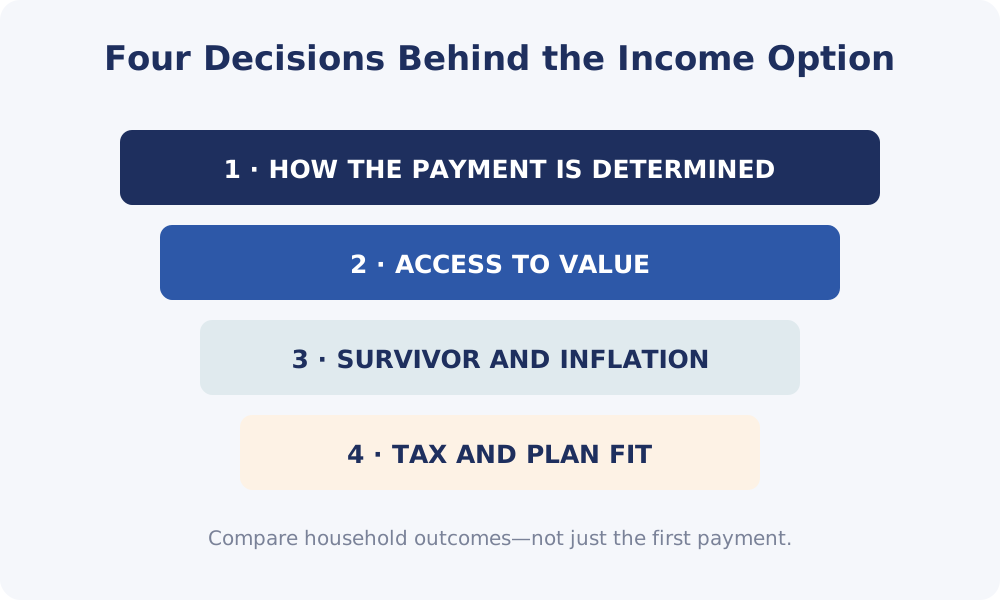
Understanding the income options means answering four practical questions: how the payment is determined, what happens to access, what a surviving spouse may receive, and how the income fits the household plan.
How is the payment determined?
Annuities generally have an accumulation phase and a payout phase. Some contracts are purchased for income beginning soon; others accumulate value before income starts. Income may arise through annuitization or through a contractual withdrawal feature. Those are not necessarily the same mechanism.
Ask which value calculates the payment, whether the amount is fixed or variable, when it begins, and which events can change it. If the illustration shows both contract value and an income base, identify which one is accessible cash.
What happens to access?
An income election may limit access to the original premium or contract value. A withdrawal feature may retain a value while applying separate rules, charges, or benefit reductions. Request a written description of what remains available after income starts and what a large withdrawal would change.
For an Orange County household, compare the proposed income with reserves for property, health care, taxes, and family needs. Monthly income does not replace a liquidity plan.
Which income option applies to a spouse?
California’s Department of Insurance describes life, period-certain, life-with-period-certain, and joint-and-survivor choices. Each changes who receives payments and for how long. A higher starting payment may leave less or nothing after the first death; a continuation feature may reduce the initial payment.
Record the survivor amount, beneficiary treatment, death benefit, and any remaining value. Then place it beside Social Security survivor rules, pensions, insurance, and the survivor’s expected expenses.
How does the income fit the plan?
Coordinate the annuity start date with Social Security, pensions, required distributions, taxable accounts, and expected spending. The IRS explains that annuity taxation depends on the source of the money, basis, and form of distribution. A qualified retirement-account annuity and an after-tax annuity can produce different tax reporting.
Also test purchasing power. FINRA notes that fixed payments typically lack automatic cost-of-living adjustments unless the contract provides otherwise, and added features generally involve tradeoffs. A payment that does not change may buy less later.
Compare income options on household outcomes
Use one worksheet for every income option:
- premium or value committed;
- income start date and payment frequency;
- single-life or joint-life terms;
- period-certain or refund terms;
- value accessible after payments begin;
- death benefit and beneficiary outcome;
- inflation or adjustment provisions;
- explicit charges and surrender terms;
- issuer and financial-strength information; and
- estimated tax character, confirmed by a tax professional.
Do not compare monthly payments while allowing the underlying choices to differ. A fair comparison holds the start date, lives covered, survivor treatment, and access assumptions constant.
What to consider next
Ask the licensed insurance professional to explain each income option without relying on marketing labels. Then ask the financial advisor to place the payment into a year-by-year household cash-flow plan, the tax professional to review tax character, and the estate attorney to consider beneficiary and authority issues where relevant.
An annuity income option is more than a payment. It is a trade among cash flow, access, survivor outcomes, and time.
Sources
- Annuity accumulation and payout phases, payout types, liquidity, inflation, and issuer considerations — FINRA, Annuities
- California descriptions of life, period-certain, and joint-and-survivor income choices — California Department of Insurance, Annuities: What Seniors Need to Know
- Federal tax treatment of pension and annuity distributions — Internal Revenue Service, Publication 575, Pension and Annuity Income