
A business owner may know the company’s revenue, payroll, and operating margin more precisely than the cost of the household’s next chapter. That is understandable: the business has reporting systems, while personal life is often funded through a mixture of salary, distributions, benefits, and occasional transfers.
Before evaluating whether an exit supports retirement, make that personal picture explicit. A proposed sale price answers a transaction question. The household still needs to know what it spends, what changes when ownership ends, and which commitments continue regardless of when a buyer pays.
For an owner in Orange County, the goal might be staying in the same home, spending more time with family, or moving into part-time work. Put those choices into the household plan before treating a transaction estimate as the answer.
Build the personal budget from records
Start with household bank and credit-card activity, then reconcile it with payroll, owner distributions, and benefit records. Remove transfers between your own accounts and duplicate credit-card payments. Separate ordinary consumption from investment contributions, debt repayment, and major one-time projects.
Do not assume the salary figure represents the amount required to maintain the household. Some pay may be saved rather than spent. Some cash distributions may have been reserved for taxes. Conversely, the household may rely on legitimate employment benefits whose replacement cost never appears in its checking account.
Write down the amount, purpose, timing, and current funding source for each item. Ask a spouse or other household decision-maker to review the list. The person responsible for the business records may not be the person who tracks medical costs, family support, or home repairs.
Sort what ends, continues, changes, or begins
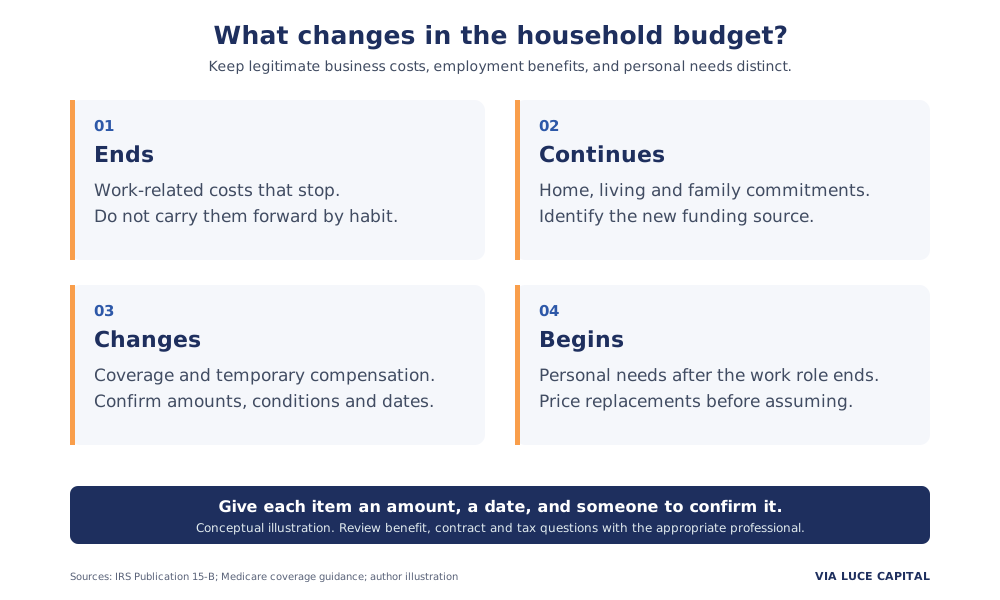
Use four categories to turn the records into a transition plan. An expense that ends with your work role should not automatically carry forward. A household commitment that continues should not disappear because its old funding source does.
Employment benefits deserve their own review. Identify health and dental coverage, life or disability coverage, retirement contributions, and any other relevant arrangements. Determine what remains available, what stops, and what would need to be replaced. Availability and cost depend on the actual plans and transaction.
Keep business and personal expenses distinct. A business vehicle used for business travel is not simply a personal retirement expense. If the household will need its own vehicle after the exit, estimate that separate need. Similarly, a work subscription may end while a personal service is newly purchased. Review treatment with the CPA; a company payment does not make a future personal payment deductible.
Price the benefits transition before closing
Health coverage deserves an explicit date and a named person responsible for confirming it. Ask when current coverage would end, what options are available afterward, who is covered, and what premiums and out-of-pocket costs would become household obligations.
For someone eligible for Medicare, the enrollment review is separate from the transaction calendar. Medicare explains that coverage based on current employment matters for enrollment timing. COBRA may offer temporary continuation of group coverage, but it is not treated as coverage based on current employment for Medicare Part B enrollment. Confirm the rules before relying on continued coverage.
Other benefits need a similar review, even if the answer is that no replacement is needed. Avoid assuming an existing company-paid insurance policy transfers with you or that a replacement policy will have the same terms. Obtain information specific to the arrangement rather than a generic cost allowance.
Separate saving from spending
Retirement-plan contributions are part of today’s cash flow, but they are not the same as household consumption. If work ends, those contributions may change. That does not mean the amount should automatically become additional lifestyle spending.
Decide whether the household still intends to save for another goal, support family, or make gifts. Identify those commitments separately. If an owner expects to keep working under a new arrangement, the availability and tax treatment of retirement contributions require review of that arrangement.
This distinction avoids two opposite errors: overstating retirement needs by carrying forward every old savings contribution, or understating them by forgetting a continuing goal. The right entry follows the household’s intentions and the applicable rules.
Give temporary income an end date
A consulting agreement, transition salary, rental arrangement, or seller payment may support the first period after a sale. Each has its own conditions. Record the expected net cash, payment timing, contract term, and the circumstances under which payments could change or stop.
Then build another household view after that income ends. Do not let a comfortable first year quietly become the assumed permanent budget. Review the consequences of a delayed payment or a shorter working arrangement, especially if that cash is expected to cover fixed obligations.
Sale proceeds belong in a separate capital schedule. They are not a recurring paycheck simply because the total seems large. Our article on business-sale payment structure and retirement planning addresses timing, liquidity, and conditional payments. This household exercise establishes the need that those funding decisions must address.
Test the household picture before relying on proceeds
Hypothetical illustration: An owner expects to leave the company and continue living in the same home. A company vehicle will no longer be available, health coverage needs review, and a proposed consulting arrangement lasts only for a limited transition. No sale price or client result is assumed.
The household first prices its continuing home and living costs. It then considers a personal vehicle, confirms coverage options, and separates temporary consulting income from later income. It builds one view for the transition and another for the period afterward.
That process may reveal an unresolved spending choice rather than a transaction problem. The household might change a travel plan, reconsider a major purchase, or investigate a different work arrangement. Those are decisions to evaluate, not outcomes that a worksheet promises.
Six items to put in the exit-planning file
- A household spending record with transfers and duplicate payments removed.
- A list of company-related benefits and payments that end, continue, change, or begin.
- Coverage dates, replacement estimates, and the person confirming each benefit.
- Separate entries for ongoing savings goals and one-time commitments.
- A timeline for temporary compensation and conditional payments.
- An unresolved-questions list shared with the advisor, CPA, attorney, and relevant benefits contacts.
Start with the business-exit checklist and use the retirement income organizer for a simple monthly comparison. Neither requires an email address. Keep personal liability for business debt, transaction taxes, legal obligations, and uses of proceeds in the broader review; these tools do not value a company or determine whether a sale is sufficient for retirement.
A useful first meeting begins with what the household will need, what is confirmed, and what is still uncertain. That gives the exit conversation a personal financial basis before the attention turns entirely to the buyer’s offer.
Sources
- Employer-provided benefits have different tax rules; receiving a benefit through a company does not establish that personal replacement costs are deductible. — Internal Revenue Service, Publication 15-B, Employer’s Tax Guide to Fringe Benefits (2026); reviewed September 19, 2026.
- Medicare enrollment after employment ends requires a separate review of current employment coverage and timing. — Medicare, Working past 65; reviewed September 19, 2026.
- COBRA may continue group coverage temporarily but does not count as coverage based on current employment for Medicare Part B enrollment. — Medicare, COBRA coverage; reviewed September 19, 2026.
- The owner household example and four-category map are conceptual illustrations, not actual client results, tax conclusions or transaction terms. — Via Luce Capital, author-created hypothetical illustration, September 19, 2026.