
An inherited IRA arrives with rules tied to the original owner, the beneficiary, and the account. Confirm those facts and the distribution calendar before making a withdrawal or moving the money.
An inheritance can arrive while a family is still handling the practical work after a death. There are institutions to contact, documents to find, and decisions that feel urgent. An IRA adds tax and distribution questions that may differ from those attached to other inherited assets.
The phrase ten-year rule is familiar, but it is not a complete set of instructions. Some beneficiaries have a different framework. Some must take annual distributions as well as empty the account by a final deadline. An account transfer can also have consequences that are difficult to reverse.
The first task is to establish which rules apply. Put the facts, required payments, and remaining decisions in one place. Then coordinate the custodian, tax professional, and, when needed, estate attorney before issuing instructions.
Identify the account and the beneficiary
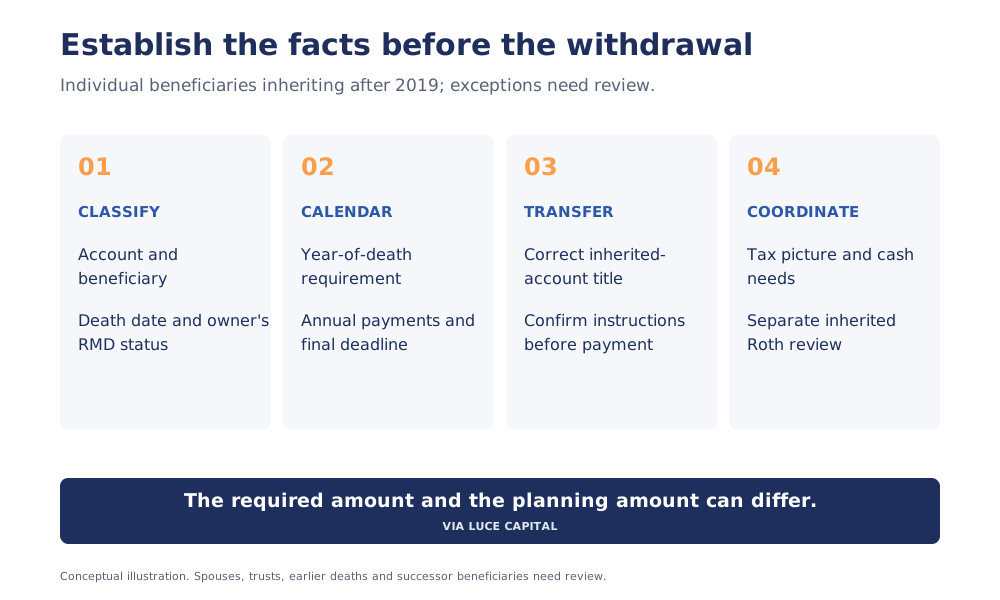
Start with the account type, the original owner’s date of death, the beneficiary designation, and whether the owner died before or on or after the required beginning date for distributions. Obtain the account records instead of inferring the answer from age or a family’s recollection of past withdrawals.
This article focuses on an individual inheriting an IRA after 2019. Earlier deaths, successor beneficiaries, employer plans, estates, charities, and trusts require separate review. A beneficiary’s legal category can change the available distribution methods. 1
An eligible designated beneficiary can include a surviving spouse, the owner’s minor child, a disabled or chronically ill person meeting the applicable definitions, or an individual not more than ten years younger than the owner. These are technical categories, not casual descriptions. A minor grandchild is not covered simply because the child is a minor. 1
Gather the records needed to confirm the category with the custodian and tax professional. If a trust is named, involve the attorney before assuming the individual-beneficiary rules apply. The trust document, beneficiaries, and required documentation may affect the analysis.
Put annual requirements and the final deadline together
For an individual designated beneficiary who is not an eligible designated beneficiary, the ten-year rule generally requires the account to be emptied by December 31 of the tenth year after the year of death. The date is tied to the death, not to when the beneficiary completes the transfer paperwork. 1
If the owner died on or after the required beginning date, annual beneficiary RMDs generally apply during the intervening years as well. If the owner died before that date, the ten-year framework generally does not require annual withdrawals before the final year. Confirm the applicable rule and account terms. 2
Also check whether the owner’s required distribution for the year of death was completed. That is a separate item from the beneficiary’s later calendar. Prior IRS relief for certain missed beneficiary RMDs in 2021 through 2024 should not be assumed to excuse a current-year requirement. 2
Write down the annual calculation responsibility, payment deadline, and final depletion date. Ask who will confirm completion. Custodian paperwork and a calendar reminder are helpful, but they should be checked against the rule that applies to the actual beneficiary.
Review the transfer before signing
A nonspouse beneficiary generally cannot treat an inherited IRA as their own or roll a distribution into their own IRA. A properly structured trustee-to-trustee transfer to an inherited IRA can be possible, with the deceased owner’s name and beneficiary relationship retained in the titling. Confirm the instructions before money is distributed. 3
A surviving spouse may have additional choices, including treating an IRA as their own when applicable requirements are met. The choice deserves review in light of age, access needs, and distribution timing. It should not be selected only because one option appears simpler on an account form. 3
Before authorizing a move, ask the receiving institution to explain the exact account registration and transaction. Have the tax professional review any unclear treatment. Keep copies of the original account statement, death certificate, beneficiary confirmation, and transfer instructions.
Administrative speed is useful only when the instructions are correct. If a distribution has already occurred, obtain advice promptly rather than assuming it can be put back. The ordinary rollover rules you may know from your own retirement account may not apply.
Separate the required amount from the planning amount
A required minimum distribution identifies a floor for a particular period. It does not determine the most suitable total withdrawal for the household. Under a ten-year deadline, leaving too much for the last year can create a concentrated taxable-income event; taking everything immediately can also have consequences.
Traditional IRA distributions are generally taxable except to the extent applicable basis or another exclusion affects the result. Inherited IRA distributions made because of the owner’s death generally are not subject to the additional 10% early-distribution tax, although income tax can still apply. Confirm the reporting for the actual account and beneficiary. 34
Compare the remaining withdrawal period with your own earnings, planned retirement, cash needs, and other taxable events. The objective is to understand tradeoffs across years. A lower-income year may deserve consideration, but no one can promise what future tax rates or household circumstances will be.
Ask the CPA to estimate the effect of proposed withdrawals before setting withholding instructions. Withholding is a payment toward tax, not proof that the final liability is covered. Coordinate state tax questions and estimated payments where relevant. Keep the inherited account separate in your records from accounts owned in your own name.
Give an inherited Roth its own review
An inherited Roth IRA also has beneficiary distribution rules. For a non-eligible individual designated beneficiary, the ten-year deadline generally applies, while annual withdrawals before that deadline generally are not required because the original Roth IRA owner is treated as dying before a required beginning date. Different beneficiary categories can change the framework. 2
The tax treatment needs a separate check. Death satisfies one condition for a qualified Roth distribution, but the original owner’s five-tax-year requirement also matters. If it has not been met, earnings in a distribution may be taxable. Obtain the relevant Roth history instead of assuming the account name answers every tax question. 2
Do not combine a traditional inherited IRA and an inherited Roth into one casual rule of thumb. Keep their records, distribution requirements, and tax treatment visible separately. Have the professional responsible for the calculations identify which withdrawals satisfy which obligation.
For an illustrative situation, not a real client, consider an adult child who inherits a traditional IRA while still working and expects to retire later. The immediate work is to establish annual requirements and the final deadline. Only then can the household compare possible additional withdrawals with its employment and retirement calendar. The example suggests a process, not a recommended schedule.
The pattern
An inherited IRA needs both an administrative file and a household plan. The file establishes the beneficiary, account registration, rules, and deadlines. The plan connects permitted and required withdrawals with the beneficiary’s own income and needs.
Before the next transaction, confirm the account classification, any unpaid required distribution, the transfer instructions, and the calendar. Assign responsibility for follow-up. Clear documentation gives the family and its professionals a shared basis for decisions during an already demanding period.
Confirm the beneficiary and the calendar before choosing the withdrawal.
The plan is the residue. The planning is the work.
Sources
- Post-2019 beneficiary categories and December 31 tenth-year deadline; eligible category includes individuals not more than ten years younger. — [1] IRS, Retirement Topics Beneficiary; reviewed September 26, 2026.
- Annual RMDs after death on or after required beginning date plus ten-year deadline; year-of-death RMD; inherited Roth and five-tax-year rules. Prior relief 2021-2024 does not establish current relief. — [2] IRS Publication 590-B, Beneficiaries and Roth IRAs; reviewed September 26, 2026.
- Nonspouse rollover limits, inherited-account trustee transfers and spousal choices; traditional IRA basis. — [3] IRS Publication 590-A, Inherited IRAs; reviewed September 26, 2026.
- Income taxation and death exception to the 10% early-distribution tax. — [4] IRS, Exceptions to Tax on Early Distributions; reviewed September 26, 2026.