

A conversion instruction moves retirement assets. A payment plan accounts for the money going to the IRS and California, and when it needs to arrive.
By late in the year, the income picture may be clearer. A household knows more about earnings, business income, investment sales, and spending than it did in January. That can make a year-end Roth conversion worth evaluating.
The operational details deserve equal attention. Which account pays the tax? How much reaches the Roth? Have enough taxes already been paid? Does California require a different calculation? An otherwise thoughtful conversion can create an unexpected cash demand when those questions are left until filing season.
The useful sequence is to estimate the tax, choose its funding source, establish the payment dates, and then authorize the transaction.
Separate the amount distributed from the amount converted
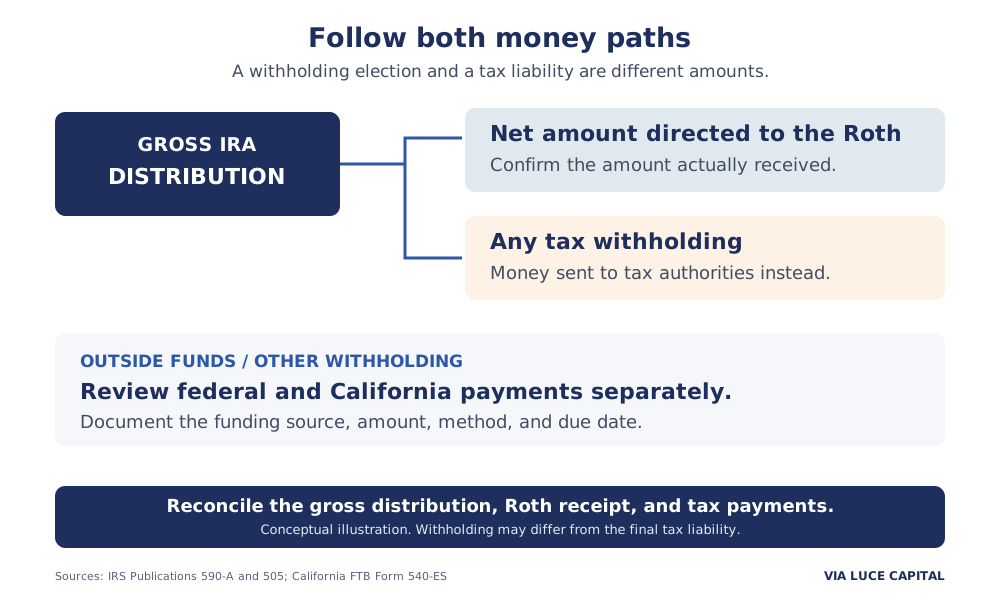
A custodian’s instruction may start with a gross IRA distribution and subtract withholding before transferring the remainder. If you think in terms of the gross amount while the instruction produces a net transfer, the Roth can receive less than intended.
Illustrative money flow, not a real client or tax estimate: A $100,000 gross distribution with an assumed $20,000 sent to tax authorities leaves $80,000 directed to the Roth. The $20,000 is an assumed withholding election. It is not a statutory tax rate or a calculation of the household’s liability.
If the IRA consists entirely of pretax funds, the full gross distribution is generally taxable even though only part reached the Roth. The money retained for tax was still distributed from the traditional IRA.
A properly completed conversion generally avoids the federal early-distribution tax on the amount converted. The taxable amount withheld or otherwise kept outside the Roth may face the 10% additional tax before age 59½ unless an exception applies. Federal and California treatment should both be reviewed. IRS Publication 590-A
Before signing, ask the custodian to show the gross distribution, tax withholding, and net Roth receipt separately.
Compare payment sources using the whole household
Paying from outside savings may leave the directed conversion amount in the Roth. But savings can have another job: near-term living expenses, home repairs, or a business cash cushion. Record which funds are actually available.
If selling taxable investments supplies the payment, account for gains created by that sale. If an extra IRA distribution supplies it, include the taxable portion of that distribution. Paying a tax bill can generate additional income that belongs in the same calculation.
There may also be existing wage or pension withholding available to adjust, subject to the payer’s procedures and remaining payment dates. A spouse’s paycheck can be relevant on a joint return, but changing withholding still affects the household’s take-home cash.
Compare the choices on a common basis: the amount reaching the Roth, total income created, expected tax, and remaining spendable cash. A withholding election is a payment instruction. It does not establish the final tax liability.
Put the payment date beside the conversion date
Federal income tax is generally paid throughout the year through withholding or estimated payments. Waiting until the return is due may leave an underpayment even if the final balance is paid with the return.
Ask the tax professional to determine the required payments using the current-year estimate, prior-year return, and amounts already withheld or paid. Meeting an applicable prior-year-based payment threshold can address underpayment exposure without covering the entire current-year bill. The remaining tax still needs funding.
A late-year payment also does not automatically cure an earlier shortfall. Estimated payments generally receive credit when paid. For federal underpayment calculations, withholding is generally treated as paid evenly across installment dates unless actual withholding dates are used under the applicable rules. That distinction can matter when evaluating payment methods. IRS Publication 505
Record the method, amount, recipient, and date for each payment. The Roth custodian’s processing schedule and the tax authorities’ due dates are separate pieces of the plan.
Check whether uneven income changes the calculation
A conversion completed late in the year raises a fair question: must the household have paid tax on that income in earlier quarters?
Not necessarily. The annualized income installment method may account for income received unevenly during the year. It uses the timing of income, deductions, and other relevant items to calculate required installments. It requires supporting records and the applicable tax forms; it is not simply permission to wait until the last payment date.
For 2026, the final regular federal estimated-tax installment is due January 15, 2027. Earlier obligations, withholding, annualization, and any applicable relief still need review. A January payment by itself does not establish that every earlier period was adequately paid. IRS Publication 505
This is especially relevant to households with consulting income, business distributions, or a transaction late in the year. Ask for the payment calculation while the conversion is being considered, when choices remain available.
Run California separately
California’s regular estimated-payment pattern differs from the federal pattern: 30%, 40%, 0%, and 30% across its four installment periods. For 2026, the final regular state installment is also due January 15, 2027. Those percentages apply to the required annual payment, not directly to a conversion amount. FTB 2026 Form 540-ES instructions
California also restricts the prior-year-tax payment alternative. At current-year California adjusted gross income of at least $1,000,000, or $500,000 for married/RDP filing separately, that alternative is unavailable. A large conversion combined with a business sale or other income can make the threshold relevant.
Ask about the state’s annualized income method and withholding treatment rather than assuming the federal result carries over. California’s conversion income may itself differ when federal and state IRA basis differ. The point is to maintain a state calculation alongside the federal one, with each payment documented.
Leave time for instructions and reconciliation
Do not treat the April IRA contribution deadline as an extension for making a new prior-year conversion. A contribution-year designation and conversion reporting are different rules. A rollover spanning two calendar years has its own treatment and needs specific review.
Confirm the custodian’s processing cutoff, asset eligibility, and whether the request specifies dollars or shares. For an in-kind transfer, changing market values may affect the reported conversion amount. Leave time to review the completed transaction rather than relying only on the requested amount.
Keep the confirmation showing what left the traditional IRA, what reached the Roth, and what was withheld. Retain separate estimated-payment receipts and basis records. Reconcile Forms 1099-R and 5498 with the tax return and Form 8606 as applicable; Form 5498 may arrive after the return deadline.
Under current law, a conversion cannot be recharacterized back to a traditional IRA. That makes the pre-transaction review consequential. IRS Form 8606 instructions
For the decision about timing itself, see the Roth conversion window. For the spending context, see the first five years of retirement withdrawals.
Bring the transaction details, payment calculation, and cash plan into the same conversation with your tax professional and financial advisor. The conversion and its tax bill should fit together before either is set in motion.
Sources
- A properly completed Roth conversion generally incurs ordinary income tax on the taxable amount; any distribution retained rather than converted may also be subject to the 10% additional tax before age 59 1/2 unless an exception applies; conversions cannot be recharacterized — IRS Publication 590-A, Conversions, Withholding, and Recharacterizations; Publication 590-B addresses early-distribution exceptions
- Federal estimated tax, withholding credit timing, and the annualized income installment method; the final regular 2026 estimated-tax installment is due January 15, 2027 — IRS Publication 505 (2026), Tax Withholding and Estimated Tax
- California's regular installments are 30%, 40%, 0%, and 30%; the final 2026 installment is due January 15, 2027; current-year California AGI of at least $1,000,000, or $500,000 for married/RDP filing separately, removes the prior-year-tax payment alternative — California FTB 2026 Instructions for Form 540-ES
- California's annualized income installment method and withholding-credit rules are addressed on the applicable underpayment form; use the filing-year version when available — California FTB Instructions for Form 5805
- Federal reporting of IRA basis and conversions uses Form 8606; conversions cannot be recharacterized as traditional IRA contributions — IRS Instructions for Form 8606
- California conversion income can differ from federal conversion income when account basis differs — California FTB Publication 1005, Roth IRA Conversions
- Illustrative cash-flow arithmetic: a $100,000 gross IRA distribution less an assumed $20,000 withholding leaves $80,000 directed to the Roth. The withholding is an assumed election, not a quoted rate or calculated tax liability — Author-created hypothetical money-flow example; no client facts or forecast