

The useful output of a Roth conversion calculation is an amount you can explain: what it costs, why it fits, and what would make you stop.
A calculator asks for balances, tax rates, and a conversion amount. The difficult work begins before that last input. Should the amount be a modest portion of the IRA, the space remaining in a tax bracket, or nothing this year?
For a household in Orange County or Los Angeles, the answer may involve a consulting payment, a spouse’s salary, California taxes, health coverage, and cash set aside for the house. A retirement account sits inside that household picture. Its balance alone cannot tell you how much to convert.
The starting point is a comparison of choices using the same facts. Then examine the additional cost of each increase in the conversion amount.
Establish the year before adding a conversion
Build an income estimate without a conversion. Include wages, consulting or business income, pension payments, taxable investment income, planned sales, and retirement withdrawals. Add the deductions and credits your tax professional expects to apply. Distinguish income already received from amounts still uncertain.
This matters in a partial retirement. Working less does not necessarily mean a low-income tax year. A bonus, deferred compensation payment, business distribution, or spouse’s earnings may occupy the space you expected to use.
Keep a separate list of required minimum distributions, if applicable. An RMD cannot be converted. Account for that withdrawal and its income before evaluating an additional conversion, and confirm the required distribution sequence with the custodian and tax professional. IRS Publication 590-A
The resulting baseline answers a concrete question: where does the household stand if it makes no conversion at all?
Calculate the taxable portion before using a tax rate
The amount moved and the amount included in taxable income are not always identical. Nondeductible IRA contributions may have created basis: money already taxed that must be accounted for when distributions occur.
You generally cannot choose to convert only that basis by opening a separate traditional IRA or selecting a particular account. Form 8606 generally brings together the owner’s traditional IRAs, including traditional SEP and SIMPLE IRAs, along with relevant distributions, conversions, and year-end values. This is commonly called the pro rata rule. A spouse’s IRAs are calculated separately.
Locate prior Forms 8606 and current account statements before relying on an online estimate. An old rollover IRA at another custodian can be relevant even if it is not the account you intend to convert. Missing basis records deserve investigation rather than an assumption that the entire balance is either taxable or tax-free. IRS Form 8606 instructions
California adds a second records question. Its IRA basis can differ from federal basis, so the state’s taxable conversion amount may need an adjustment. A federal estimate multiplied by a state rate can miss that distinction. FTB Publication 1005
Compare the cost of the next dollars
Ask for side-by-side calculations: no conversion, a smaller conversion, and a larger conversion. Keep unrelated assumptions the same so the differences mean something.
Compare the change in federal and state income taxes. Separately identify any change in marketplace assistance or Medicare premiums. Medicare generally uses income from two tax years earlier; marketplace assistance uses household income for the coverage year. Those effects belong on different lines and potentially different dates. SSA income-review process, IRS premium tax credit guidance
Illustrative arithmetic, not a real client or a tax estimate: Suppose one additional $10,000 conversion produces an assumed $2,500 in combined incremental taxes and income-related health costs. That is 25% of the additional amount. Suppose the next $10,000 produces an assumed $4,000 in those costs. That next increment costs 40%.
Neither percentage is a quoted tax bracket. The example shows why the average cost of the full conversion may conceal a more expensive final increment. Crossing a threshold is not automatically wrong, but it should be a deliberate tradeoff supported by the household’s facts.
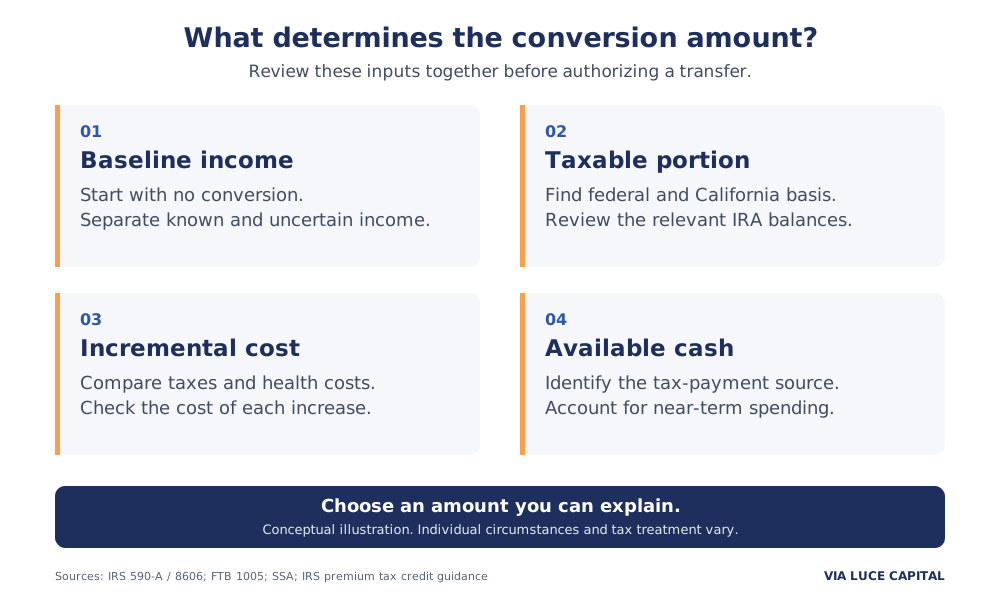
Give the tax payment a place in the spending plan
The tax bill needs a funding source. Cash in a bank account may already be assigned to living expenses, property work, family commitments, or emergencies. Counting the same cash as both a reserve and a conversion-tax fund overstates what is available.
If investments must be sold to pay the tax, include any resulting taxable gains in the calculation. If an additional IRA withdrawal would fund it, include that withdrawal’s tax consequences too. The method used to pay the bill may change the bill itself.
Record what remains available after the payment. A household may decide that keeping more cash for a business transition or an approaching retirement date matters more than converting an additional amount this year. That is a planning choice with a clear reason behind it.
Test the assumptions behind the long-term case
The case for a conversion often depends on future income, future tax rates, when the money will be spent, and who may eventually inherit it. Those are uncertain inputs. A calculation should identify them explicitly rather than make one result appear inevitable.
Discuss what happens if employment continues longer, spending begins sooner, a spouse dies first, or a planned move does not occur. Consider how much of the rationale depends on a particular future tax rate or return assumption. Identify which assumptions would materially change the decision and which facts deserve another review before acting.
Your existing tax mix also matters. Having some Roth money may offer choices when funding future spending, but additional conversions still carry current costs. The merits of the next conversion need their own review even when an earlier one made sense.
Write down the amount and the stopping point
A useful decision record fits on one page: the baseline income estimate, proposed amount, taxable portion, incremental costs, payment source, cash remaining, and unresolved assumptions. Add the date through which the income information is current.
Name the events that would require another look before execution: a revised bonus, unexpected gain, different health coverage, or a change in cash needs. Under current law, a completed conversion cannot be recharacterized back to a traditional IRA. The review belongs before the instruction. IRS conversion and recharacterization rules
For the broader timing question, see The Roth Conversion Clock Stopped. The Opportunity Didn’t.. If you buy coverage before Medicare, The Conversion Year Is Now the Insurance Year develops that particular interaction.
Bring the comparison to your CPA and financial advisor together. The intended result is a reasoned amount, including the possibility of no conversion, that fits both the tax return and the household’s spending commitments.
A conversion amount is more useful when you know why the next dollar belongs in it—or why it does not.
Sources
- Traditional IRA conversions generally include the otherwise taxable distribution in income; basis is excluded; required minimum distributions cannot be converted; conversions made in 2018 or later cannot be recharacterized — IRS Publication 590-A, Converting From Any Traditional IRA Into a Roth IRA and Recharacterizations
- Form 8606 calculates the taxable and nontaxable portions using basis, distributions, conversions, and December 31 IRA values; traditional SEP and SIMPLE IRAs generally participate in the IRA calculation — IRS Instructions for Form 8606, Definitions and Part I
- California conversion income may differ from federal conversion income when California and federal IRA basis differ — California FTB Publication 1005, Roth IRAs and Roth IRA Conversions
- Medicare income-related premiums generally use modified adjusted gross income from two tax years before the premium year — Social Security Administration Handbook, Section 2504
- Premium tax credit household income is based on modified adjusted gross income, with specified additions to federal adjusted gross income — IRS Questions and Answers on the Premium Tax Credit, Question 8
- Illustrative arithmetic only: $2,500 divided by $10,000 equals 25%; $4,000 divided by $10,000 equals 40%. These assumed combined costs are not statutory brackets, estimates, or client results — Author-created hypothetical comparison; all inputs are assumed